Shopify · August 23, 2026 · 10 min read
Best Shopify Themes for Kids & Baby Clothing
Rank Wosa, Broadcast, and Enterprise for kidswear measurements, set contents, materials, care, gifting, safety wording, and parent support.
By Polo Themes
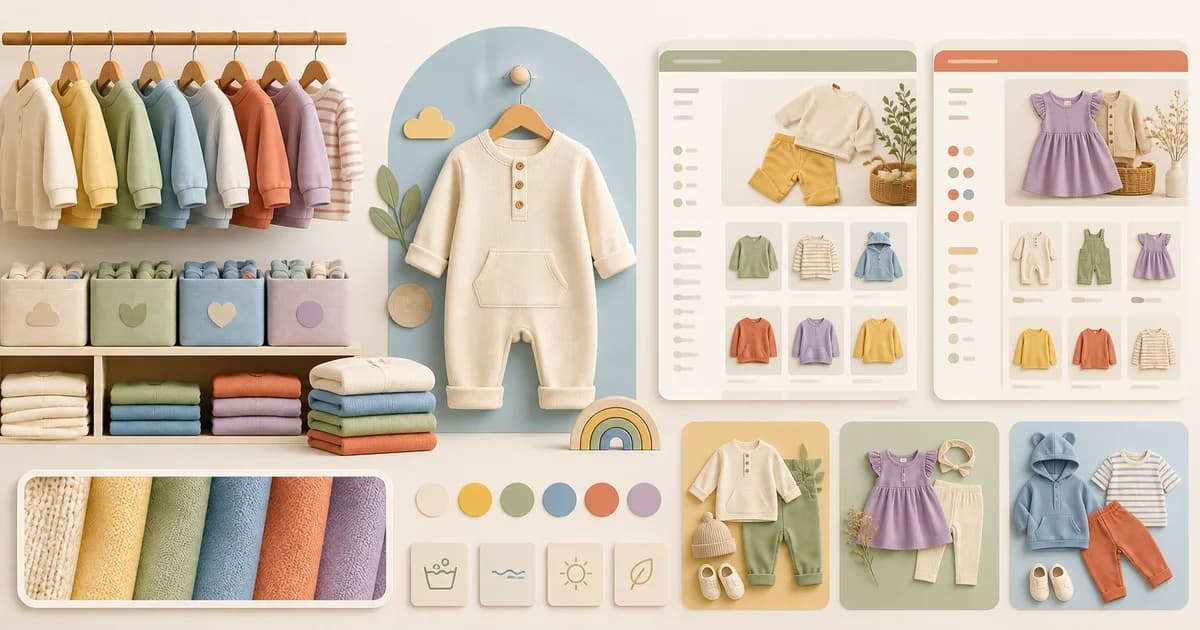
Kidswear decisions must translate age-marketed sizes into actual measurements, state included pieces, preserve material and care facts, and restrict safety or suitability claims to approved evidence. This editorial ranking starts with the closest Polo structure and two named Theme Store controls. It is an evaluation order for caregivers and gift buyers choosing by measurements, material, care, and approved safety information, not a promise of sales, speed, compliance, or specialist functionality.
Which themes should a kidswear store shortlist?
Caregiver tasks provide a sharper ranking method than playful branding. In Children’s Products, the CPSC says classification considers intended-use statements, packaging, promotion, consumer recognition, and age guidance. Test Wosa for adjacent clothing, Broadcast for gift storytelling, and Enterprise for catalog breadth; use the Shopify fashion theme guide while adding measurements, set contents, care, and fast support access.
1. Wosa — closest Polo adjacent fit
Wosa is the closest Polo adjacent fit because Polo seeds it for clothing stores, giving a fashion collection and variant foundation to adapt for childrenswear. It is not kidswear-specific and does not establish age-to-size accuracy, material suitability, product testing, safety compliance, gift logic, care, returns, or fulfillment. In this kids and baby clothing comparison, rank 1 identifies the nearest Polo structure to preview; the merchant’s controlled catalog test can reverse the order.
2. Broadcast
Broadcast is a flexible apparel candidate whose official page lists size charts, swatches, product options, galleries, zoom, video, filtering, enhanced search, gift wrapping, and shipping information. A size chart or gift control does not make age labels universal, confirm what a photographed set includes, or substantiate material and safety wording. In this kids and baby clothing comparison, rank 2 identifies the first independent control to preview; the merchant’s controlled catalog test can reverse the order.
3. Enterprise
Enterprise is the broader-catalog control, with official listings for mega-menu navigation, filtering, options, size charts, usage information, galleries, zoom, quick buy, and account tools. A dense catalog structure must still work for rushed caregivers, and quick buy should not bypass measurements, included pieces, care, or critical product-specific information. In this kids and baby clothing comparison, rank 3 identifies the second independent control to preview; the merchant’s controlled catalog test can reverse the order.
What should decide a kids and baby clothing theme ranking?
The strongest candidate exposes product measurements, exact size, set contents, composition, care, variant identity, gift clarity, and approved safety information. Under the CPSC’s Children’s Products, clothing may qualify as a children’s product when the governing factors apply. Reject layouts where age replaces measurements, photography defines the package, badges imply suitability, or quick buy hides consequential details.
- Measurements behind age labels. Every age or height range should map to maintained garment measurements, a measuring method, fit notes, and product-family exceptions.
- Set and gift identity. Titles, imagery, descriptions, variants, packaging choices, and cart lines must state exactly which pieces and sizes are supplied.
- Material and care clarity. Composition, lining, fastening, washing, drying, and special handling should sit near the size decision and match the selected item.
- Approved safety wording. Badges, filters, suitability statements, and age guidance need an accountable product-specific basis rather than decorative reassurance.
- Caregiver mobile use. Essential choice, unavailable alternatives, delivery, returns, and support should be reachable quickly with one-hand touch and readable focus states.
How can a kidswear catalog expose theme weaknesses?
Borrow overlapping-size discipline from the shoe store theme guide for a multipiece baby set, adjustable trousers, reversible jacket, mixed-size gift, and composition-changing color. Shopify defines each option-value combination in Variants as a possible variant. Follow included pieces, exact size, measurements, material, care, selected configuration, stock, and policy access through cart, fulfillment, and support.
- Everyday bodysuit: several age-labeled sizes backed by garment measurements, measuring instructions, composition, fastening, and care.
- Three-piece sleep set: imagery shows all pieces and the title, option, cart, and fulfillment record enumerate the exact included items and size relationship.
- Gift blanket: a one-size product with dimensions, material, care, packaging choice, message handling, and delivery context for a remote buyer.
- Seasonal outer layer: a layering-sensitive garment with product-specific fit notes, closures, lining, care, and an unavailable middle size.
- Sibling gift order: two different sizes and products in one basket, testing whether confirmation and packaging instructions remain attached to the right lines.
How should age labels connect to product-specific fit and care?
Use age bands only for navigation, then anchor each item to maintained size, relevant body or garment measurements, measuring method, material, and care. Children’s Products from the CPSC treats size as one of several classification factors, not a standalone suitability decision. Show family exceptions before purchase and preserve the actual selected size through cart and order.
Caregivers often browse by age, but age bands are only a navigation aid unless the garment’s measurements and fit basis support them. Build each product around actual size labels, body or garment measurements as appropriate, material composition, care, closures, included pieces, season or layering context, and any safety statement the merchant can substantiate. Wosa is an adjacent apparel structure, not a child-safety or sizing authority. Keep decorative badges from implying certification, suitability, or testing that does not belong to the product record.
Test an assortment that crosses caregiver intents
Preview a multipiece baby set, a garment with several age-labeled sizes, a giftable one-size accessory, and a seasonal outer layer. The set page should list every included piece and its size relationship. The age-sized garment should provide measurements and explain whether a caregiver should measure the child or a comparable garment. Gift navigation should allow browsing by practical range without hiding composition, care, delivery, or returns. Photographs can show movement and layering, but must not substitute for construction and fit details.
Kidswear failure modes
- Age-band certainty: “6–9 months” is treated as a universal body standard rather than a label tied to the merchant’s measurement guide.
- Set ambiguity: the main image contains several pieces, while the title and cart do not state what the buyer receives.
- Safety theater: icons or reassuring phrases imply testing, materials, or suitability without an approved product-specific basis.
- Care surprise: shrinkage-sensitive washing, special handling, or material facts are buried after the size decision.
Implement a caregiver-led acceptance test
- Map every size label. Attach measurements, measuring instructions, fit notes, and product-family exceptions instead of one sitewide age chart.
- Audit sets and gifts. Reconcile title, imagery, included pieces, packaging, variant, and cart line so a remote gift buyer can describe the order.
- Test rushed mobile use. Ask a caregiver to choose a size, check material and care, find delivery, and recover from an unavailable option with one hand.
- Review claims at product level. Require an accountable source for safety, material, performance, or suitability wording before it appears in filters or badges.
Kids and baby clothing failure modes
- Age-band certainty: “6–9 months” is treated as a universal body standard without the merchant’s measurements or fit method.
- Set ambiguity: a hero image contains several garments while product identity and cart fail to state what the buyer receives.
- Safety theater: an icon or broad phrase implies testing, material performance, or suitability without an approved product-level basis.
- Care afterthought: composition and handling that could change fit or use are hidden after the size selection or copied incorrectly across products.
Which tests prove a kidswear storefront supports caregivers?
Choose by age navigation, verify measurements, switch a composition-changing color, inspect a multipiece set, send it as a gift, and request support. The CPSC explains in Children’s Products that classification determines which safety standards apply. Acceptance therefore requires exact size, contents, materials, care, media, price, stock, approved wording, and policy access through post-purchase records.
- Map every label. Attach maintained garment measurements, measuring method, fit notes, and exceptions to each size-bearing product family.
- Audit the complete set. Reconcile every photographed piece, title, selected option, description, packaging choice, cart line, and fulfillment record.
- Run one-hand selection. Ask a caregiver to choose a size, check material and care, find delivery, encounter sold stock, and recover on a phone.
- Review each claim. Trace safety, suitability, material, performance, or age wording from filters and badges to an approved product-specific source.
- Place a sibling order. Verify two sizes, gift notes, packaging, quantities, availability, and returns context stay attached to the correct items.
- Test post-wash support. Confirm care guidance, exact product and version, order line, reported issue, and merchant-approved resolution can be reconciled.
Why must caregiver convenience remain separate from product suitability?
Convenience may shorten browsing, save gift details, or group age ranges, but it cannot decide fit, safety, or suitability. As the CPSC’s Children’s Products makes clear, a manufacturer’s intended-use statement is only one classification factor and must be reasonable. Keep recommendations factual, expose exceptions, and prevent nearby sizes or sibling items from appearing automatically safety-equivalent.
A caregiver may shop by age, but the catalog should fulfill by exact product and maintained size. Stress-test Wosa, Broadcast, and Enterprise with a newborn bodysuit multipack, an adjustable toddler trouser, and a reversible jacket whose two sides have different visible details. Add a gift set containing garments in more than one labeled size and a color that changes the fiber composition. Wosa tests the nearest Polo fashion structure, Broadcast tests story-led gifting, and Enterprise tests a broader family catalog. Each candidate must expose chest, length, waist, rise, or other relevant measurements at the product level; name every included piece; and update composition, care, media, price, identifier, and stock when the selected configuration changes. A broad age navigation label can remain a discovery aid, but it must not overwrite the manufacturer or merchant’s actual size designation in the cart.
Safety and suitability wording requires an especially clear jurisdiction boundary. Selling market, destination, product category, age grading, labeling, and evidence can affect what must be stated or avoided. Qualified legal, compliance, and product owners should approve the applicable text; the theme should render it for the correct item and market without converting badges, photography, or collection names into a universal promise. Test a recalled or withdrawn variant, an updated care instruction, and a gift buyer shipping directly to another region. The affected option should become unpurchasable everywhere it is ineligible, cached copy should not survive on quick buy, and the order record should retain the exact item supplied. Do not recommend a nearby size or sibling product as a safety-equivalent substitute unless the merchant has explicitly approved that relationship.
Key Takeaways
- Wosa is an adjacent clothing foundation. Kidswear measurement, age grading, set contents, care, safety wording, and gifting behavior still need explicit implementation.
- Age ranges support browsing, not universal fit. Preserve actual size designations, relevant measurements, methods, and product-family exceptions.
- Sets need itemized identities. Name every included piece, its size relationship, material, care, selected variant, and any permitted substitution.
- Safety wording must remain product- and market-specific. Badges, photography, and collection names cannot substitute for approved evidence and current eligibility.
Final decision for a kids and baby clothing catalog
Wosa is Polo’s closest adjacent clothing structure, Broadcast is the flexible gift-and-apparel control, and Enterprise is the broad-navigation control. Select the candidate that lets a caregiver identify measurements, material, care, included pieces, approved claims, exact variants, and recovery paths fastest. Reject any design whose warmth or playfulness substitutes for product truth.
Frequently asked questions
Is Wosa a baby-clothing-specific theme?
No. It is the closest Polo clothing foundation and must be labeled adjacent. Kidswear measurement, materials, safety, gift, care, and operational requirements need separate implementation.
Are age ranges enough for sizing?
No. Tie age-marketed labels to maintained garment measurements, measuring instructions, fit notes, and exceptions; children of the same age do not share one universal fit.
How should multipiece sets appear in the cart?
The product identity should enumerate the included pieces and preserve their relevant size relationship, selected variant, quantity, and any packaging choice.
Can a theme supply safety badges?
A theme may render badges, but the merchant needs an approved product-specific basis, accurate scope, current evidence, and a process for removing or changing the wording.
How should mixed-size gift sets be described?
List every included piece with its own size designation, measurements or fit guidance where relevant, material, and care information. Give the bundle a distinct identifier and make substitutions explicit. A single age range in the title is not enough when the bodysuit, hat, and trouser use different labeled sizes.