Shopify · August 23, 2026 · 11 min read
Best Shopify Themes for Electronics Stores
Compare Warehouse, Electronix, and Enterprise for technical specifications, compatibility, large catalogs, search, and exact cart identity.
By Polo Themes
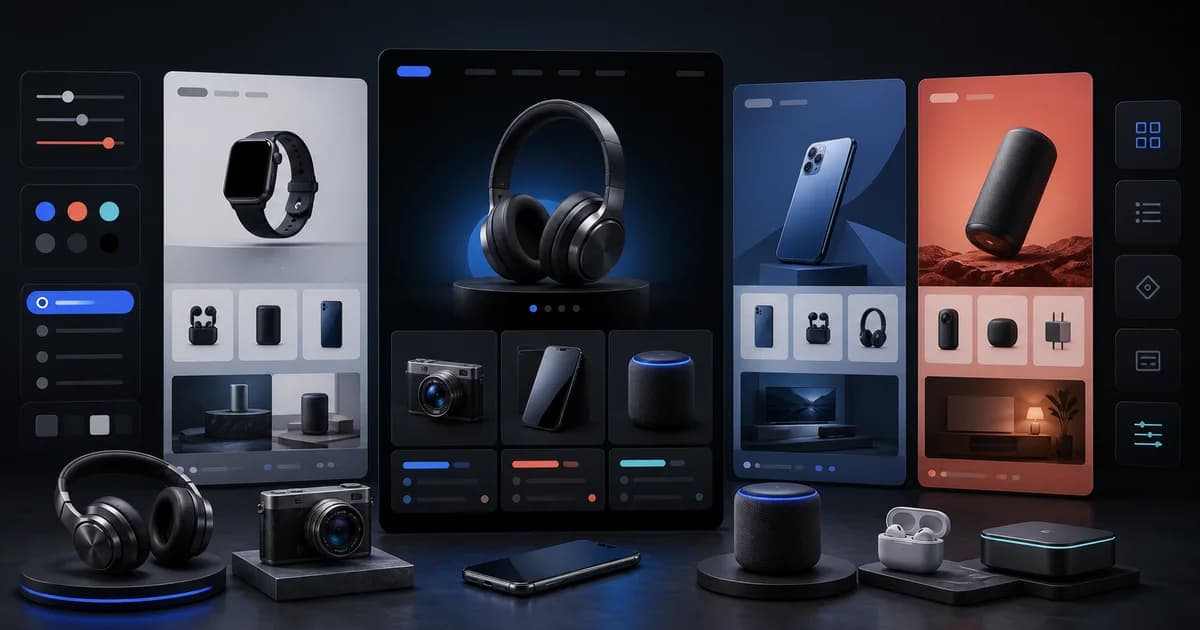
Warehouse ranks first for an electronics store with a very large specification-led catalog, Electronix ranks second as Polo’s verified direct electronics match, and Enterprise ranks third for a broad promotional catalog with strong discovery tools. This editorial ranking rewards normalized specifications, exact model identity, compatibility communication, accessory safety, mobile comparison, and maintenance cost. It does not repeat vendor speed or conversion claims as measured results.
Use the pillar guide for the shared decision framework, inspect Electronix directly, and continue to the gadgets guide if accessories dominate the assortment. The performance-theme comparison supplies a disciplined speed test, while the electronics launch guide covers suppliers, warranty, compatibility, and hazardous-goods operations.
Why do electronics stores need more than a tech aesthetic?
Electronics buyers need exact models, comparable specifications, power context, included components, supported relationships, warranties, and revision history. Shopify Help Center — Metafields says custom data can extend products and gives dimensions as a structured example. Warehouse, Electronix, and Enterprise organize presentation differently, but aesthetics cannot repair ambiguous identifiers or invented compatibility.
Buyers often compare products whose marketing names obscure small but consequential differences. A useful theme must preserve manufacturer model, measurable specifications, connector or protocol context, included components, region or power option, compatible devices, warranty boundaries, delivery, and support. It should let the merchant create category-specific schemas rather than forcing monitors, cables, routers, and batteries into one empty universal table. Visual futurism is irrelevant if the wrong revision reaches the cart.
- 1. Warehouse — best for very large electronics catalogs. Its official Theme Store page explicitly describes large-catalog and technology merchandising and lists collection navigation, enhanced search, filtering, a mega menu, product tabs, options, video, shipping information, and metafield-oriented flexibility. Its limit is that catalog capacity does not create normalized specs or compatibility rules.
- 2. Electronix — best direct Polo electronics match. Polo’s seed verifies a modern electronics showcase with an Ajax cart, customizable sections, a mega menu, responsive design, Shopify OS 2.0 architecture, and easy customization. It does not claim a comparison engine, model finder, compatibility database, warranty system, or measured production performance.
- 3. Enterprise — best broad discovery and promotion alternative. Its official listing includes enhanced search, filtering, infinite scroll, a mega menu, product tabs, video, quick buy, and related merchandising surfaces. Test those features with exact identifiers; a fast-feeling demo or vendor marketing statement is not evidence for the configured store.
Which electronics catalog fits each candidate?
Warehouse fits a very large catalog, Electronix a bounded specialist assortment, and Enterprise broad retail with disciplined promotions. Shopify Theme Store — Warehouse documents collection-page navigation, filtering, and product-discovery features. Choose only after representative mobile tests keep exact identifiers, complex options, compatibility evidence, and cart states understandable.
Choose Warehouse when thousands of items, deep collections, filters, and metafield-driven presentation are the primary challenge. Choose Electronix when a small or medium electronics retailer wants the direct Polo category match and its Ajax cart and configurable sections fit the planned journey. Choose Enterprise when a broad retailer values discovery plus promotion and can keep those modules from obscuring exact models. Require separate solutions for fitment, serials, warranties, regional restrictions, or regulated goods unless the tested implementation proves them.
What should a worked electronics compatibility example test?
Test visually similar docks with different host requirements, consequential cable lengths, regional power variants, and a revision-specific replacement. Shopify Help Center — Variants establishes that option combinations can represent distinct product versions. The exercise must distinguish identity, included components, valid, invalid, and unknown relationships, carrying the exact configuration through cart, fulfillment, and support.
Create two laptop docks that look similar but use different host connectors, a cable in three lengths, a device with regional power variants, and a replacement adapter supported by only selected model revisions. Collection cards must show the model and decisive distinction rather than reducing both docks to “multiport hub.” Product pages must separate what is in the box from optional accessories. A recommendation row may show the adapter only when the maintained compatibility record supports the selected revision.
In Warehouse, test whether filters and metafield presentation help a shopper narrow by connector, model family, and power requirement without drowning in empty fields. In Electronix, test the mega menu and Ajax cart with long identifiers and region changes, confirming cart state remains exact. In Enterprise, test search, infinite discovery, and quick-buy boundaries; quick buy should not bypass a consequential compatibility choice. The theme wins when both shopper and support can explain why the chosen combination works.
Electronics failure modes
- Compatibility by resemblance: accessories are linked because they share a brand, image, or collection rather than an explicit supported-model rule.
- Unit inconsistency: power, dimensions, storage, or transfer values use mixed units and incomparable rounding.
- Variant identity loss: region, capacity, or revision changes the order but leaves model text, image, or cart line ambiguous.
- Quick-buy bypass: a collection action adds a default configuration before the shopper sees a critical connector or power choice.
- Warranty fog: manufacturer coverage, merchant support, exclusions, and returns collapse into a generic reassurance badge.
- Performance overclaim: vendor language or a clean demo is repeated as proof of the merchant’s production speed without representative measurement.
How should you implement and test electronics specifications?
Define canonical schemas by product family, record compatibility evidence, and preserve model, revision, region, and capacity through every view. Shopify Help Center — Metafields explains that definitions can enforce validation rules for consistent values. Test exact search, close-model comparison, regional selection, replacements, and mixed baskets; leave missing facts unknown rather than inferred.
- Define category schemas. Set canonical labels, units, allowed values, evidence sources, and owners separately for each product family.
- Model compatibility explicitly. Store supported models, revisions, connectors, and requirements; expose the basis near the relevant option instead of inferring from collection membership.
- Preserve exact identity. Carry manufacturer model, selected variant, region, capacity, and revision through card, page, cart, order, fulfillment, and support views.
- Run four shopper tasks. Find the right connector, distinguish close models, choose a regional variant, and locate a confirmed replacement part on mobile.
- Validate mixed baskets. Add a primary device, cable, and accessory; edit quantities and options; then verify identifiers, availability, compatibility messages, and included-versus-optional contents.
- Measure the staged store. Use representative images, scripts, apps, and catalog depth on key templates. Record observed conditions instead of attributing results to the theme name alone.
When should Electronix lead, and when should it not?
Electronix should lead when a bounded specialist catalog, long identifiers, and consequential Ajax-cart changes do not need large-catalog machinery. Polo Themes — Electronix E-Commerce Shopify Theme documents its electronics focus and Ajax cart. Warehouse remains first for genuinely useful deep discovery; no candidate wins when quick actions bypass compatibility or regional choices.
Warehouse ranks first here because a very large specification catalog is the hardest case in the comparison. Electronix should move into first place when the assortment is bounded enough for its mega menu and configurable sections, the Ajax cart preserves exact selections, and the merchant values a direct Polo electronics presentation over deeper large-catalog machinery. Enterprise should move ahead when broad retail discovery and campaign flexibility matter more than specialist framing. These are catalog-shape decisions: count product families, schema differences, compatibility relationships, and operator tasks, but do not invent a product-count cutoff that the evidence does not support.
Use three records to challenge the order: a laptop dock with several host requirements, a simple cable whose length is the only consequential option, and a region-specific powered device. Warehouse should justify its extra discovery structure on the dock without burdening the cable. Electronix should prove that a region change survives its product page and Ajax cart. Enterprise should prove that quick discovery never bypasses the powered device’s required choice. A candidate wins only if category-specific detail expands where needed and stays concise elsewhere; one giant specification template is not sophistication.
How do you recover from an incompatible or revised basket?
Identify conflicting models, stop unsupported recommendations, preserve unrelated cart lines, and offer evidence-backed next actions. US CPSC — Recalls and Product Safety Warnings publishes product-specific safety notices, illustrating why exact identity matters. Give same-name revisions distinct records, separate stock, retain prior documents, and propagate recovery through search, orders, picking, warranty, and support.
Stage an order containing a dock and an adapter that share a brand but are not compatible with the selected laptop revision. The storefront should prevent the recommendation when the maintained relationship is known to be invalid. If the conflict is discovered after cart creation, identify the two exact models, explain that the combination cannot be confirmed, preserve unrelated items, and ask the shopper to choose among supported actions. Never silently swap the adapter or turn a support note into a new compatibility claim.
Then simulate a supplier revision that keeps the marketing name but changes a connector, included cable, or regional power requirement. Create a distinct controlled identity rather than overwriting history. Update media and specifications for the new record, stop unsupported cross-sells, and ensure fulfillment can distinguish old and new stock. Existing customers must reach documents and replacements for what they actually bought. Recovery is complete when search, card, page, cart, order, recommendation, warehouse pick, and support lookup all preserve the revision.
Which acceptance gates should an electronics launch pass?
Gate release on exact model handoffs, category-schema consistency, explicit compatibility states, consequence-aware cart actions, and revision history. The US FTC — Businessperson’s Guide to Federal Warranty Law explains merchant warranty obligations and written-warranty handling. Together, the gates preserve required choices and retain product evidence needed by fulfillment, warranty service, and support.
- Model gate: manufacturer model, revision, capacity or region, selected option, and included components remain exact across every commercial and support view.
- Schema gate: each tested category exposes its decision-making specifications with canonical labels and units, while unavailable facts remain absent rather than inferred.
- Compatibility gate: valid, invalid, and unknown relationships produce different honest states, and no recommendation is based only on brand or collection membership.
- Cart gate: Ajax, quick-buy, and cart editing preserve consequential choices and route complex products through the information required before purchase.
- Revision gate: a same-name supplier change can be staged, sold, picked, supported, and later retired without erasing the identity of earlier orders.
Who should own specification and compatibility changes?
Assign owners for supplier records, schemas, media, compatibility, warranty copy, theme configuration, fulfillment, and support. US CPSC — Recalls and Product Safety Warnings organizes notices around identifiable products and hazards, reinforcing exact record custody. Review revisions before changing filters or recommendations, and return downstream corrections to the canonical record and regression fixture.
Assign owners for supplier imports, category schemas, media, compatibility, warranty copy, theme configuration, and support. A new laptop revision, connector standard, regional adapter, or supplier description should enter a review queue before it alters filters or recommendations. Warehouse can expose a large structured catalog, Electronix can provide a direct electronics presentation, and Enterprise can add discovery breadth, but each will faithfully render bad source data if no one governs it. Support corrections should flow back to the canonical product record instead of becoming isolated notes or theme patches.
The acceptance record should identify theme version, representative product families, deepest collection, longest identifiers, tested devices, apps, custom code, and compatibility evidence. Save results for search, filtering, quick buy, variant changes, mixed carts, and a deliberately incompatible accessory. Re-run them after a theme release, schema change, supplier update, or integration change. Define who can publish and how the previous draft is recovered. A candidate that needs extensive custom code may still win, but its maintenance owner and regression tests belong in the decision score.
Include one support-led test in which an operator identifies the ordered revision and explains a compatible replacement from the same controlled evidence.
Key Takeaways
- Choose Warehouse for genuine large-catalog discovery, Electronix for a bounded direct electronics fit, or Enterprise for governed broad retail.
- Preserve exact model, revision, region, capacity, connector, and included-component identity through support.
- Represent valid, invalid, and unknown compatibility states explicitly instead of inferring relationships from resemblance.
- Route complex products away from quick buy when a consequential choice still needs explanation.
- Keep old product records and documents reachable when a supplier reuses a marketing name for a changed revision.
Conclusion
Warehouse leads for the largest catalog and strongest native large-inventory framing. Electronix is the honest direct Polo choice for electronics presentation and may be the better fit for a more bounded catalog. Enterprise offers another capable discovery-heavy base. The selection should be decided by exact model comprehension, compatible basket construction, mobile comparison, operator maintenance, and staged evidence—not a futuristic demo or an unsupported performance promise.
Frequently asked questions
Why does Warehouse rank above the direct-match Electronix theme?
For a very large catalog, Warehouse’s official large-catalog positioning and discovery surfaces align closely with the ranking criteria. Electronix can rank first when a smaller catalog values direct category fit and its verified section, menu, and cart structure.
Does Electronix include a compatibility finder?
The seed data does not claim one. Build or integrate compatibility from maintained product evidence, then test valid, invalid, unknown, and revised-model cases.
Should electronics stores enable quick buy?
Only for products whose consequential configuration is already clear. Disable or redirect it when connector, capacity, region, fitment, or other choices need explanation before adding.
How should specifications be compared?
Use category-specific canonical fields and units, prioritize the facts that change the decision, preserve the full technical record, and never fill missing values by inference.
How should a same-name hardware revision be sold?
Give the revision a controlled identity that fulfillment and support can distinguish, even when the marketing family name remains unchanged. Attach its own media, specifications, included components, regional requirements, compatibility relationships, documents, and stock. Preserve earlier order history rather than overwriting it. Search and collection copy may group the family, but product selection, cart, pick record, warranty route, and replacement guidance must identify the exact purchased revision.
Before publishing the replacement, test an old customer seeking a compatible part and a new customer comparing both revisions. Neither route should inherit a connector, document, or recommendation merely because the family label matches.
Keep the deliberately incompatible case in the regression fixture so future navigation, search, recommendation, or cart changes cannot quietly restore the invalid relationship.