Shopify · August 23, 2026 · 10 min read
Best Multipurpose Shopify Themes
Compare Dawn, Enterprise, and Impulse across distinct catalog scenarios to find reusable structure without accepting unnecessary complexity.
By Polo Themes
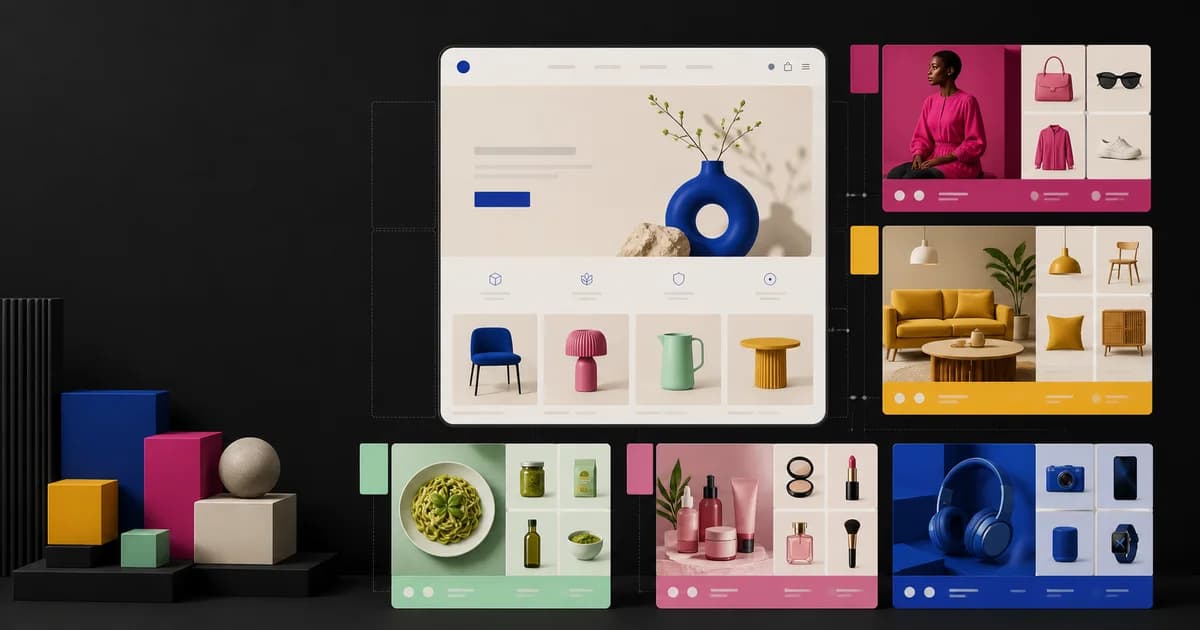
A multipurpose Shopify theme should support several credible merchandising models without turning every page into a generic pile of options. This multipurpose theme shortlist ranks Symmetry as the best balanced candidate, Enterprise as the best for broad catalogs, Impulse as the best for promotion-led merchandising, and Be Yours as the best for flexible lifestyle and beauty storytelling. Each is a current official Theme Store theme with named strengths. “Multipurpose” does not mean that every workflow is present or appropriate. The winner accommodates the business’s real range while enforcing enough consistency for shoppers and editors.
Use the every-niche comparison to challenge the generalist premise, the premium-versus-free guide to price actual capability, and the Shopify theme catalog to inspect current candidates before the pricing page turns platform cost into a complete ownership decision.
Which themes belong on a multipurpose shortlist?
Symmetry offers balanced presentation, Enterprise deep-catalog discovery, Impulse governed campaign variety, and Be Yours lifestyle education. The Symmetry — Shopify Theme Store listing emphasizes versatile layouts, promotions, and discovery for larger inventories, making it a plausible generalist; each configured candidate must still survive planned change cases without eroding navigation or purchase language.
- 1. Symmetry — best balanced multipurpose candidate. Its official positioning calls it versatile and professional, with a wide selection of customizable sections and strong filtering. It is the first premium trial for merchants who need breadth without committing to one narrow aesthetic.
- 2. Enterprise — best for broad or expanding catalogs. Extensive discovery, navigation, merchandising, and promotional tools make Enterprise suitable when catalog scale is the stable requirement across otherwise different categories.
- 3. Impulse — best for changing campaigns and visual merchandising. Impulse offers a deep promotion and product-discovery toolbox that can serve fashion, lifestyle, and seasonal assortments when a team governs message priority.
- 4. Be Yours — best for flexible lifestyle, beauty, and content-rich product education. Its presets and specialized storytelling features support varied creative directions, while its strongest fit remains brands that can use its product-content patterns authentically.
How do you prove multipurpose is a real requirement?
Name committed categories, campaign patterns, and global changes that a focused candidate cannot support predictably, then model them with real content. Shopify’s Choosing themes — Shopify Help Center directs merchants to consider business needs and desired features, so imagined future channels do not justify a permanently larger editor or less coherent customer experience.
List the product families, markets, campaign types, and content models the store will support during a realistic planning horizon. Then identify what must remain consistent: navigation logic, product identity, option behavior, policy placement, cart interaction, typography, and support access. If every category needs a different buying workflow, a single flexible theme may still require specialized templates; if every category needs a different brand, the problem may be portfolio architecture rather than theme selection. Breadth is useful only when the business can articulate the common system underneath it.
Build a stress catalog that deliberately combines unlike items. Include a visually led product, a technical product, a multi-variant item, a considered purchase with long-form education, a low-cost accessory, an unavailable product, and at least one deep collection. Use genuine title lengths, media ratios, metafields, policies, and filters. A multipurpose candidate should let each item explain what is distinctive without causing controls and information placement to move unpredictably. Reusable templates with purposeful variants are better than one universal template overloaded with conditional sections.
When should you choose Symmetry or Enterprise?
Choose Symmetry when several product families need controlled visual variation within shared conventions; choose Enterprise when taxonomy, filters, search, and return-to-collection state are harder. The Enterprise — Shopify Theme Store listing targets large catalogs and includes search, filtering, mega-menu, and collection-navigation features, supporting that choice when deep discovery is the evidenced requirement.
Symmetry is the most balanced first trial because its official Theme Store position is explicitly versatile, modern, and professional. Its configurable sections and filtering make it plausible for merchants who need visual flexibility and dependable discovery. Create two contrasting homepage or collection narratives within the same design system and see whether they still feel related. Test fashion-like swatches alongside a technical category with long filters. Symmetry should win when the team can reuse a controlled set of sections rather than designing every campaign from scratch. Flexibility without editorial rules becomes inconsistency.
Enterprise ranks ahead when catalog scale, navigation, and speed-sensitive discovery dominate. Its listing includes enhanced search, filtering, infinite scroll, recently viewed products, recommendations, a mega menu, and sticky navigation, plus native promotional tools. Test the deepest taxonomy and worst collection on a phone. Verify filter semantics across categories; a shared filter named “size” can mean incompatible things. Enterprise is multipurpose when its discovery system helps different audiences form the right shortlist. It is merely feature-rich when categories still require manual navigation workarounds or confusing global labels.
When do Impulse or Be Yours fit better?
Impulse fits when coordinated promotions are the recurring change; Be Yours fits when related lifestyle categories share a truthful education model. The Impulse — Shopify Theme Store listing includes extensive promotion and discovery features, supporting the first fit when campaigns are governed; choose Be Yours only when maintained education answers recurring shopper questions.
Impulse is the campaign operator’s candidate. Its promotions, badges, popups, quick buy, recommendations, cross-selling, lookbooks, tabs, search, filters, and mega menu can support many merchandising cycles without installing a separate tool for each one. The team needs a publishing hierarchy: which campaign can occupy the announcement, hero, collection tile, product badge, and cart at one time. Define expiry and rollback for every promotion. A multipurpose campaign system succeeds when a new season reuses proven components; it fails when old messages survive in forgotten templates.
Be Yours provides a different kind of flexibility. Its official presets and feature inventory combine mobile commerce controls with rich product education, including ingredients, usage, lookbooks, hotspots, before-and-after media, tabs, and delivery information. Beauty is its stated center, but adjacent lifestyle catalogs may find the same content structures useful. Trial it only with truthful, relevant material. A furniture seller does not need an ingredient pattern, and a technical catalog should not be forced into ritual storytelling. Multipurpose selection should reward adaptable structure, not the number of unrelated features available.
What guardrails keep flexible themes coherent?
Define fixed navigation terms, product facts, card behavior, purchase controls, promotion priority, accessibility states, and component ownership while limiting where categories may vary. Shopify’s Using the theme editor — Shopify Help Center explains reusable templates, sections, and blocks, giving teams concrete boundaries another operator can follow without inventing a new page system.
Document approved templates, section purposes, spacing and type rules, image ratios, card data, promotion hierarchy, filter vocabulary, and the required homes for delivery, returns, compatibility, care, or ingredients. Give each rule an owner and example. Locking every choice creates developer dependence, while unlimited freedom produces visual and semantic drift. The goal is guided composition: editors can launch a new category or campaign using supported building blocks, and reviewers can tell when a page violates the customer journey. Rehearse the workflow with an editor who did not design the system.
Review extension seams before purchase. Install required reviews, subscriptions, bundles, pickup, localization, search, consent, and analytics integrations in every trial. Exercise app blocks across the distinct templates, not only the homepage. Check mobile overlays, keyboard focus, translations, long currencies, unavailable variants, and cart updates. Compare performance with equivalent content and scripts. A theme that supports many native features may reduce apps, but unused native modules should remain disabled. Multipurpose must not become an excuse to ship every capability simultaneously.
What acceptance bar should each kind of flexibility meet?
Symmetry must preserve a recognizable system across categories, Enterprise must keep discovery understandable, Impulse must make campaigns reversible, and Be Yours must reuse honest education patterns. Shopify’s Adding, previewing, and buying themes — Shopify Help Center confirms candidates can be previewed before publication, enabling comparable acceptance cases without exposing unfinished variations to customers.
Symmetry passes when a small set of approved templates can express contrasting categories without making them look like unrelated stores. Ask editors to launch a visually led range and a specification-led range using the same navigation, type system, cards, and purchase conventions. Reject it if every new category begins with a blank-page design exercise, shared components cannot accommodate real content, or campaign variations weaken brand recognition. Its versatility should reduce bespoke work while preserving enough controlled difference for each product family to communicate clearly.
Enterprise passes when structural breadth is more important than visual reinvention. Load the deepest planned taxonomy, category-specific filter vocabularies, long search terms, and products that belong to more than one collection. Acceptance means shoppers can form the right shortlist across departments and return without losing state. Reject it when global filters produce misleading values, infinite loading makes navigation harder, or teams maintain manual collection workarounds. Enterprise deserves the higher rank for catalog growth only if its discovery model remains understandable as categories diverge.
Impulse passes when the repeated change is a campaign rather than a product architecture. Rehearse a seasonal launch, its midpoint update, expiration, and complete removal across announcement, homepage, collection, product, and cart surfaces. Acceptance means editors reuse governed components, price and inventory messages agree, and no stale creative remains afterward. Reject it when flexibility becomes simultaneous popups, tiles, badges, and timers with no priority rule. A multipurpose campaign theme should make coordinated change reversible; it should not give every stakeholder a new place to publish competing urgency.
Be Yours passes when several lifestyle categories share an authentic education model: ingredients or materials, usage, routine, comparison, and visual demonstration. Test whether those fields mean something truthful for every planned category and whether phone shoppers can move between education and options without losing state. Reject it when specialized modules are relabeled awkwardly, before-and-after content lacks appropriate context, or category teams invent inconsistent templates. Its flexibility is strongest within a related product language. If the assortment lacks that common language, Symmetry’s broader neutrality may be the more maintainable choice.
Score the real change cases
Ask each theme to handle three planned changes: add a genuinely different category, publish a seasonal campaign, and revise a global purchase condition. Record editor time, new assets, code changes, app changes, regressions, and customer-task results. The best candidate is not the one that can technically create any layout. It is the one that handles these changes predictably while preserving brand recognition and purchase clarity. Keep the evaluation qualitative where no controlled numeric evidence exists; do not invent an overall flexibility score that conceals a critical failure.
Also test subtraction. Remove a campaign, retire a category, disable an app, and simplify a product template without leaving empty gaps, stale navigation, orphaned blocks, or hidden scripts. Businesses change in both directions, and a multipurpose system that only accumulates features becomes expensive to understand. Archive the before-state, review affected templates, and verify search and internal navigation afterward. The small-business theme guide is a useful companion when a lean team must own this housekeeping without a permanent developer.
Key Takeaways
- Multipurpose value must be proved with committed categories and campaigns, not a long feature inventory.
- Symmetry, Enterprise, Impulse, and Be Yours express different kinds of flexibility with different operating burdens.
- Shared navigation, product facts, purchase controls, accessibility states, and promotion rules need explicit guardrails.
- Test addition and subtraction: a flexible system must retire categories, campaigns, and apps cleanly as well as add them.
Decision
Choose Symmetry for balanced visual and structural versatility, Enterprise for discovery across a broad assortment, Impulse for governed promotional variety, and Be Yours for content-rich lifestyle merchandising. Compare specialist themes first if the business has one durable niche, because a focused system may be easier to operate. Choose multipurpose only when breadth is a demonstrated requirement and the team will maintain its guardrails. A flexible theme should make change safer, not make every page different. The small-business theme guide helps test whether the operating team can sustain that breadth.
Frequently asked questions
What makes a Shopify theme multipurpose?
It supports several credible catalog and content patterns through reusable templates, sections, navigation, and discovery controls while preserving a coherent customer experience. A long feature list alone is not enough.
Is a multipurpose theme better for growth?
Only when planned growth actually introduces new categories or campaigns that the theme handles well. A specialist theme can be more maintainable when the core niche and buying workflow remain stable.