Shopify · August 23, 2026 · 10 min read
Best Shopify Themes for Pharmacies
Rank Medical, Medicines, and Enterprise for pharmacy catalog identity, permitted sales paths, pack details, support routing, and jurisdiction checks.
By Polo Themes
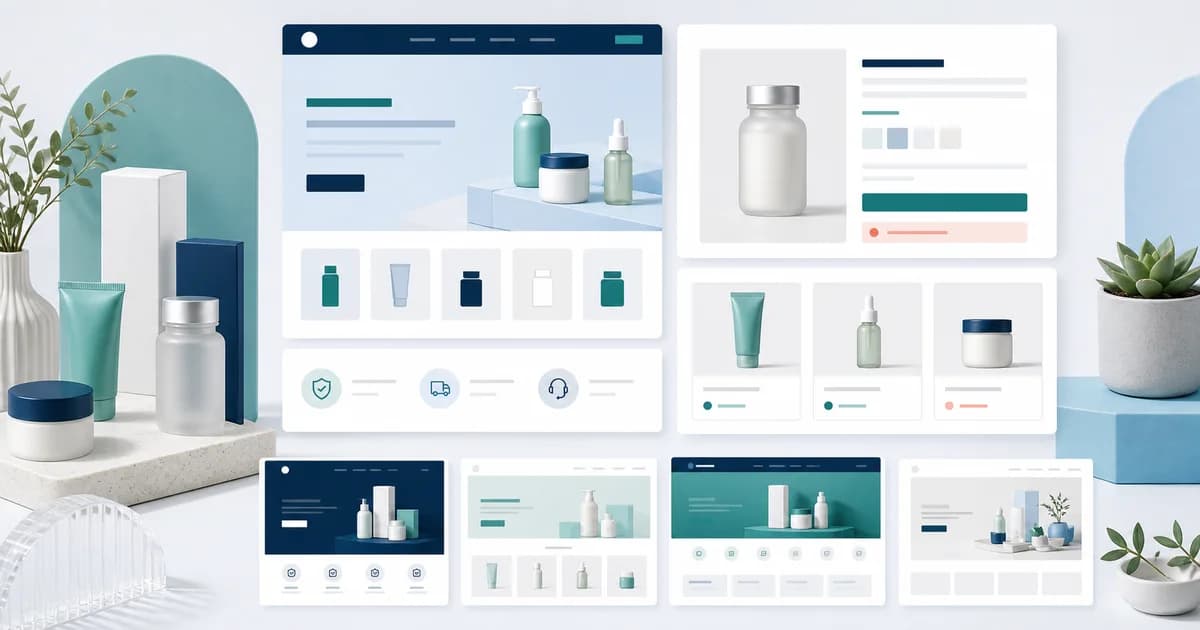
The best Shopify theme for a pharmacy is the one that keeps exact product identity and the permitted sales path clear. Our ranked starting order is 1. Medical by Polo Themes, the honest closest Polo fit; 2. Medicines, a preset of Area on the official Shopify Theme Store; and 3. Enterprise, also on the official Theme Store. Medical is first because Polo directly describes it as a responsive medical-supply presentation. That is useful adjacency, not evidence of prescription intake, dispensing, pharmacist review, identity checks, restricted-product controls, clinical advice, or regulatory compliance. Medicines and Enterprise are independent candidates to preview against the same catalog, not endorsements of a particular pharmacy operating model.
Use the all-niche theme guide to keep Medical’s adjacency honest, the medical-supply launch guide to define regulated catalog operations, the Shopify theme catalog to inspect other current candidates, and the pricing page to budget theme and platform costs before a pharmacy preview becomes a commitment.
Which Shopify themes belong on a pharmacy shortlist?
Start with Medical as the closest Polo fit, then compare Medicines and Enterprise against the same governed catalog. Polo Themes describes health, beauty, and medical supplies in Medical E-commerce Shopify Theme | Polo Themes, supporting its first evaluation slot without implying prescription, dispensing, or regulatory capabilities.
1. Medical — closest Polo fit
Medical earns the first evaluation slot because the seed describes a medical-supply presentation that can adapt to health catalogs. Its value is information framing: a merchant can test whether product names, formats, amounts, pack sizes, warnings, and support routes stay prominent. Its limit is equally important. A medical appearance does not create a pharmacy system, decide whether an item can be sold online, or determine which customer, destination, review, or delivery path is permitted. Treat every specialist step as a separately owned service with a documented handoff. If the business cannot name that owner and test the handoff, the storefront must not imply that the step exists.
2. Medicines by Area — health-oriented official alternative
Medicines is second because its current official listing gives merchants a health-oriented preset to inspect without confusing it with Polo. Evaluate its product discovery, usage-information presentation, product options, tabs, filtering, search, and contact surfaces with long regulated product names and near-identical packs. The preset name is not a compliance claim. It does not establish that warnings are complete, that category rules are correct, or that an ordinary add-to-cart action is lawful for every item. Disable fast purchase paths wherever required information or an external review must precede the order, and verify the final behavior in the real market.
3. Enterprise — large-catalog control
Enterprise is the third candidate when the pharmacy also carries a large general-retail assortment. Its official listing emphasizes search, mega-menu navigation, filtering, usage information, options, and high-volume selling. Those are useful controls for separating first aid, personal care, household, devices, and other factual departments. They do not understand active ingredients, strengths, dosage forms, pack counts, age limits, temperature handling, or restricted fulfillment. Enterprise is therefore a catalog-scale control: it should outrank Medical only if the staged store proves clearer discovery without weakening product boundaries or creating risky shortcuts.
What should a pharmacy require from its storefront theme?
Require exact product identity, visible warnings, governed category boundaries, truthful fulfillment, and an appropriate support route. Shopify explains that product details affect customer display and organization in Product details, making maintained fields a sound storefront foundation while pharmacy classification and professional review remain separately governed.
- Identity before promotion. Search cards and pages must preserve the exact maintained name, form, amount or strength where applicable, pack size, and distinguishing identifier. A campaign label cannot replace them.
- Sales-path separation. General retail items, advice-led products, and products routed through a specialist or external process need visibly different next actions based on the merchant’s approved classification.
- Warning and support proximity. Required warnings, use information, storage notes, and the accountable support route should be discoverable before purchase without presenting theme copy as professional advice.
- Search under ambiguity. Misspellings and broad queries should not collapse materially different formats or amounts into one indistinguishable result. Filters must use governed, factual categories.
- Fulfillment truth. Destination, pickup, handling, cancellation, and return constraints must match operations for the exact product family rather than a sitewide promise.
Record the market decision before configuring the theme
A pharmacy serving more than one jurisdiction should not begin with a universal product template and remove buttons later. Build a market matrix from the approved product classification, destination, customer path, support owner, and fulfillment route. The same item may need an ordinary retail action in one served market, an information-only page in another, or exclusion from online discovery elsewhere. That decision belongs to the accountable pharmacy and legal team. The theme should consume the approved outcome and make it visible; it should not infer permission from inventory, product type, or a customer-entered address after the item is already in the cart.
Run a release rehearsal with a shopper, a pharmacist or other accountable reviewer, fulfillment staff, and support using the same staged order. Introduce a destination change after cart creation, a reclassified product, and a support question that arrives through the wrong form. Acceptance requires the storefront to recompute the permitted next action, preserve the exact product identity, prevent an old quick-buy state from surviving, and route the question without representing ordinary customer service as clinical advice. Keep the screenshots and downstream record with the classification decision so a later theme or app update can be compared against the approved behavior.
Score each criterion with captured evidence from the same production-like catalog. A zero means the requirement is absent or creates a bypass; one means custom work with no stable owner; two means a maintainable configuration or validated integration; and three means an unfamiliar tester completes the task correctly and the downstream record preserves the decision. Make identity and sales-path separation pass/fail gates. A beautiful preset must not compensate for a restricted item inheriting a retail purchase button or for two strengths becoming indistinguishable in search.
How should you compare pharmacy themes with real products?
Use one awkward, production-like catalog in every preview, asking unfamiliar testers to distinguish close options, find warnings, identify support, and complete only permitted actions. Shopify says variants represent option combinations in Variants, so each test should confirm that materially different forms, amounts, and packs remain distinguishable.
Build five deliberately awkward records: a general wellness accessory; two same-brand products with different formats or amounts; a temperature-sensitive item only if the business actually sells one; an item requiring a separately governed process; and an unavailable product with a permitted alternative path. Give all candidates identical titles, approved descriptions, image sets, metadata, policies, and destinations. Ask a tester to find the correct same-brand item, explain what is in the pack, identify the support route, and say what happens next. The specialist item should never enter an ordinary cart by inheriting the general template accidentally.
Capture collection results, product-page default state, selected options, warning placement, destination checks, cart line, confirmation, and the operational record. Then cross the paths: enter from a promotional collection, search by a partial product name, navigate from a general category to the specialist product, and use browser back after an unavailable state. The exact item and permitted next action must remain stable. If quick buy omits information necessary to distinguish the product, turn it off for that family rather than attempting to solve the ambiguity with a later cart message.
Which pharmacy rules must be resolved before launch?
For the United States, resolve product classification, professional oversight, claims, customer and destination restrictions, privacy, records, and fulfillment before enabling purchase. The U.S. Food and Drug Administration warns consumers about unsafe online sellers in How to Buy Medicines Safely From an Online Pharmacy; other jurisdictions require their own primary regulators.
United States: the FDA is a primary federal regulator for drugs, medical products, food, and related labeling areas, while the merchant must determine which additional federal and state pharmacy, professional, privacy, controlled-substance, advertising, tax, and delivery rules apply. FDA materials are a starting source, not a storefront compliance certificate. Outside the United States, identify the corresponding national and subnational regulators and professional bodies before defining categories, claims, eligibility, and fulfillment. Verify requirements in every market served with qualified counsel and accountable pharmacy professionals; this guide gives no legal, medical, dispensing, or compliance guarantee.
Which pharmacy failures should staging deliberately expose?
Force retail-path leakage, ambiguous strengths, stale warnings, unsupported claims, destination changes, and misrouted support before publication. Shopify notes that product media can include images, videos, and three-dimensional models in Product media, so staging should verify that every medium stays synchronized with the approved product record.
- Retail-path leakage: a governed product receives the same quick-buy control as soap or a storage case.
- Strength collision: truncation hides the difference between two amounts, forms, concentrations, or pack sizes.
- Advice by merchandising: a “best for” badge implies a recommendation that approved product information does not support.
- Support dead end: one generic form cannot route product information, order help, or a specialist question appropriately.
- Destination mismatch: a broad shipping banner conflicts with a product-level geographic or handling restriction.
- Stale warning: a product update changes approved information but cached cards, comparison content, or an app block retain old wording.
What proves a pharmacy implementation is ready to publish?
Publication requires traceable SKU classifications, consistent identity across every handoff, tested exclusions, accessible tasks, and accountable approval. Shopify permits merchants to try paid themes before purchase according to Choosing themes; use that preview with representative products, then separately prove connected services and operational records preserve approved decisions.
- Classify every SKU family. Record its permitted storefront action, required fields, review owner, destinations, fulfillment method, and exception route before assigning a template.
- Reconcile identity. Compare source record, card, page, selection, cart, confirmation, pick record, and support view for exact name, form, amount, pack, and identifier.
- Challenge navigation. Search with ambiguous terms, use category menus and filters, follow a promotion, and confirm each route lands on the same governed product state.
- Test exclusions. Attempt an unsupported destination, invalid option, unavailable stock state, mixed cart, and return request; verify no generic theme behavior bypasses policy.
- Review with accountable staff. Have qualified owners inspect rendered labels, claims, warnings, calls to action, and escalation routes before publication and after material catalog changes.
- Check accessibility. Complete the identity and support tasks with keyboard navigation, zoom, visible focus, meaningful labels, and a narrow mobile viewport.
Key Takeaways
- Medical is the closest Polo starting point, not a prescription, dispensing, or professional-review system.
- Exact product identity and the permitted sales path are release gates, not optional merchandising refinements.
- Market, destination, support, and fulfillment decisions must be approved outside the theme and survive cart changes.
- A staged near-miss catalog should expose quick-buy leakage, stale warnings, and ambiguous strengths before publication.
Conclusion
Start with Medical because it is Polo’s direct medical-supply presentation and therefore the closest honest fit. Put Medicines second for a health-oriented official Theme Store comparison, and Enterprise third when catalog breadth is the harder problem. Change that order only after controlled testing shows a clearer, safer, and more maintainable result. The winning pharmacy theme is the candidate that makes product identity and operating boundaries difficult to misunderstand; it is never the candidate whose visual language merely looks the most clinical.
Frequently asked questions
Does Medical include prescription or dispensing workflows?
No direct seed claim says that it does. Medical supplies the adjacent presentation layer. Prescription intake, verification, professional review, dispensing, identity, restricted-product handling, and related records require separately selected and validated systems and accountable operators.
Is a theme named Medicines automatically appropriate for a pharmacy?
No. The name and preset can make it useful to preview, but appropriateness depends on the exact catalog, jurisdiction, operational model, required integrations, and acceptance tests. A theme listing is not regulatory approval.
Should pharmacy quick buy be enabled?
Only for product families where the merchant has proved that no required identity, warning, option, eligibility, or process information is skipped. Disable it elsewhere and test the full path.
Who should approve pharmacy storefront claims?
Use the accountable qualified owners defined by the business and market. They should trace claims to approved sources and review rendered pages, not merely a content spreadsheet.
Can one pharmacy catalog use the same purchase action everywhere?
Only when the accountable market review establishes that the product and process have the same permitted path in every served destination. Otherwise, render the approved market-specific action and test destination changes before and after cart creation.