Shopify · August 23, 2026 · 9 min read
Best Shopify Themes for Medical Equipment Stores
Rank Medical, Enterprise, and Warehouse for equipment models, dimensions, documents, compatible parts, delivery limits, and service records.
By Polo Themes
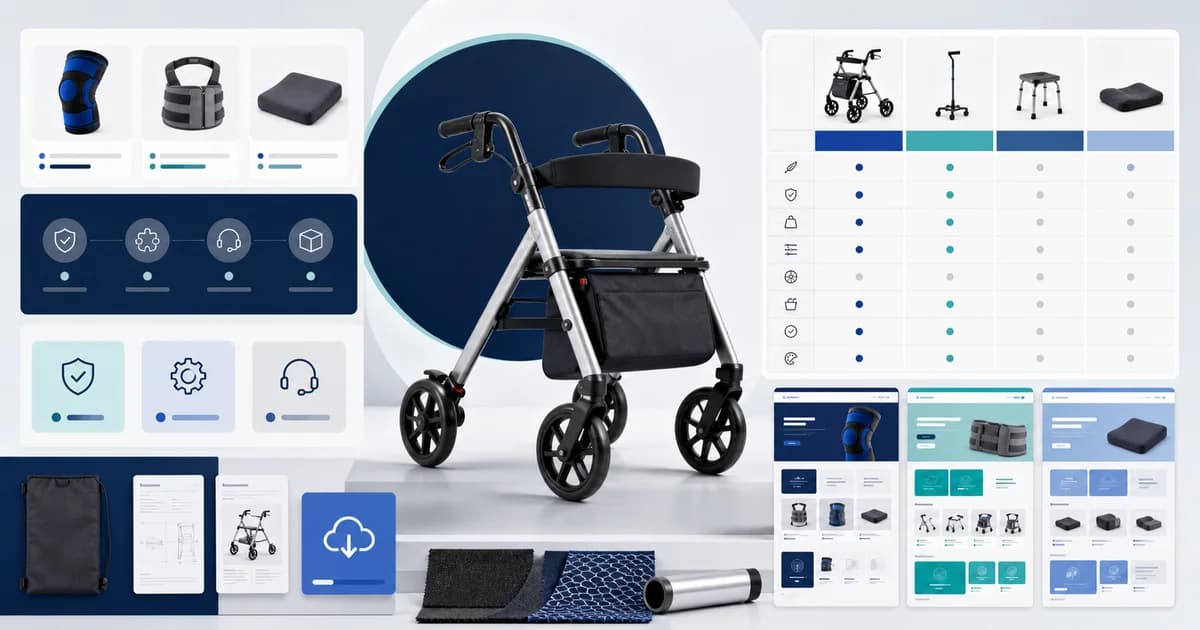
For a medical-equipment store, the ranked starting order is 1. Medical by Polo Themes, the closest Polo fit; 2. Warehouse from the official Shopify Theme Store; and 3. Enterprise from the official Theme Store. Medical is the honest first hypothesis because Polo seeds it for medical supplies. Warehouse is the specification-heavy large-catalog alternative, while Enterprise is a search-and-navigation control for broad inventories. None is an equipment-management system. A theme cannot assess suitability, confirm a model relationship, install or calibrate a device, schedule maintenance, manage regulated records, or establish that a product may be sold in a destination.
Compare this shortlist with the all-niche theme guide, translate device records into an operating plan with the medical-supply launch guide, inspect the current Shopify theme catalog, and use the pricing page to separate storefront cost from equipment-service and compliance work.
Which themes should a medical-equipment store shortlist?
Preview Medical first, Warehouse for dense technical records, and Enterprise for broad procurement discovery. Polo Themes positions health, beauty, and medical supplies in Medical E-commerce Shopify Theme | Polo Themes, making Medical the closest direct fit; only representative model, document, accessory, and service-boundary tests should determine the final choice.
1. Medical — closest Polo fit
Medical starts first because its seeded medical-supply presentation can support a trust-led hierarchy around exact models, supporting information, and service contact. Test whether it can reveal dimensions, configuration, included components, documentation, and delivery conditions without pushing them beneath generic reassurance. Do not expand the seed claim into suitability advice or device workflow. If a product requires professional selection, fitting, installation, calibration, training, or follow-up, the storefront must describe the real process and accountable provider rather than making the theme appear to supply it.
2. Warehouse — specification and catalog alternative
Warehouse is second because its official listing is explicitly positioned for large catalogs and tech merchandising, with filtering, search, product tabs, options, videos, and usage information among its listed tools. That makes it a strong test for a store with many models, replacement parts, and accessories. The limitation is semantic: a tab can display a compatibility table but cannot prove the table is correct. A recommendation surface can show accessories but cannot know whether a particular revision, capacity, connector, size, or regional configuration supports them.
3. Enterprise — broad procurement-oriented control
Enterprise belongs in third place when buyers need to traverse a very broad range quickly. Preview its mega-menu, enhanced search, filtering, options, and usage-information features with both household and procurement tasks. Enterprise should move upward only if the evidence shows that exact model identity, document access, and configuration survive its faster shopping patterns. Quick purchase controls may be unsuitable for equipment that requires measurements or acknowledged delivery terms, so test disabling them selectively instead of accepting the preset’s normal path as a requirement.
What distinguishes a reliable medical-equipment storefront?
A reliable storefront preserves configuration, dimensions, compatibility, current documents, service coverage, and downstream model identity. Shopify says merchants can connect metafields to compatible themes in Product details, supporting maintained technical fields without turning the theme into a device-classification, suitability, installation, or professional-review system.
- Configuration integrity. Model, revision, size, approved limits, power or regional configuration, included components, and selected options must travel together.
- Measured fit and space. Use consistent units, labeled diagrams, measuring instructions, and explicit distinction between product, assembled, internal, and package dimensions.
- Compatibility evidence. Accessories and consumables need maintained supported-model relationships rather than appearance, category, or family-name guessing.
- Documentation governance. Manuals and specification files need model scope, version, owner, and replacement rules so an old file cannot remain beside new inventory.
- Service and logistics truth. Delivery, setup, training, warranty, maintenance, returns, and local support must describe the actual purchased service and coverage area.
Turn the shortlist into an equipment release decision
Compare Medical, Warehouse, and Enterprise with the same decision sheet rather than separate demo impressions. For every test product, record where the shopper finds the exact model, which surface owns the specification table, how a supported accessory relationship is sourced, and what information reaches fulfillment and support. Medical should retain first place when its information hierarchy makes the model and service boundary easiest to understand. Warehouse should move ahead when dense specifications and part discovery are materially clearer. Enterprise should lead only when its broad navigation improves procurement without shortening model identity or encouraging an unverified quick order.
Add an operational acceptance session around a model revision. Replace the approved manual, withdraw one accessory relationship, change an included component, and leave a saved cart from the prior revision. The release passes only if search, product media, downloads, recommendations, cart, confirmation, warehouse view, and support view expose either the current configuration or a deliberate historical order record. A stale manual beside current stock is a failure even if checkout succeeds. A support agent should not have to guess which revision shipped from a shortened title or customer photograph.
Jurisdiction decisions should be attached to the exact equipment record and the merchant’s role. A household aid, a regulated device, an accessory, and a service package may require different market, labeling, documentation, installation, or reporting treatment. Do not let a shared medical category flatten those distinctions. Before enabling a destination, the responsible specialists should approve the product status, claims, supplied documents, service coverage, and post-sale route for that market. The storefront then demonstrates that the approved boundary survives address changes, mixed carts, returns, warranty questions, and a product revision.
Weight configuration and compatibility most heavily, because mistakes can create an unusable purchase or unsafe assumption. Require evidence for every score: a rendered state, a successful task, an editor workflow, or an operational record. Reject any candidate that cannot prevent a known-incompatible accessory or that loses exact configuration between product page and order. Visual calm, editorial storytelling, and fast collection browsing matter only after the exact equipment decision remains recoverable by customer, fulfillment, and support.
How should you test models, revisions, and accessories?
Build a matrix containing adjacent models, a regional configuration, revisioned manuals, one valid accessory, and one plausible incompatibility. Shopify defines each option-value combination as a variant in Variants; verify that customer, warehouse, installer when applicable, and support views all preserve the selected configuration and exclusions.
Create a controlled catalog with a support item in two sizes, a powered device with a regional configuration, a replacement consumable, and two visually similar accessories where only one supports the chosen model revision. Add a downloadable manual and a dimension drawing for each relevant model. Identify the base package separately from optional installation or service. Ask a household tester to choose a configuration for stated space constraints, and ask a procurement tester to capture the exact model, revision, document, warranty boundary, and delivery expectation.
Now seed contradictions intentionally. Attach an old manual to the revised model, recommend the wrong accessory, switch measurement units in one table, remove one included component from the variant, and choose a destination outside service coverage. A passing implementation either prevents publication of these states or makes each conflict conspicuous before purchase. Follow the resulting order into fulfillment and support. Both teams should retrieve the same model and documentation the buyer saw without inferring from the marketing title or gallery.
Which medical-device authorities and markets must be checked?
For the United States, classify the exact device, accessory, service, merchant role, and destination before deciding what may be sold. The U.S. Food and Drug Administration explains risk-based device classes in Classify Your Medical Device. Each additional jurisdiction needs its own named regulator and market-access review.
United States: FDA oversight can apply to medical devices, including areas such as classification, registration and listing, labeling, reporting, and other lifecycle obligations. The exact obligations depend on the product and role of the business; a storefront theme determines none of them. Other US bodies and state rules may also matter for advertising, professional practice, privacy, accessibility, warranties, tax, or distribution. Outside the US, identify the relevant national and regional device regulators and market-access requirements. Verify every destination with qualified regulatory and legal specialists. This guide offers no suitability, medical, legal, certification, or compliance guarantee.
Which medical-equipment failures should staging force?
Deliberately simulate a stale manual, wrong accessory, mixed measurement units, unsupported service destination, and revision mismatch. Shopify describes images, videos, and three-dimensional models as product media in Product media, so the rehearsal must catch configuration drift across files, visuals, orders, fulfillment, and support records.
- Lifestyle substitution: reassuring photography crowds out measurements, exact model identity, operating constraints, or shipment contents.
- Accessory-family guessing: a replacement part is associated with a broad range but not the supported models and revisions.
- Manual drift: an updated product keeps a superseded specification sheet or translated document.
- Service implication: copy suggests setup, calibration, training, maintenance, or local support without a named provider and boundary.
- Unit ambiguity: capacity, dimensions, or package measurements appear without units or mix unit systems inside one decision.
- Procurement split: household copy and downloadable procurement data describe different configurations or included items.
What evidence makes medical-equipment publication defensible?
Require rendered model records, bidirectional compatibility tests, controlled document revisions, unavailable-destination checks, and downstream order traces. The U.S. Food and Drug Administration identifies general labeling requirements in Device Labeling; publication evidence must additionally demonstrate that every theme surface and integration renders the merchant’s approved, current configuration.
- Define the model record. Store identifier, revision, options, approved specifications, supported accessories, included items, documents, and source ownership.
- Run a dimension task. Have an unfamiliar tester determine fit in a stated space and explain which measurement applies without relying on the photograph.
- Run compatibility both ways. Start at the equipment and find a consumable, then start at the consumable and confirm the same supported model relationship.
- Break a configuration. Attempt a known-wrong accessory, unsupported region, unavailable size, and mixed-service cart; verify safe blocking or an accurate next step.
- Audit document versions. Change a revision and prove stale manuals, diagrams, cards, caches, search results, and app blocks cannot survive unnoticed.
- Trace downstream. Confirm order, warehouse, installer if applicable, and support views expose the exact model and service purchased.
Key Takeaways
- Medical begins the evaluation, while Warehouse or Enterprise can win when technical density or procurement discovery is demonstrably clearer.
- Model, revision, region, included components, and supported accessories must remain one recoverable configuration.
- Manuals and specification files need explicit scope, ownership, and replacement rules across current and historical orders.
- A theme presents approved device information; it does not assess suitability, install equipment, or create regulatory compliance.
Conclusion
Medical remains the closest Polo fit because medical supplies are its seeded domain, but Warehouse may win when model density and technical comparison dominate, and Enterprise may win when broad discovery is the larger obstacle. Decide with a representative model matrix, not a demo homepage. The chosen theme must preserve configuration, documentation, compatibility, and service boundaries across every handoff. Any specialist assessment or regulated process remains outside the theme and must be separately designed, owned, and verified.
Frequently asked questions
Is Medical a device-management platform?
No. The confirmed seed supports a medical-supply presentation. Device records, professional assessment, installation, calibration, maintenance, reporting, and other operational systems remain separate.
When should Warehouse outrank Medical?
Move Warehouse up only when a controlled preview proves it handles the real model, document, filter, and accessory matrix more clearly while preserving every critical boundary.
Can related-products blocks establish compatibility?
No. They may display a maintained relationship, but the business needs an authoritative compatibility source, update owner, and regression test for each supported model or requirement.
What is the minimum useful equipment test catalog?
Include multiple sizes, a regional or powered configuration, a revisioned document, a consumable, one supported accessory, and one deliberate near miss. Trace one order through support.
How should a saved cart behave after an equipment revision?
It should not silently convert the old selection into the current model. Revalidate availability, compatibility, documents, included items, service, and destination, then require an explicit customer decision where the original configuration can no longer be supplied.