Shopify · August 23, 2026 · 9 min read
Best Shopify Themes for Fitness & Gym Brands
Rank Wosa, Impact, and Motion for fitness apparel and equipment, dimensions, bundle contents, delivery constraints, and controlled health claims.
By Polo Themes
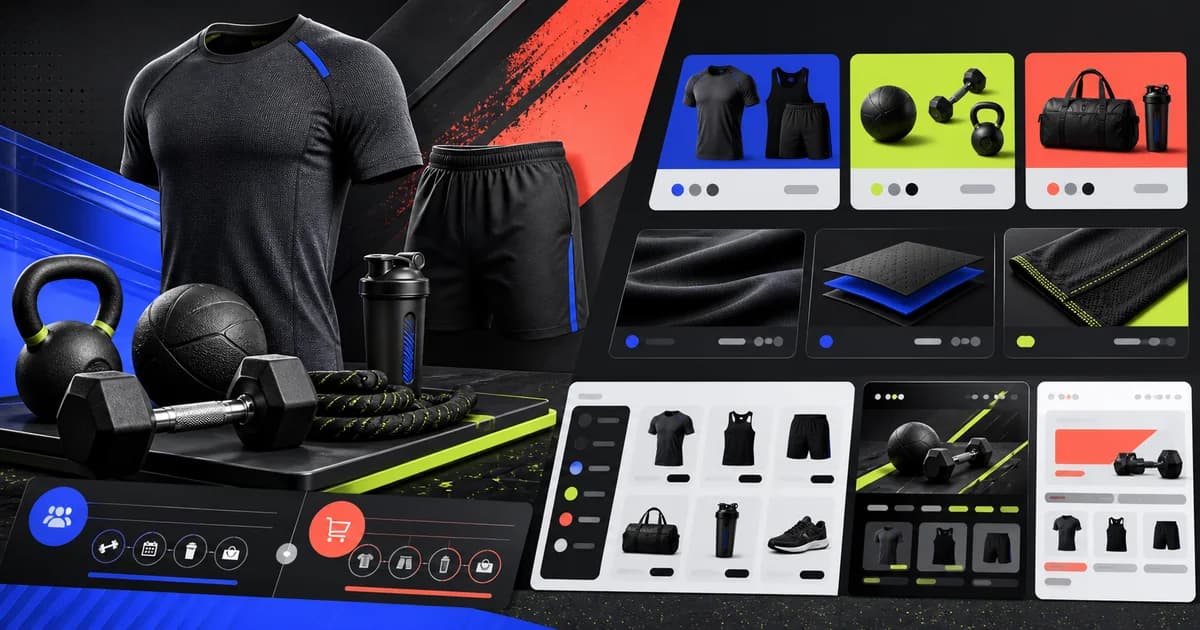
For fitness and gym brands, rank the candidates 1. Wosa by Polo Themes, the closest Polo fit; 2. Optimum, a Sitar preset on the official Shopify Theme Store; and 3. Motion, also on the official Theme Store. Wosa comes first because Polo seeds it for fashion-led product presentation, making it the nearest match when activewear is the anchor. Optimum is the stronger independent hypothesis for supplements and training assortments, while Motion offers a visual storytelling control. None verifies apparel fit, equipment capacity, exercise suitability, training outcomes, digital access, or any health or performance claim.
Anchor the evaluation in the all-niche theme guide, use the clothing-brand launch guide for activewear sizing and release operations, browse the Shopify theme catalog for current fitness candidates, and check the pricing page before assigning budget to content, subscriptions, or specialist apps.
Which themes fit a mixed fitness catalog?
Choose Wosa first when activewear drives the business, test Optimum when supplements and replenishment matter, and use Motion to challenge visual storytelling. Polo Themes frames clothing and visual assortments in Wosa E-commerce Shopify Theme | Polo Themes, supporting an activewear-first evaluation while mixed stores may need different templates for equipment or consumables.
1. Wosa — closest Polo fit for activewear-led brands
Wosa earns the first slot only where apparel and visual lifestyle merchandising dominate. Its confirmed seed describes clean typography and fashion-led product presentation for clothing and visual assortments. That can support color, size, material, care, and movement imagery. It is not a universal fitness schema. A rack, resistance band, mat, wearable device, nutrition product, and digital plan ask different questions. Create distinct templates rather than stuffing equipment dimensions into a size chart or treating campaign photography as evidence of performance.
2. Optimum — fitness-oriented Theme Store alternative
Optimum ranks second because its official listing explicitly addresses fitness and supplement brands and large inventories with flavors and value packs. Preview it when the catalog mixes training goods and replenishment products. Its niche language still does not prove claims, resistance levels, equipment limits, package contents, or customer suitability. Test every prominent benefit section, ingredient icon, bundle, sticky purchase control, and quick-buy path with approved data. Optimum should move above Wosa when the actual assortment is less apparel-led and the staged tasks demonstrate clearer family-specific decisions.
3. Motion — visual training-story control
Motion is third because its official Theme Store presence makes it a useful candidate for movement-rich product media and editorial-to-product paths. Use it to test training stories that connect to exact products without turning an athlete’s result into a promise. Animation must not hide technical facts, make keyboard focus difficult to follow, or worsen motion sensitivity. A product video can demonstrate setup only if the exact model and configuration are identified; it cannot replace written dimensions, included parts, warnings, or approved instructions.
What should mixed fitness commerce keep separate?
Separate apparel fit, equipment dimensions, consumable facts, set contents, and digital access because each creates a different buying decision. Shopify says product details influence storefront display and organization in Product details, supporting family-specific maintained fields instead of forcing unrelated products into one campaign-driven schema.
- Product-family separation. Apparel fit, equipment specification, consumable information, and digital access need purpose-built fields and page order.
- Selection clarity. Garment measurements, equipment dimensions, resistance or capacity where approved, included pieces, and variants must remain distinguishable.
- Evidence-controlled language. Activity labels may guide browsing, but outcome, recovery, strength, speed, body, or health statements require approved support and qualifiers.
- Editorial conversion without distortion. A training story should land on the exact featured product and preserve the distinction between inspiration and product capability.
- Operational fit. Oversized delivery, set completeness, digital fulfillment, returns, warranties, and stock exceptions should follow the selected family and configuration.
Before scoring, classify the assortment by the buyer’s decision rather than the campaign. Weight family separation and exact selection above cinematic presentation. A zero on included components, dimensions, or a required warning should reject the template for that family. Do not average apparel success into equipment failure. It is acceptable for Wosa to remain the activewear theme while a mixed catalog requires additional templates or a different candidate; the goal is a maintainable system, not loyalty to one demo.
How should a mixed fitness cart be tested?
Combine sized apparel, a component set, a dimension-sensitive mat, and compact equipment in one controlled journey. Shopify defines variants through option-value combinations in Variants. Test unavailable selections, incomplete sets, oversized destinations, stale editorial links, reduced motion, keyboard use, and downstream records without averaging away a family-specific failure.
Load four products: leggings with size and color; a resistance-band set with exact included levels and pieces; a mat with dimensions, material, and care; and a compact equipment item whose assembled footprint and shipped package differ. Link all four from one training article. Ask a mobile tester to choose apparel from measurements, confirm the band-set contents, check whether the mat fits a stated storage space, and identify what assembly or delivery information applies to the equipment. Each answer must come from the exact product page, not an inference from photographs.
Then construct a mixed cart and create exceptions: make one apparel size unavailable, remove one component from a set variant, choose an oversized destination, and follow an old editorial link after a product revision. The cart and fulfillment record must preserve exact garment and equipment selections. A story should never keep a discontinued specification or silently redirect to a near substitute. Test reduced-motion preferences, keyboard navigation, zoom, long option labels, and slow mobile conditions so the visual concept does not erase the actual buying task.
Which fitness claims and product rules need review?
For the United States, review each product and implication separately because apparel, equipment, supplements, connected devices, and services can invoke different authorities. The Federal Trade Commission explains substantiation expectations in Health Claims. Name the primary regulator for every other served jurisdiction before approving health or performance language.
United States: the FDA is a primary federal regulator for foods, dietary supplements, medical devices, and other product areas that may appear in a fitness catalog; the FTC has authority relevant to advertising claims. Which rules apply depends on the product and claim, not the theme category. Apparel, general equipment, digital services, subscriptions, privacy, warranties, and state sales can introduce other authorities and obligations. Outside the US, identify the equivalent regulators in every served market. Obtain qualified legal, regulatory, product-safety, and professional review as appropriate. This comparison gives no legal, health, safety, efficacy, or performance guarantee.
Which fitness storefront failures deserve a forced test?
Force schema crossover, unsupported outcome language, incomplete sets, dimension confusion, stale training stories, and motion-related barriers. Shopify lists images, videos, and three-dimensional models as product media in Product media; staging must additionally prove readable facts, stable focus, reduced-motion behavior, exact carts, and family-specific recovery.
- One-template distortion: equipment receives apparel labels, or a digital plan receives shipping and size controls.
- Outcome by association: an athlete image or transformation story implies a result unsupported for the exact product.
- Set ambiguity: handles, bands, anchors, adapters, or bags appear in photographs but are absent from the written package definition.
- Dimension collision: body fit, product size, assembled footprint, package size, resistance, and capacity are mixed together.
- Story drift: an editorial page continues to cite an old material, model, configuration, or availability state.
- Motion obstruction: animation delays information, disrupts focus, ignores reduced-motion preference, or obscures errors.
What proves a fitness theme works beyond the homepage?
Proof combines family-specific schemas, cross-category tasks, component reconciliation, claim review, operational exceptions, and accessible media. The World Wide Web Consortium documents suppressing nonessential interaction-triggered animation in Technique C39: Using the CSS prefers-reduced-motion query to prevent motion; release testing should demonstrate that behavior on actual mobile and keyboard journeys.
- Assign family schemas. Define approved fields and owners separately for wearables, equipment, consumables, sets, and digital products.
- Complete cross-category tasks. Move from a training story into apparel and equipment, compare alternatives, select valid options, and build a mixed cart.
- Reconcile included items. Compare title, gallery, written contents, variant, cart, packing record, and delivered set.
- Challenge claims. Trace every performance, recovery, body, durability, or suitability implication to its approved source and exact scope.
- Exercise exceptions. Test unavailable sizes, an incomplete set, oversized delivery, a broken editorial link, and an unsupported product question.
- Inspect accessibility and motion. Verify keyboard focus, media controls, reduced motion, text resizing, labels, errors, and narrow-screen comparison.
Key Takeaways
- Wosa leads activewear-first evaluations, while Optimum and Motion test replenishment and visual-story priorities.
- Apparel, equipment, consumables, sets, and digital goods need distinct fields, templates, and exception paths.
- Training imagery and athlete stories cannot establish product suitability, safety, or performance outcomes.
- Rank themes per product family and market, then validate the mixed cart and support handoff as one system.
Decide per product family and market
Write the ranking outcome separately for activewear, equipment, consumables, sets, and digital products. Wosa should win the activewear lane only when its fit and variant path beats the same records in Optimum and Motion. Optimum should lead a replenishment or supplement lane only when complete facts and claim controls survive its stronger merchandising. Motion should lead an editorial lane only when media remains accessible and every story resolves to a current, exact product. This prevents a strong apparel homepage from disguising a weak equipment order and gives maintainers a clear reason for each template choice.
Regulatory review follows the product and claim into each served market. A training accessory, a connected device, a supplement, apparel, and a digital plan can have different authorities, disclosures, safety responsibilities, subscription terms, privacy questions, and professional-practice boundaries. Record the approved category, claims, instructions, destination, fulfillment, and escalation owner for each family. Then test a direct product link and a saved cart after changing the customer market. The storefront must not retain a claim, purchase action, or delivery promise that belongs only to the previous destination.
Run a cross-family incident drill before release. Withdraw an equipment component, make an apparel option unavailable, retire a training article, and revoke access to a digital product order in a controlled test. Acceptance requires a precise message for each failure, preservation of unaffected cart lines, an operational record that identifies the original selection, and a support path suited to the product family. A single generic error response is insufficient because it hides whether the customer should choose another size, remove an incompatible item, wait for fulfillment, or contact the digital-service owner.
Repeat the drill on mobile with keyboard access and reduced motion enabled. The shopper must still recover exact options, see family-specific errors, and reach the correct support owner. Capture the final cart and downstream records so an animation, app, or theme update cannot be accepted on appearance alone.
Conclusion
Begin with Wosa when activewear truly leads, because fashion presentation is its direct seed. Use Optimum as the strongest official fitness and supplement alternative, and Motion as the visual-story control. Re-rank them with family-by-family evidence. The right choice may be the theme that looks less athletic but preserves equipment facts, or the one that needs separate templates for radically different goods. Do not let a single campaign vocabulary erase the differences between fit, configuration, fulfillment, and claim review.
Frequently asked questions
Is Wosa suitable for gym equipment?
It is only an adjacent hypothesis. Wosa is seeded for fashion-led catalogs. Equipment needs separately tested dimensions, components, capacity, delivery, documentation, and support.
Why test Optimum?
Its current official listing explicitly addresses fitness and supplement brands. That makes it a relevant independent comparison, but its real suitability still depends on catalog tests.
Should training articles make product recommendations?
They may link to products using approved language, but they must not turn inspiration into unsupported personal, health, or performance advice.
Can one size chart cover apparel and equipment?
No. Apparel fit, product dimensions, assembled footprint, package size, capacity, and resistance describe different decisions and need clear labels.