Shopify · August 23, 2026 · 9 min read
Best Shopify Themes for Bakeries
Rank Groxery, Local, and Combine for bakery lead times, pickup capacity, cake options, box contents, allergens, and kitchen handoffs.
By Polo Themes
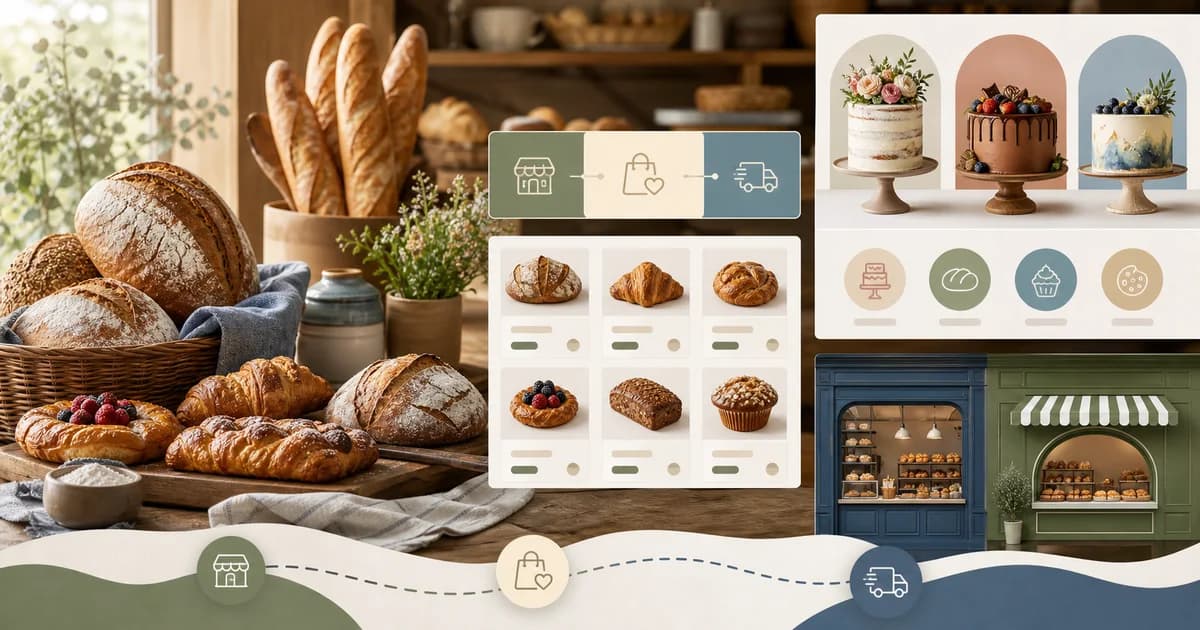
For bakeries, rank the starting candidates 1. Groxery by Polo Themes, the closest Polo fit; 2. Local on the official Shopify Theme Store; and 3. Combine on the official Theme Store. Groxery leads because its grocery-focused layouts are the direct Polo adjacency for food catalogs. Local is the strongest independent candidate when pickup and place-based selling matter, while Combine is the assortment and gift-box control. None provides kitchen capacity, lead-time calculation, pickup slots, delivery routing, date validation, personalization approval, allergen review, or food-safety management.
Keep the shortlist tied to the all-niche theme guide, use the grocery-store launch guide to test perishable and pickup operations, inspect the Shopify theme catalog for current bakery candidates, and consult the pricing page before allocating budget to scheduling or delivery integrations.
Which themes best match a bakery’s operating model?
Use Groxery as the everyday-food baseline, Local as the pickup and location challenger, and Combine for boxes, gifts, and add-ons. Polo Themes presents grocery-focused layouts in Groxery E-commerce Shopify Theme | Polo Themes, supporting the first hypothesis; actual capacity, cutoff, customization, and production records should determine each family’s winner.
1. Groxery — closest Polo food fit
Groxery takes first place as Polo’s grocery-focused presentation for replenishment-led food assortments. It is best tested first for everyday bread, cookies, pantry goods, and clearly bounded preorder items. The seed explicitly places delivery slots, cold-chain rules, and perishable inventory beyond the theme, so do not imply otherwise. Celebration work needs additional logic for date, location, size, design, message, and production capacity. If Groxery cannot prevent a shopper from customizing an impossible order, it should remain only the everyday-catalog option.
2. Local — pickup-oriented official alternative
Local ranks second because its official Theme Store listing includes in-store pickup, pre-order, delivery information, search, filtering, and food-and-drink positioning. Those surfaces make it a relevant bakery candidate, especially for one or more physical locations. They are presentation and commerce controls, not a bakery calendar. Preview the actual integration that owns slots, cutoffs, capacity, blackout dates, address eligibility, and mixed carts. A pickup label is useful only when it identifies the correct location and time in the order record.
3. Combine — celebration and assortment control
Combine is third because bakery carts often combine everyday goods, boxes, gifts, and add-ons. Test its official capabilities with fixed assortments and celebration orders, ensuring cross-selling does not introduce an ineligible product or change fulfillment. The page must enumerate box contents and distinguish optional candles, stands, toppers, notes, or packaging from included goods. Combine should move upward only when its staged experience preserves exact contents and constraints better than the other candidates.
What does a bakery storefront need to protect?
Protect fulfillment eligibility, kitchen capacity, product and portion identity, approved allergen communication, constrained personalization, and a legible production handoff. Shopify says product details influence storefront display and organization in Product details, supporting maintained production facts; a decorative request field still cannot approve capacity or availability.
- Fulfillment classification. Every item needs an explicit stocked, preorder, made-to-order, pickup-only, local-delivery, or shippable path tied to real operations.
- Capacity before customization. Date, location, route, cutoff, blackout, and quantity eligibility should be known before customers invest in flavor or inscription choices.
- Product and portion clarity. Size, count, approximate serving guidance where approved, included decorations, packaging, and optional add-ons must remain distinct.
- Allergen and ingredient communication. Use the bakery’s approved statements and contact path without allowing filters or badges to create guarantees the process cannot support.
- Production handoff. Exact product, size, flavor, count, message, date, time, location, notes, and approved exceptions must reach the kitchen legibly.
Make fulfillment eligibility and production handoff pass/fail gates. A theme that accepts an impossible date or drops an inscription should not launch regardless of its imagery. Score everyday and made-to-order families separately; a loaf should not inherit a cake calendar, and a cake should not inherit instant add-to-cart behavior. Include the actual slot, routing, and personalization integrations in the preview. Their behavior after theme updates matters more than whether the untouched demo shows a pickup label.
How should counter goods and celebration orders be tested?
Use a same-day item, fixed box, personalized cake, and location-limited product, then cross actual cutoffs and invalid dates. Shopify’s Variants describes how option values form purchasable versions. Require customer confirmation, capacity source, kitchen ticket, packing record, and support view to agree on the producible order.
Build a same-day loaf, a fixed six-item box, a cake with size and inscription choices, and a product sold only at one location on selected dates. Use one valid date-location pair and one deliberately invalid pair. The loaf should be purchasable without irrelevant customization. The box title, photograph, written list, selected variant, and packing record must agree. The cake must disclose lead time, approximate serving guidance if approved, fulfillment eligibility, customization limits, included decorations, and allergen communication before the final commitment.
Place boundary orders immediately before and after a cutoff. Combine pickup and shipping in one cart, exceed a quantity limit, enter an overlong inscription, remove a slot after it was viewed, and request a change after submission. A passing system blocks impossible combinations early and gives support and kitchen staff the same record the shopper confirmed. It never promises that a request is accepted merely because a text field captured it. Observe recovery copy when capacity is full and make the next permitted action explicit.
Which food and local rules must a bakery resolve?
For the United States, resolve production location, category, packaging, ingredients, allergens, quantity, claims, premises, pickup, and delivery for every kitchen. The U.S. Food and Drug Administration outlines federal allergen topics in Food Allergies; state and local health authorities govern additional operations, and other countries require named primary regulators.
United States: the FDA is a primary federal food regulator, while state and local health departments and other authorities commonly matter for bakery production, facilities, labeling, allergens, weights and measures, taxes, delivery, and local sales. The applicable mix depends on the food, packaging, claims, location, and operating model. Other countries and regions have their own food, allergen, distance-selling, and local-premises rules. Verify every market and kitchen location with qualified food-safety and legal professionals. This article provides no allergen-free, food-safety, delivery, legal, or compliance guarantee.
Which bakery failures should staging force?
Force impossible dates, mismatched box imagery, invalid inscriptions, overconfident allergen badges, mixed-fulfillment deadlocks, and capacity races. Shopify describes location and inventory conditions in Setting up pickup in store for online orders. Acceptance must also prove the connected availability source and kitchen record retain the exact product, customization, and exception status.
- Calendar theater: a date picker accepts a time the kitchen, location, product lead time, or route cannot honor.
- Image-content mismatch: styled photography shows decorations, stands, candles, or quantities that are not included.
- Inscription overflow: the form permits unsupported length, characters, placement, color, or late edits.
- Allergen certainty: a badge communicates absence or handling certainty beyond approved recipes and kitchen processes.
- Mixed-cart deadlock: pickup-only and shippable items reach checkout with no truthful resolution.
- Capacity race: a displayed slot remains selectable after capacity changes and no final validation occurs.
What evidence makes a bakery launch operationally credible?
Evidence should include boundary orders, constrained personalization, route validation, component reconciliation, accessible error recovery, and kitchen-readable tickets. Shopify explains address and location eligibility in Setting up local delivery for online orders; the bakery must still demonstrate that capacity, cutoffs, customer promises, and production instructions remain aligned under exceptions.
- Assign fulfillment paths. Record location, lead time, cutoff, date rules, capacity source, route, and exception owner for each product family.
- Constrain personalization. Validate size, flavor, design, inscription, characters, add-ons, and amendment rules against production capability.
- Place boundary orders. Test before and after cutoff, blackout dates, two locations, invalid routes, quantity limits, and mixed fulfillment.
- Trace the kitchen ticket. Compare confirmed order with exact product, count, size, flavor, message, timing, location, notes, and allergen communication.
- Reconcile box contents. Audit title, copy, media, substitutions, inventory components, cart, ticket, and packed result.
- Test accessible recovery. Verify errors identify the specific date, location, route, or customization problem and preserve valid work.
Key Takeaways
- Groxery suits everyday assortment, Local tests location-led ordering, and Combine tests celebration boxes and add-ons.
- Capacity, location, lead time, and route eligibility should be known before customers complete detailed customization.
- A successful storefront confirmation is insufficient unless the kitchen receives the exact producible order.
- Allergen language, substitutions, pickup promises, and delivery boundaries require approved operational sources beyond the theme.
Choose against the bakery’s real operating boundary
Create separate ranking decisions for counter stock, preorder goods, celebration work, local delivery, and shipped gifts. Groxery should lead everyday assortment only if it keeps stock and package choices clear. Local should lead location-based ordering only if the actual slot and inventory services survive cutoff and location changes. Combine should lead boxes and add-ons only if component availability, substitutions, and packing remain exact. This family-level record prevents a successful loaf purchase from being used as evidence that a customized cake or mixed-location basket is also safe to launch.
Jurisdiction review belongs to each kitchen, sales channel, destination, and product form. The responsible operators should establish the applicable production, labeling, allergen, quantity, tax, delivery, and premises rules before the storefront exposes that combination. A product that can be collected at one bakery may not share the same process when shipped or produced elsewhere. Test switching location after customization and changing destination after cart creation. The system must revalidate capacity and permitted fulfillment while preserving the customer’s work or clearly explaining which selections cannot carry forward.
Run an acceptance drill with a celebration order whose requested date loses capacity after selection. Add a fixed box containing a newly unavailable component and an everyday item assigned to another location. A passing implementation stops final confirmation until each conflict has an approved resolution, never treats a text note as operational acceptance, and produces a kitchen or packing record only for the final agreed state. Support should see both the customer request and the confirmed production details so staff do not reconstruct an inscription, substitution, or pickup promise from email fragments.
Repeat with keyboard navigation and a narrow screen, where calendars, long inscriptions, location selectors, and error summaries commonly compete for space. The customer must understand which choice failed, retain unrelated valid details, and reach the approved correction path. Verify the final kitchen ticket rather than stopping at a successful confirmation page. Ask kitchen staff to read the ticket without opening the storefront; location, due time, product, size, flavor, inscription, approved decoration, and exception status should not depend on memory or interpretation.
Conclusion
Start with Groxery for the closest Polo food structure, preview Local when pickup and physical locations dominate, and keep Combine as the assortment-and-gifting control. A bakery should re-rank by operational proof: can the theme and connected services reject impossible promises, preserve exact customization, and produce a usable kitchen record? The best theme is not the prettiest cake gallery. It is the storefront that protects customer time and production capacity while communicating food information honestly. Keep a dated acceptance order for each location and major product family so later calendar, menu, or integration changes can be compared with a known producible result.
Frequently asked questions
Does Groxery include bakery date slots?
No confirmed seed claim supports that. Date, capacity, pickup, and delivery logic require separately selected and validated operational tooling.
Is Local enough for multiple bakery locations?
Its listing makes it relevant to preview, but test the exact location, inventory, cutoff, pickup, routing, tax, and support behavior before deciding.
Where should allergen information appear?
Use approved product-level information before ordering, with a clear contact route and appropriately qualified wording. Do not let a filter or icon create an unsupported guarantee.
How should custom cake requests be confirmed?
The storefront should state whether entry is a firm order, a request, or subject to review. Operations must return an explicit status and retain the exact agreed details.