Shopify · August 23, 2026 · 7 min read
Single-Purpose vs Multipurpose Themes: Specialization or Breadth?
Choose a focused theme for niche customer decisions; choose a multipurpose theme when varied catalogs need its range and the team can govern it.
By Polo Themes

Verdict: select the theme whose defaults respect the customer decision
A single-purpose Shopify theme is preferable when customers repeatedly need a particular kind of information, comparison, or reassurance that should shape the default page hierarchy. A multipurpose theme is preferable when a merchant truly serves different product models and can define consistent rules across them. The wrong choice is often not a theme with too few features; it is a theme whose features encourage generic pages that hide the decision customers actually need to make. Specialization should mean a useful content and interaction model, not a few decorative images associated with an industry.
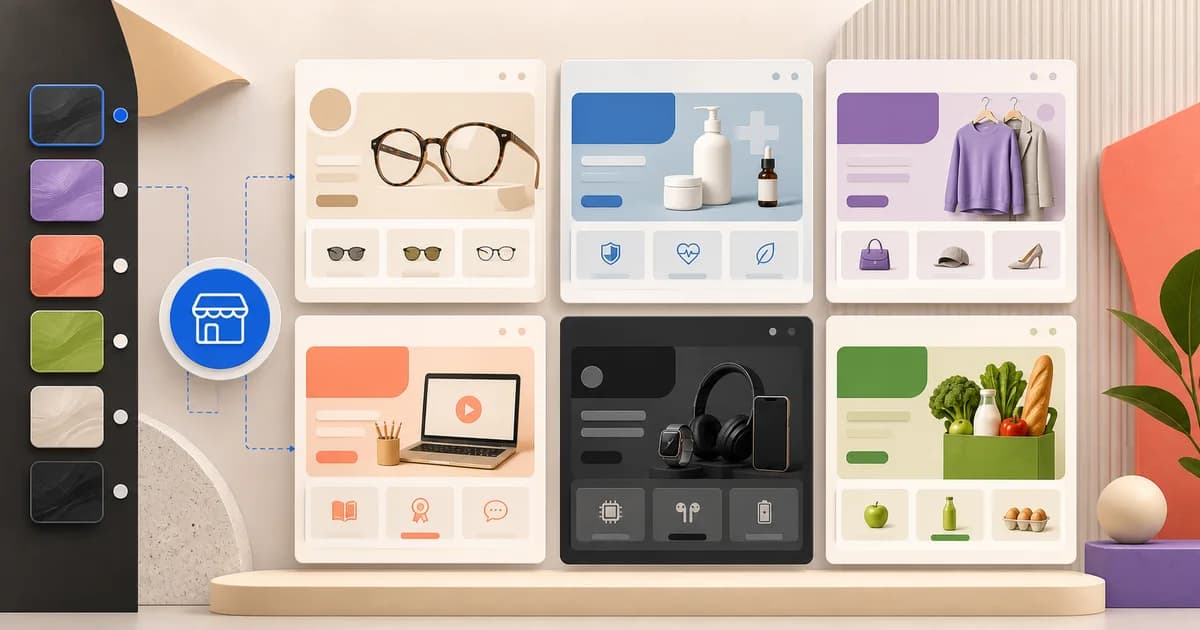
Start by studying the catalogue and support questions rather than the label on the demo. Eyewear may call for fit and lens information; medical goods may require careful specifications and intended-use language; fashion may need fit and care detail; courses may need curriculum and access terms; electronics may need compatibility; grocery may need availability, ingredients, and delivery conditions. Those examples are not an endorsement that any theme handles every requirement. They describe the decision evidence a theme must preserve. If the product data and customer journey are different, the closest-looking niche theme may be a poor operational fit.
Measure relevance against configuration burden
A focused theme should remove decisions that the merchant should not have to reinvent while leaving room for honest brand expression. Evaluate its templates, product blocks, collection patterns, navigation, search, and editor settings against actual category work. A credible specialized theme makes the important facts easier to place and harder to accidentally omit. It should not force false uniformity on products that differ in material ways. Check the smallest and largest product pages, a sparse collection, a promotion, an unavailable item, and the support path. If the theme needs repeated exceptions to show ordinary product facts, its specialization may be superficial.
A multipurpose theme creates a different responsibility: governance. Its large component set can support multiple brands, content types, or product families, but it also lets every campaign become a new pattern. Define a page taxonomy, an approved component set, and editorial rules before scaling it. Test whether an operator can tell which section belongs on which page without interpreting a long menu of possibilities. The most flexible theme can create the least coherent store when no one owns those choices. Do not treat unused options as harmless; they add training, review, and future-maintenance load.
Avoid a false choice between niche and adaptable
Many businesses have a core niche plus expansion categories. In that case, decide which customer journey is strategically primary and build the theme choice around it. A niche-oriented theme may serve adjacent products well if their information model is compatible; it may fail badly if the adjacent category requires different decisions. Conversely, a broad theme may be appropriate if the merchant can establish a small set of category-specific templates and no group overwhelms the others. The proof is a mixed-cart catalogue test, not a promise that one brand will eventually sell everything.
Review the performance and accessibility implications of breadth too. More sections and optional media can lead to heavy pages when teams copy demo composition without an editorial budget. More variants of a component can produce inconsistent headings, controls, and focus behavior. The answer is not automatically a simpler theme; it is a set of constraints that make the preferred theme predictable. Set content limits, define mandatory product information, and test the templates with keyboard and mobile use. A commercial theme is a foundation, not a substitute for release discipline.
Ownership and migration checklist
- Classify real products by the customer evidence they need, not only by marketing collection names.
- Give each required page a primary task and mark the sections that are allowed to support it.
- Configure candidate themes with contrasting categories, long content, incomplete data, and campaign states.
- Ask editors to create and correct pages without code, then document confusing settings or recurring exceptions.
- Assign an owner for template rules, product-data completeness, applications, accessibility review, and theme updates.
- Keep the current theme recoverable while the new configuration is tested, published, monitored, and reconciled.
When changing themes, inventory not just pages but decisions: filters, metafields, recommendation logic, campaign URLs, analytics, consent, application embeds, and the unanswered support questions the store has normalized. Map each decision to an explicit owner and replacement behavior. Confirm that redirects and structured metadata remain correct if templates or paths change. Roll back to the prior theme if a critical customer or operator path does not hold up, then fix the evidence gap instead of applying an unreviewed production patch.
Compare category depth with portfolio breadth
Build two candidate stores from the same deliberately uneven catalogue. Give the focused theme its core category plus one adjacent category; give the multipurpose theme the same products but restrict it to a documented subset of templates and sections. Ask customers to locate the facts needed to distinguish two similar products, then ask editors to add a product whose information model does not fit the default. The focused candidate succeeds when its defaults make the core decision clearer without concealing adjacent-product facts. The broad candidate succeeds when its governed templates accommodate both categories without turning each page into a unique composition.
Use an exception ledger during the trial. For every workaround, record whether it changes product data, template structure, copy guidance, an application, or code. A small number of explicit category templates may be healthy breadth; recurring one-off sections suggest the theme is not modelling the catalogue. For the niche candidate, repeated omissions in the adjacent category reveal the opposite limit. Review the ledger with merchandising and support, then choose the constraint the team is actually prepared to govern.
Action plan for the next category decision
- Write the mandatory decision facts for the core and adjacent categories before opening theme demos.
- Configure both candidates with the same mixed catalogue and intentionally incomplete product records.
- Run customer-findability and editor-correction tasks, recording each exception by data, content, configuration, app, or code.
- Choose the focused route only if adjacent products remain honest; choose the broad route only if approved template rules remain understandable.
- Publish the selected category taxonomy, mandatory fields, permitted sections, and exception owner alongside editor training.
- Repeat the trial when a category introduces a genuinely new decision model instead of copying the nearest existing template.
Where Polo Themes fits
Polo Themes positions its Shopify products around particular store types, with Figma kits and bundles available as separate design or paired assets in the live catalogue. Use a Polo theme as a direct candidate only when the product type and its stated niche match the actual customer decision model. For an adjacent category, it is a closest fit: list the necessary template, data, and content changes before deciding. A Figma kit can help a team explore a page system; it is not a production Shopify theme. A bundle pairs assets but does not turn an adjacent niche into a verified fit.
FAQ: Is a niche theme always better for SEO?
No. A niche label does not establish search performance. Search visibility depends on many factors including useful content, technical implementation, information architecture, and the competitive query. Choose the theme for the quality and maintainability of the shopping experience, then validate the technical and content work separately.
FAQ: Can a multipurpose theme be made focused?
Often, yes. Limit the approved sections, build a small template taxonomy, provide content guidance, and review deviations. The work is governance. If the team cannot sustain that governance, the apparent flexibility may become an operating cost rather than an advantage.
FAQ: What makes a product an adjacent rather than direct fit?
It is adjacent when the visual category is similar but the customer must evaluate different facts, policies, or workflows. Document those differences and prototype the hardest page. Do not infer support from similar colors, imagery, or a broad marketing label.
Final selection check
Make the final choice with people who own the catalogue, content, support, and storefront implementation in the room. Ask each person to identify the page they expect to change under pressure and show how the candidate handles it. A focused theme is winning if it makes the important customer facts routine; a broader theme is winning if its breadth can be governed without hiding those facts. Record the categories the decision excludes and the condition that would require a different theme. This turns future expansion into a planned review rather than an implicit promise that the current theme can serve every imaginable product.
Use customer-facing evidence after launch too. Review search terms, support contacts, return reasons, and editorial correction requests for signs that the theme is obscuring a decision. These signals cannot prove that one theme caused an outcome, but they can identify where the page model needs investigation. Keep the recommendation conditional on that evidence.
When a new category arrives, repeat the category test before copying an existing template. Its visual similarity is irrelevant if it needs different specifications, delivery expectations, or post-purchase support. This discipline lets a focused theme remain focused and tells a broad theme team when controlled expansion is justified.