Shopify · August 23, 2026 · 7 min read
Free vs Premium Shopify Themes: Pay for Proven Fit, Not a Badge
Start free when it proves the customer journey; pay for a premium Shopify theme when tested fit removes meaningful delivery and ownership work.
By Polo Themes
Verdict: begin with the smallest theme that proves the store
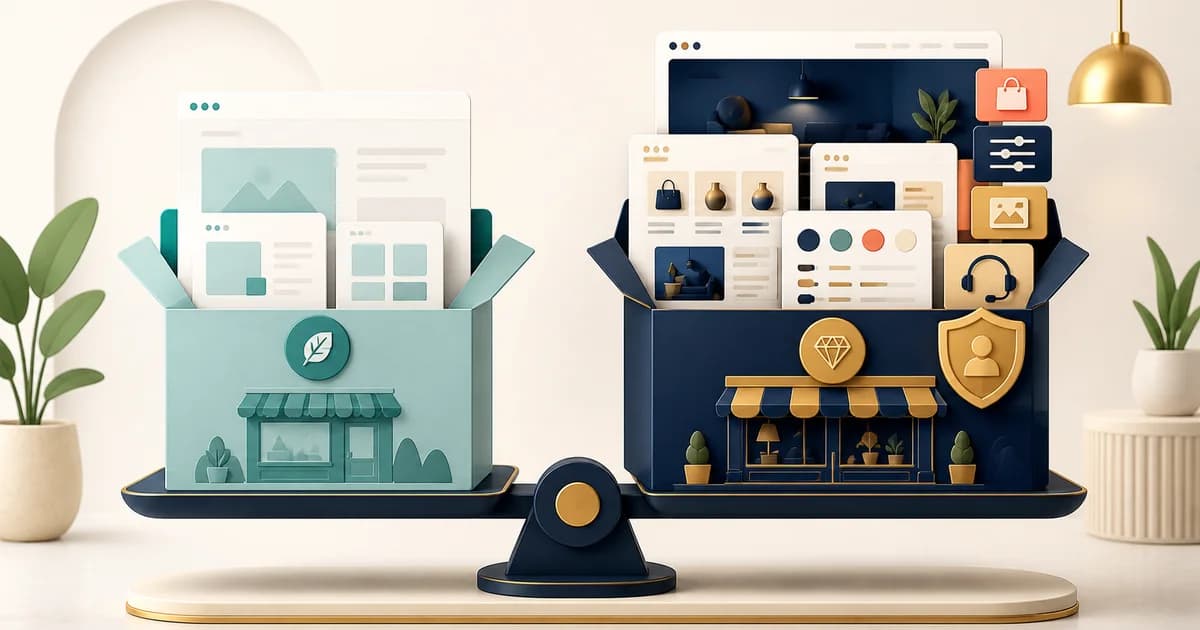
Free versus premium is not a quality contest and it is not a shortcut to a conversion claim. Start with a free Shopify theme when it can express the real shopping journey with honest product information, manageable merchandising, and a workflow the store team can repeat. Buy a premium theme when a named theme has been tested against the same journey and its section model, niche-oriented presentation, documentation, and update path eliminate work that the team would otherwise build and maintain. The important word is tested. A polished demo is evidence of a demo, not evidence that the theme fits a long catalogue, a complicated product, a particular app, or the people who will edit it after launch.
Shopify itself distinguishes free themes made by Shopify from paid third-party themes in the Theme Store. It also notes that a theme architecture and its developer determine the features and customizations available. That is a useful baseline: compare the exact candidate, its architecture, its version, and the support boundary rather than treating either price category as a feature list. A no-cost theme can be the more responsible choice when it creates fewer exceptions. A paid theme can be the less expensive ownership decision when it replaces a pile of fragile custom work. Current prices, licensing terms, support commitments, and availability change, so obtain those facts from the seller and Shopify before approval rather than copying a number from this article.
Evaluate the work, not the screenshot
Make the comparison with production-like content. Add a representative product with the longest title, the least flattering image, real variants, incomplete optional fields, and the policy language a customer actually needs. Create a collection that needs filters or different product-card treatment. Build the landing page that marketing changes most often. Then ask an operator who did not configure the theme to make a seasonal update without changing code. This exercise shows whether a setting is understandable, whether the structure preserves the required hierarchy, and whether the candidate creates hidden dependencies on one developer or agency. It also makes apparent when the premium candidate merely offers more controls rather than the controls the store needs.
Use a weighted scorecard before opening the demos. Useful criteria are: whether templates cover the catalogue and content model; whether sections solve a recurring merchandising job; how an app integrates; what requires custom Liquid, CSS, or JavaScript; how easy it is to retain a clear mobile hierarchy; how the editor handles genuine content; whether the theme can be upgraded; and which party supports a problem. Record the evidence next to every score. “The demo looks like our brand” is an observation, not a requirement. “A content editor can publish a collection page with the required information, review it, and reverse it” is a requirement that can be demonstrated.
Where each option usually fits
A free theme is often the better choice for a new offer, a small catalogue, a conventional shopping path, or a team that needs to learn the operating model before investing in aesthetic differentiation. Its restraint can be an advantage: fewer optional patterns make it easier to form editorial rules and easier to see what is genuinely missing. It is also useful as a control in a premium-theme evaluation. If the paid alternative cannot show a material improvement on the same product page, collection, navigation task, and editor workflow, it may be a styling preference rather than a business case.
A premium theme is justified when the store has a specific recurring need that a candidate handles with less bespoke effort. For example, a niche may need a product-information hierarchy, a way to guide comparison, or a composition that keeps a complex assortment legible. That does not make a theme universally appropriate for that niche. Check every product type, app dependency, locale, content workflow, and exception. Treat the theme as an implementation asset with a boundary, not a promise that the store will be faster, more accessible, or more profitable. The merchant still owns product accuracy, content quality, accessibility of modifications, app selection, analytics, and the decision to publish.
The ownership cost is larger than the license
Count implementation, content migration, image production, app work, quality assurance, accessibility review, ongoing editing, update testing, and incident response. Separate a predictable purchase from open-ended customization. A cheap theme becomes expensive when each new campaign requires developer intervention; a paid theme becomes expensive when its demo assumptions force the team to fight the editor or fork its code. Include the time needed to understand the seller’s documentation and update process. A theme that has an available update is not automatically safe to update: changes should be reviewed in a duplicate theme with the store’s applications, settings, and content.
Accessibility belongs in the total cost too. Check keyboard navigation, visible focus, headings, form errors, image alternatives, contrast after brand changes, reduced-motion behavior, and reading order with ordinary store content. Shopify’s theme documentation includes accessibility among its best-practice areas, but a theme cannot make later content and customization decisions accessible by itself. Assign a named owner for checks before a campaign is published. That turns accessibility from a marketing adjective into a release practice.
A low-risk selection and migration path
- Duplicate the live theme and keep the published version available as a rollback target.
- Inventory templates, custom code, app embeds, tracking, content sources, navigation, redirects, and operator-only workarounds.
- Configure the free and premium candidates with the same representative content instead of comparing empty demos.
- Test discovery, product selection, cart, checkout handoff, search, account or support paths, and the editing flow with accountable owners.
- Review accessibility and performance with the intended apps enabled, then document remaining exceptions and their owners.
- Publish only after the rollback path, monitoring plan, and post-launch reconciliation are understood.
This is a theme migration even when the platform stays Shopify. Preserve URLs and metadata, verify analytics and consent behavior, and rehearse customer-facing changes. Keep a record of which settings were manually recreated and which old customizations were deliberately retired. The most valuable migration artifact is not a screenshot; it is a short decision record explaining the selected theme’s supported responsibilities, the custom code that remains, who owns it, and what event should trigger a re-evaluation.
Compare the same merchandising week, not two ideal demos
Give both candidates the same seven-day operating scenario. On the first day, publish a new product whose photography is incomplete. On the second, add a collection promotion without changing product data. Later, correct a policy sentence, feature an unavailable variant without misleading customers, and remove the campaign cleanly. Record which changes use native settings, which require an app, which require code, and which cannot be expressed safely. This comparison exposes a distinction that price categories conceal: the free theme may provide a smaller but coherent operating surface, while the premium theme may provide a broader surface whose extra options demand more review. The better candidate is the one that handles the store’s recurring work with fewer undocumented exceptions.
Also compare the recovery path. Duplicate each configured theme, deliberately introduce a harmless layout mistake, and ask a second operator to find and reverse it from the available history and documentation. A theme is not operationally friendly merely because the initial designer can configure it. Recovery shows whether naming, settings, vendor guidance, and local records are intelligible after context has been lost. Note any feature that depends on demo content, a particular app, or custom code, because that dependency belongs in the ownership decision.
A two-stage action plan for the purchase decision
- Stage one: configure the strongest free candidate as a control with representative products, collections, policies, navigation, and applications.
- List only the customer or operator tasks that the control cannot perform acceptably; avoid turning visual preferences into missing requirements.
- Stage two: trial one named premium candidate against those gaps and the identical weekly-change scenario.
- Document the exact section, setting, app, or code path that resolves each gap, including who maintains it and how it is reversed.
- Approve the paid candidate only when its demonstrated advantages outweigh the added training, update, and testing surface.
- Keep the control scorecard and decision date so a later theme change can be compared with the same evidence instead of a new demo.
Where Polo Themes fits
Polo Themes sells Shopify themes, Figma design kits, and bundles that pair a Shopify theme with a Figma asset. Those are direct candidates only for a Shopify storefront and only when the product’s stated niche and the actual catalogue match. A Polo Figma kit is a design source, not a Shopify theme installation, and a bundle does not remove configuration, app integration, content, testing, or release ownership. For an adjacent niche, call it a closest fit, identify the adaptations required, and prove them with real content before purchase. The live Polo catalogue is the authority for current products and terms; this article deliberately makes no price, number-of-products, compatibility, or performance promise.
FAQ: Are free Shopify themes only for early-stage stores?
No. A free theme can remain the right long-term choice when it continues to meet the store’s product, content, editing, and maintenance needs with fewer exceptions. The decision should be revisited when a weighted requirement changes, not when a team feels it has “outgrown” a price category.
FAQ: Does a premium theme include every app integration?
Do not assume that. Test the exact app, placement, editor controls, styling, loading behavior, and failure state in a duplicate theme. Shopify’s architecture can support app blocks and embeds, but compatibility and presentation remain specific to the theme and application.
FAQ: Can a theme purchase replace a designer or developer?
It can reduce the amount of design or engineering work, but it does not replace judgment. Someone must decide information hierarchy, create accurate content, govern brand changes, verify accessibility, test updates, and own the live store. Bring in specialist help when those decisions are high-risk or cannot be made maintainably with the team available.