Shopify · August 23, 2026 · 7 min read
Buy a Shopify Theme vs Build a Store From Scratch
Buy a theme for a proven commerce baseline; build from scratch only when validated differentiation justifies long-term engineering ownership.
By Polo Themes
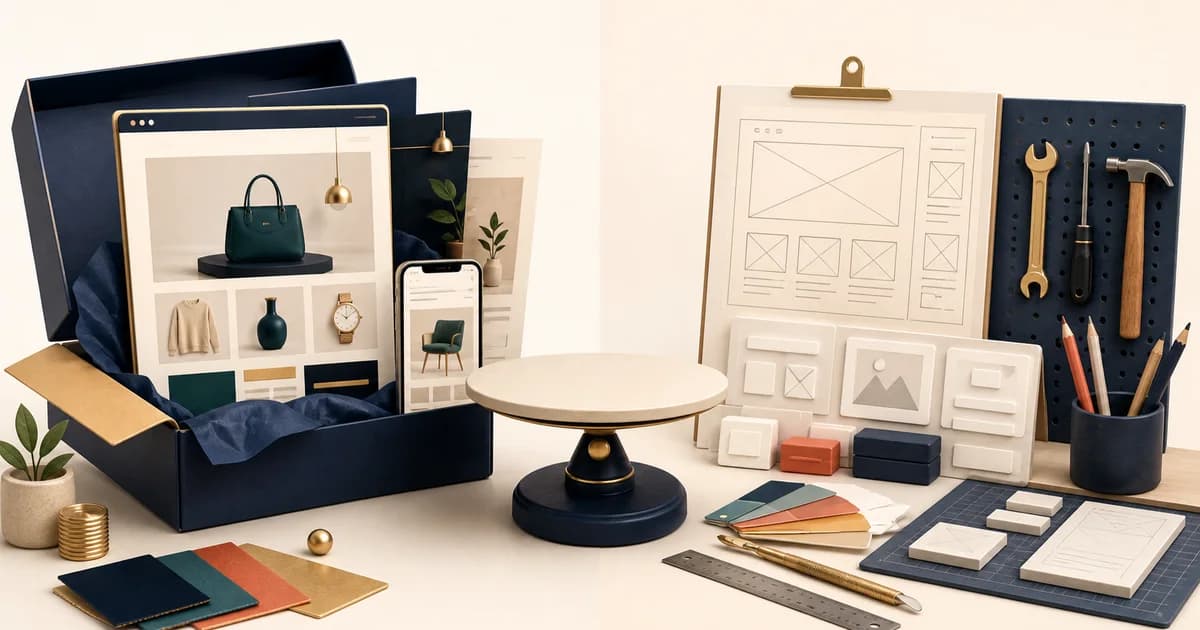
Verdict: purchase the conventional path and build only the proven exception
Buying a Shopify theme is the sensible route when the store needs dependable product, collection, content, navigation, cart, and editor patterns now. Building a storefront from scratch is justified only when a documented customer or operating requirement cannot be met maintainably by configuring and extending a theme, and when the business can fund the resulting software ownership. “From scratch” is not a higher tier of branding. It replaces an existing foundation with a program of design, implementation, quality assurance, release engineering, and maintenance. Choose it because a validated difference requires it, not because blank files feel more creative.
Shopify’s theme stack is itself a development system: Liquid, HTML, CSS, JavaScript, JSON templates, sections, blocks, settings, and platform tooling. A purchased theme packages decisions inside that system. It gives a team a visible starting point and a bounded configuration model. That model can be restrictive, which is sometimes useful: it makes a merchant decide which customer information is essential instead of commissioning every possible interaction. The question is whether those boundaries preserve the store’s distinctive value. If they do, a theme concentrates effort where it matters—catalogue truth, imagery, copy, service, and learning from customers.
Make the case with a difficult customer task
Write down the task claimed to require a custom build. It should identify the customer, the decision, the data needed, the expected action, and how success or failure will be observed. Build the narrowest possible prototype, then put real data and people through it. Test an alternative with a candidate theme as well. If both reach the result, prefer the path with clearer ownership. If the theme version needs a few targeted extensions, price their maintenance honestly before declaring the custom program necessary. If it breaks the core task or makes editing dangerously obscure, preserve that evidence for a build decision.
A useful comparison separates parity from differentiation. Parity includes the existing store’s critical pages, integrations, compliance or policy content, analytics, support routes, and operational edits. Differentiation is the new behavior that makes the custom investment worthwhile. Teams often underestimate parity because it is invisible in a design concept: redirects, tracking, application configuration, search states, product availability, translation, accessibility semantics, failure messages, and on-call handoff all exist in production. A from-scratch roadmap that lists only the hero interaction is not a store build plan.
Compare the full ownership model
A purchased theme needs a merchant who owns content, settings, applications, update review, and the decision to customize. A custom storefront needs those people plus durable source control, a release process, test coverage proportionate to risk, operational access, documentation, and engineering succession. Budget for discovery, design, implementation, browser and device testing, accessibility validation, performance monitoring, security maintenance, integration changes, and support. Include the time it takes a new teammate to safely modify a promotion or diagnose a broken customer path. If the business cannot name those owners, it has not chosen custom; it has deferred responsibility.
Do not reduce the comparison to a one-time theme fee versus an agency estimate. Both paths incur content and testing costs. Both can fail when applications are added without governance. Both need a rollback plan. The relevant economic question is which arrangement delivers the evidence the business needs with a cost shape it can sustain. Current vendor prices, plans, and terms should be confirmed directly with the sellers. They are intentionally absent here because they change and because a price alone cannot account for future change work.
Build an exit-aware delivery plan
- Inventory the live storefront, data sources, applications, URLs, events, consent flows, and manual operating procedures.
- Define customer-facing parity, the differentiated behavior, measurable acceptance evidence, and what will be deliberately retired.
- Prototype the highest-risk custom task and configure a theme alternative with the same representative content.
- Name design, engineering, content, analytics, accessibility, release, and incident owners before implementation expands.
- Build in a reversible environment, test normal and failure paths, and rehearse the exact rollback action.
- Launch incrementally where possible, monitor production behavior, reconcile critical events, and revisit the original business case.
Do not let a Figma file become the specification by default. It can convey layout intent, but it does not establish semantic structure, responsive rules, content states, data contracts, or production behavior. Capture those decisions in tickets, acceptance criteria, and implementation documentation. Treat performance and accessibility as paths that must be demonstrated with the assembled storefront, not as attributes inherited from a design. A small, conventional theme implementation can be more respectful of customers than an unfinished custom interaction.
Compare the routes through a change budget, not a launch budget
Give each route the same sequence of likely changes after launch: introduce a product attribute, alter a collection rule, add a content-led landing page, replace an application, correct an analytics event, and support a longer locale. For the purchased theme, identify which changes are settings, content, app configuration, bounded extensions, or structural overrides. For the custom build, identify which changes require product clarification, design, data work, implementation, tests, deployment, and operational follow-up. This exercise does not need speculative money or velocity figures. It needs accountable steps, dependencies, and evidence of who can perform them.
The theme path wins when ordinary evolution remains inside a legible operating model and the accepted constraints do not harm the store’s important decisions. The build path wins when the differentiated model makes those changes more coherent than repeated adaptation would, and the team can maintain its delivery system. Pay particular attention to application replacement and data evolution. A custom surface may be visually independent yet tightly coupled to private assumptions; a theme may look conventional yet keep platform and app boundaries easier to replace. Document those couplings before treating either path as flexible.
Action plan: use three gates before building from scratch
- Gate one, customer proof: demonstrate the hard task with real product data and show why a configured theme or bounded extension fails it.
- Gate two, operational proof: name the content, data, application, accessibility, release, monitoring, incident, and succession owners for the proposed build.
- Gate three, exit proof: define recoverable releases, data portability, replacement boundaries, and what happens if the original supplier or team leaves.
- Build parity for one complete customer journey before expanding the custom component catalogue or visual system.
- Run the same post-launch change scenario against the theme alternative and the custom increment, recording dependencies rather than guessed savings.
- Approve further custom scope only when the differentiated behavior remains valuable in use and the ownership evidence remains current.
If a gate fails, the decision is not permanently closed. Use the best-fitting theme, isolate the unmet requirement, and collect better evidence. A later custom increment can replace a bounded responsibility without discarding every conventional storefront pattern at once. Likewise, a custom program can deliberately use platform-native theme concepts where invention has no customer value. Treat “buy” and “build” as architecture boundaries that can be reviewed, not identities the team must defend. Attach a review date and evidence owner to every deferred custom requirement so it does not return later as an unsupported assumption.
Where Polo Themes fits
Polo Themes sells Shopify themes for the buy-and-configure path, Figma kits for design exploration, and bundles that pair a Shopify theme with a Figma asset. A theme is not a bespoke build, and a bundle does not eliminate the merchant’s responsibility for configuration, content, applications, tests, and publishing. If a Polo product is a direct niche match, evaluate it with the store’s real tasks. If it is only the closest fit, identify what must be adapted and whether that adaptation is still less risky than custom work. Consult the live catalogue for current product availability and terms.
FAQ: Is adding one custom section the same as building from scratch?
No. A bounded, documented extension can retain a theme foundation and be a sensible compromise. It becomes a warning sign when extensions repeatedly override the same architecture, depend on undocumented behavior, or make safe theme updates impossible.
FAQ: Can a theme support a differentiated brand?
Yes. Brand distinction is often created through the product offer, information hierarchy, language, imagery, service, and a focused visual system. Use custom code when it is required to improve a verified customer or operator task, not simply to demonstrate that code was written.
FAQ: What should trigger a re-evaluation after launch?
Revisit the choice when a materially new catalogue, market, integration, accessibility obligation, or customer workflow changes a weighted requirement. Reassess using production evidence rather than assumptions from the original project.
Final decision rule
The purchase-versus-build decision should reduce a known risk, not create a prestige project. Choose the theme route when it gives customers and operators a tested baseline with manageable exceptions. Choose the custom route when the team can point to a prototype-backed requirement, a funded ownership model, and an exit-aware delivery plan. Keep the alternative visible in the decision record: note the theme limitations accepted or the custom capabilities that justify future maintenance. That record is especially important when staff or agencies change, because it makes the architecture a conscious business choice instead of inherited code.
Do a post-launch comparison against the original acceptance evidence. If a custom feature does not improve the intended task, simplify it before funding more surface area. If a theme limitation blocks a demonstrated customer need, document that limitation and prioritize the smallest maintainable extension. This is how the choice remains evidence-led.
Keep the delivery scope narrow enough to learn. A custom storefront can grow in stages, and a purchased theme can be improved through accountable extensions. In either direction, require each increment to preserve checkout, product data, support, and release evidence. The work becomes safer when a team can stop after a useful improvement. Give every increment a named owner and rollback condition.