Business · August 23, 2026 · 7 min read
Shopify vs BigCommerce
Choose Shopify or BigCommerce by proving catalog, checkout, integration, channel, and operating requirements—not by labels.
By Polo Themes
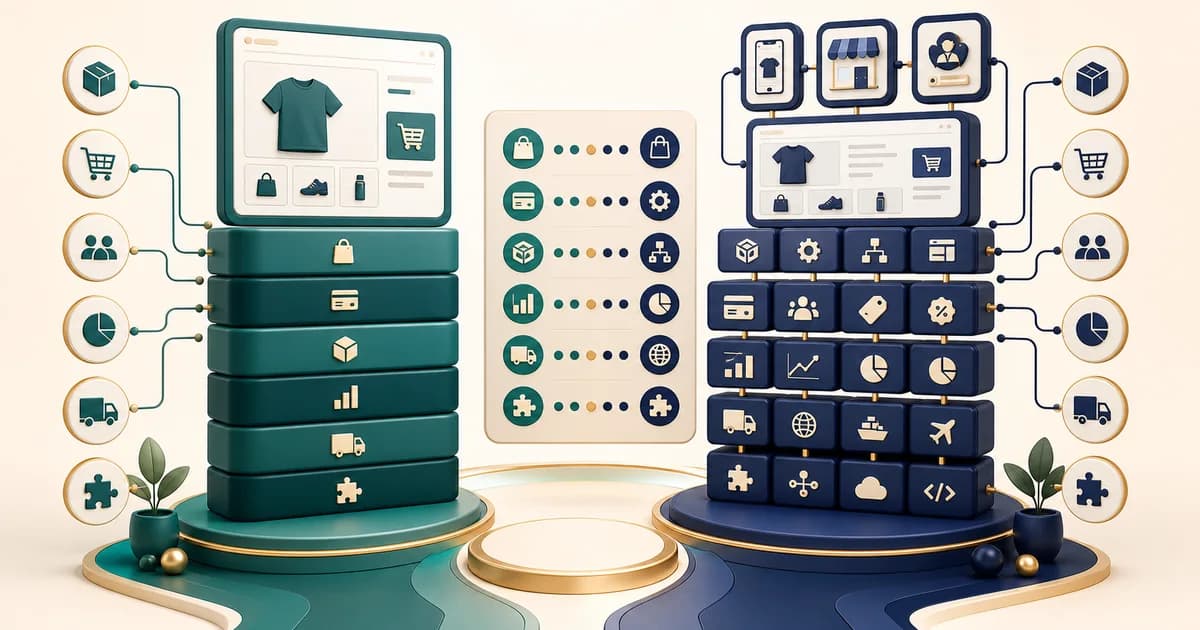
Verdict: do not choose Shopify or BigCommerce because one has a stronger “enterprise” reputation. Choose the platform that proves it can support your catalog, storefront, checkout, channel, integration, and operator requirements with fewer critical workarounds and a lower fully loaded risk. Shopify is often attractive where its ecosystem, commerce admin, implementation talent, and a suitable theme reduce delivery risk. BigCommerce is attractive where its documented catalog, storefront, channel, or API model better fits the weighted requirements. The evidence should decide.
This comparison is most useful for teams beyond the first-store question. They may have complex options, multiple brands or regions, wholesale and direct customers, an ERP, a PIM, or a separate front-end team. At that point, demos can be misleading because every capability looks available in isolation. The selection problem is integration: can the customer receive accurate information, can an operator change the record safely, can an engineer evolve the system, and can finance and support reconcile what happened? Start with those joined-up journeys.
Define “enterprise” as requirements, not scale theatre
A large order volume alone does not prescribe a platform. Neither does a small team disqualify a business from needing strong governance. Write the requirements in observable language: “Merchandising can launch a new regional catalog using approved data and a review workflow”; “a buyer sees only eligible pricing after the account rule is confirmed”; “the warehouse receives an order state it can act on”; “a checkout change is tested and recoverable.” These statements reveal implementation and operational effort that plan grids hide.
BigCommerce’s primary developer documentation exposes separate areas for catalog, store operations, storefront, APIs, and integrations. That is a reminder to test the platform at the boundary where your system of record meets the storefront, rather than assuming a product screen proves data architecture. Shopify’s documentation similarly separates the Online Store and its theme structure from other commerce functions. A platform can be excellent while still requiring carefully designed data ownership and integration contracts.
Prove the highest-risk paths first
Build a small but representative proof in each finalist. Use a product family with the most demanding options, media, merchandising logic, pricing rule, customer eligibility, inventory condition, and SEO requirement. Feed it from the intended upstream system, publish it through the intended storefront path, and observe a downstream fulfillment and accounting event. Then alter the record: retire a variant, correct an attribute, change availability, or process a return. A proof that only creates products by hand does not test the architecture that will matter in production.
Include human operations. Have the merchant change copy, the support team find a customer order, the finance user reconcile a charge, and an engineer deploy a safe storefront change. Measure not just elapsed time but unclear ownership, out-of-band spreadsheets, privileged access, and recovery steps. A platform selection should reduce “only one person knows how” dependencies. If a vendor demonstration cannot show a route, mark it unproven rather than filling the gap with an assumption.
Score the decision through these lenses
- Product data: Represent variants, attributes, bundles, media, availability, and relationships as the business actually uses them; identify the authoritative system for every field.
- Storefront and design: Test performance, accessibility, content publishing, personalization requirements, search, and the developer workflow under the selected architecture.
- Checkout and buyer rules: Validate region, tax, payment, account, contract, B2B, promotion, and post-purchase needs with vendor documentation and a functioning test environment.
- Channels and integrations: Trace failures, retries, data latency, audit needs, and ownership for ERP, PIM, OMS, CRM, marketing, analytics, and fulfillment connections.
- Governance: Confirm staff roles, approval workflows, secrets and access, release process, logging, incident response, and documentation—not just API availability.
- Vendor and partner fit: Assess support terms, roadmap conversations, implementation capability, and the availability of people who can responsibly operate the chosen stack.
Total cost needs a risk-adjusted model
Request a dated commercial proposal from each vendor and use it as an input, not the whole answer. Then model implementation, integration build and maintenance, theme or storefront work, tests, data cleansing, PIM or middleware, application licences, observability, security reviews, training, partner support, accessibility, content operations, and internal staff time. Include a realistic allowance for changes that fail or take longer than expected. These are not penalties added to make a spreadsheet scary; they are the costs of delivering the promised experience.
Model the cost of a different future too. If the organization opens a new market, acquires a brand, adds a channel, changes an ERP, or adopts a different storefront, which components move and which must be rewritten? Avoid invented percentages or promises of “unlimited scalability.” A useful model states assumptions, ranges, confidence, and the business events that would make the conclusion change. Revisit it when contracts, product architecture, or team capacity changes.
Choose where commerce authority lives
For a connected business, the decisive question is often not which platform can store a field, but which system is authoritative when records disagree. Create a field-level ownership map for identifiers, descriptions, options, prices, customer eligibility, inventory, fulfillment status, tax evidence, and refunds. Then mark which Shopify or BigCommerce interface may change each field, which integration propagates it, and how an operator recognizes stale data. A platform proof that accepts a clean import but cannot explain a later correction has not proved the operating model.
Run a conflict exercise. Change a product upstream while a merchandiser edits storefront copy; reserve the last unit through another channel; cancel an order after fulfillment has received it; and retry a failed outbound event. The goal is not to manufacture chaos but to expose precedence, idempotency, reconciliation, and human escalation. Score Shopify and BigCommerce on how clearly the chosen architecture supports those rules. Do not award points for an API endpoint without the monitoring and ownership that turn it into a dependable business process.
Match storefront architecture to team boundaries
Evaluate a platform-managed theme path and any separately built storefront as different operating proposals. A composable front end can give a dedicated product team control over presentation and release cadence, but it also creates contracts for content preview, search, cart state, identity, checkout transition, accessibility, observability, and incident response. A theme-led path may keep more work inside the commerce administration model, but only if it can express the required experience cleanly. Ask who deploys each surface at night, who can roll it back, and how support distinguishes a storefront failure from a commerce-service failure.
Polo Themes and the storefront decision
Polo Themes Shopify themes are direct Shopify assets and can lower time-to-proof for a Shopify storefront where the direct niche fit is strong. They are not generic headless front ends, BigCommerce themes, or evidence that a complex commerce architecture should be forced onto Shopify. Use a Polo Shopify theme to validate navigation, product detail, merchandising, and responsive content with the actual catalog; investigate specialized requirements separately and retain a versioned rollback path.
If BigCommerce wins, a Polo Figma UI kit is a closest-fit design reference only. It can help a design team articulate components and states, but it must be implemented, integrated, and tested in the BigCommerce storefront architecture. Polo does not offer a direct BigCommerce theme. That distinction belongs in the budget, statement of work, and acceptance criteria.
Migration: preserve the record and the operating contract
Begin with a canonical data map. Identify products, variants, categories, attributes, prices, media, customer accounts, company or B2B records, orders, returns, promotions, tax, inventory, shipping, subscriptions, gift cards, content, redirects, permissions, integrations, and reports. For every object, state source, destination, identifier, transformation, validation rule, owner, and retention requirement. Do not allow a middleware mapping to become the only documentation of business meaning.
Migrate in rehearsed waves. Reconcile key counts and financial totals, verify a selection of records line by line, crawl critical URLs, test order-to-fulfillment-to-refund paths, and run a disaster scenario such as an integration backlog or a duplicate event. Decide whether a period of dual operation is required and what system is authoritative during it. At cutover, freeze only the changes that need freezing, have named decision makers available, retain backups and rollback instructions, and monitor customer impact as closely as technical health.
Conclusion
Shopify versus BigCommerce is a fit decision, not a popularity contest. Pick the option that meets the difficult requirements in a representative proof, has accountable owners for the operational edges, and offers an acceptable total cost and exit path. A theme, API, or sales demonstration can support that conclusion, but cannot substitute for it. The most durable platform decision is one the merchandising, engineering, finance, support, and fulfillment teams can all explain and operate.
Frequently asked questions
Should we run an RFP before a proof of concept?
For a substantial procurement, an RFP can clarify commercial and governance requirements. It should not replace a proof. Ask finalists to demonstrate the same high-risk workflow using documented assumptions, then verify the evidence with your own operators.
Does an API-first requirement automatically favor one platform?
No. “API-first” must be unpacked into objects, events, authentication, limits, errors, observability, partner tooling, and the team’s implementation capacity. Use the official developer documentation and a working prototype to judge the exact integration.
Can a premium Shopify theme replace a custom enterprise storefront?
Sometimes a theme is an excellent direct storefront foundation, but it cannot prove every architecture, checkout, data, or channel requirement. Validate the theme at the presentation layer and make a separate evidence-backed decision about custom work.