Guides · August 23, 2026 · 8 min read
Marketing an Online Grocery Store
Attract the right grocery missions, coordinate demand with inventory and delivery capacity, and earn repeat orders through reliable service.
By Polo Themes
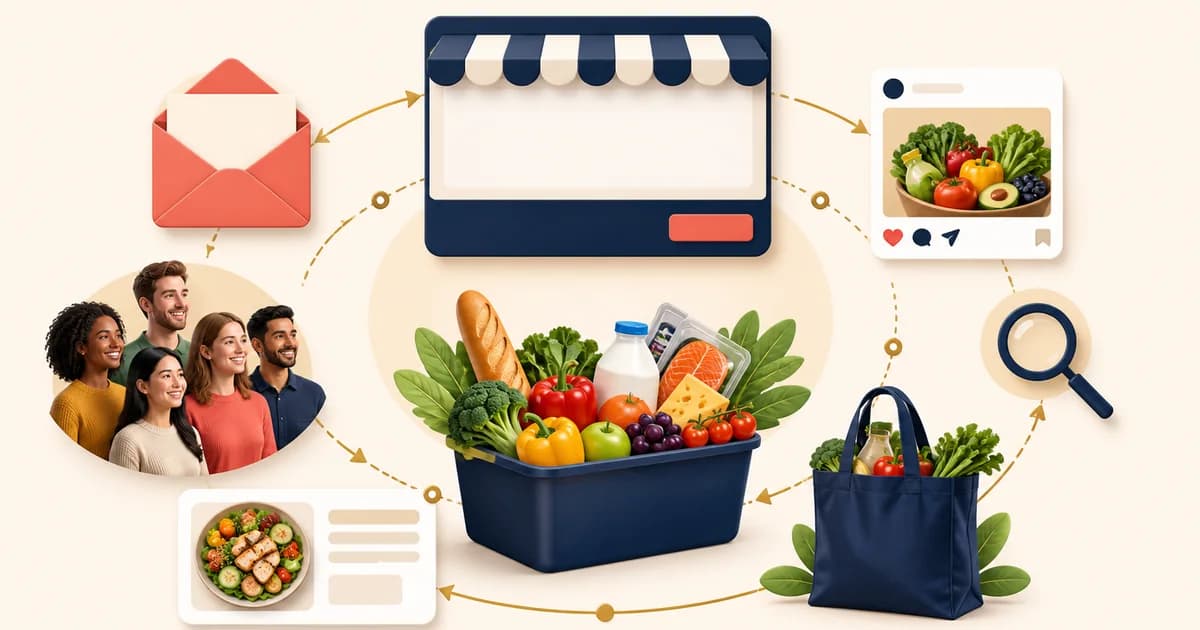
The short answer: market an online grocery store around a useful recurring job and a service level you can sustain. A grocery customer is not merely buying an item; they are completing a weekly shop, solving dinner, replenishing a staple, finding an ingredient for a dietary need, or organizing an event. The most durable marketing makes that job easier, sends people to an accurate local assortment, and coordinates demand with stock and delivery capacity. Promotion that outruns fulfillment may create first orders while damaging the habit that produces repeat business.
Choose a mission before choosing a channel
Segment the work by customer mission rather than by a vague demographic label. A weekly household basket, quick dinner, office pantry, specialty diet, seasonal celebration, and pantry refill have different content, order size, timing, and support needs. Describe the mission in the customer’s language, the products that solve it, the service area, and the operational constraint. This gives every campaign a testable promise instead of an interchangeable “save time and money” headline.
Do not invent urgency or imply that a promotion is universally available. Delivery areas, assortment, minimums, time slots, and product eligibility may vary. The landing page, ad, email, product page, basket, and confirmation should agree on the conditions. If an offer has limits, state them where a reasonable customer would need them to make a decision. FTC advertising guidance provides a primary U.S. reference for truthful marketing principles; exact obligations depend on jurisdiction and offer type.
Build useful local landing pages
Location-aware pages can answer practical questions: which neighborhoods are served, which delivery or pickup choices exist, when a customer should check availability, and what type of assortment the store carries. They should not clone a city name into a thin template or promise coverage the operation has not verified. Give each page a real purpose, accurate location boundary, an accessible way to check serviceability, and a path to the relevant basket or collection.
If the store publishes recipes, meal ideas, or ingredient guides, connect them to current, serviceable products without concealing substitutions or availability. Editorial content is strongest when it remains useful if an item is temporarily unavailable. It should never turn a recipe into a deceptive product bundle by hiding pack sizes or adding products that are not in stock.
Make repeat ordering a service, not a nag
Repeat purchasing is central to grocery, but reminders should respect timing, consent, and customer control. Give people useful tools first: saved lists, previous baskets, favorites, and the ability to edit a repeat order. A reminder can point to a relevant list or replenishment opportunity when the customer has opted into that communication and can stop it easily. Do not infer a sensitive dietary condition or household fact from browsing behavior and surface it in a surprising message.
For commercial email, follow the applicable consent, identification, and unsubscribe requirements. In the United States, the FTC’s CAN-SPAM compliance guide is a primary reference for commercial email. Other jurisdictions may impose different or stricter requirements, especially for consent and tracking. Use a reviewed preference model rather than assuming a checkout email address authorizes every form of marketing.
Use offers to help a real basket decision
A discount is not the only useful offer. A clear starter basket, a pickup incentive, a seasonal collection, a well-explained bundle, or a delivery threshold can reduce decision effort when the conditions are transparent. Before launching, check the applicable inventory, product restrictions, margin, substitution likelihood, picker capacity, delivery slots, and support script. Avoid broad product claims or “free delivery” language unless the eligibility and current availability are clear.
Do not optimize only for the headline redemption rate. A campaign that increases substitutions, late deliveries, cancellations, or customer complaints can be expensive even if it generates orders. Review the full journey from creative impression through basket, fulfillment, refund, and next purchase.
Create content that reduces grocery uncertainty
The best organic content answers purchase questions with evidence: how to store an ingredient, what a pack contains, how to choose between forms, a transparent seasonal availability note, a meal-planning guide, or a pickup and delivery explainer. Keep product information and editorial claims synchronized with the product record. If a health, nutrition, environmental, origin, or performance statement needs support, identify its source and owner before publication. Helpful education does not require outcomes, endorsements, or statistics that the business cannot substantiate.
Build a review loop with customer service. Questions about substitutions, product size, allergies, freshness, or delivery timing are content opportunities because they identify a gap in the storefront. Fix the source of uncertainty first, then decide whether a guide, product detail, or campaign message should also explain it.
Coordinate every channel with operations
Marketing needs a live approval path for availability and capacity. Before a send or campaign launch, confirm the target zone, product set, exact terms, pickup and delivery capacity, customer support coverage, and fallback if a featured item changes. During the campaign, communicate changes early rather than letting the support team discover them through complaints. Afterward, reconcile the promised order with the fulfilled order and share the learning across marketing, merchandising, and operations.
This coordination also protects brand trust. A polished social post cannot repair a delivery window that the business never had capacity to fulfill. Conversely, a clear pause or substitution notice can preserve a relationship when it treats the customer’s time and plan seriously.
Measure quality of demand, not just volume
Set measures before the campaign and interpret them with context. Useful measures can include serviceable landing-page progression, basket completion, first-to-second-order behavior, saved-list use, fulfillment completion, substitution acceptance, on-time delivery, issue rate, refund reasons, unsubscribe behavior, and support contacts by uncertainty type. Do not present a metric as a benchmark without a defined calculation, period, and comparable context. The goal is to learn whether a campaign produced the kind of demand the operation can serve well.
Avoid treating repeat rate as a magic answer. A returning customer may be happy, but they may also have few alternatives; a non-returning customer may have moved or completed an occasional event purchase. Pair quantitative signals with order records, service feedback, and careful qualitative inquiry.
A responsible grocery campaign workflow
- Name one customer mission, zone, and operational promise for the campaign.
- Validate current product availability, eligibility, delivery capacity, commercial terms, and support ownership.
- Create a landing page that states the offer and limits in plain language.
- Publish useful product or meal content that preserves quantity, ingredient, and availability truth.
- Use permissioned, controllable email or messaging and retain the required records.
- Monitor fulfilled orders, substitutions, delays, complaints, refunds, and unsubscribe behavior—not just clicks.
- Update or stop the campaign when the fulfillment facts change, then document what to improve next time.
How Groxery supports, but does not replace, the plan
Groxery is a grocery and food Shopify theme in the Polo Themes catalog. Its listed capabilities include Shopify OS 2.0, responsive design, custom branding, advanced navigation, custom pages, social sharing, newsletter support, documentation, and support. These features can help a store publish collections, useful content, and a consistent branded storefront. They do not create consent, verify marketing claims, keep stock current, reserve delivery slots, or resolve a failed order. Use the theme to present a campaign whose operational promise has already been checked.
Add suppression rules to the campaign brief
Define who should not receive or act on a grocery offer before selecting an audience. Suppress locations the operation cannot serve, customers who have withdrawn the relevant marketing permission, products or categories under an availability or quality hold, and time-sensitive messages after their verified cutoff. Where a customer recently reported a serious unresolved order problem, decide whether ordinary promotion should pause until support owns the next contact. The appropriate rule depends on the communication and applicable requirements, but leaving it undefined makes the campaign compete with recovery.
Give operations a named route to change the suppression set without rebuilding the whole campaign. The launch record should show when availability and capacity were checked, which owner approved them, and what event ends the offer. Test the suppression on internal records before sending. Afterward, review accidental inclusions, excluded but eligible customers, stale product links, and messages delivered after a material condition changed. Those findings improve targeting more meaningfully than adding another demographic guess.
Conclusion
Online grocery marketing compounds when it builds a dependable habit: the customer can find a useful basket, understand what is available, choose a realistic delivery option, and feel that the store handles changes honestly. Make demand generation answer to service quality, and the marketing becomes part of the operating system rather than a source of avoidable exceptions.
Frequently asked questions
What is the best marketing channel for a new online grocery store?
There is no universal best channel. Start where a defined local customer mission can be reached with an offer the operation can fulfill, then evaluate the full customer and service outcome rather than clicks alone.
Can a grocery store market dietary collections?
It can when the collection’s definition, data source, and review process are clear. Keep ingredient and allergen detail accessible and avoid making individual suitability or health claims that the business cannot substantiate.
How often should grocery marketing emails be sent?
Choose a cadence based on customer expectations, consent, the genuine usefulness of the message, and fulfillment capacity. Give recipients clear controls and monitor complaints and unsubscribes; frequency is not a substitute for relevance.