Business · August 23, 2026 · 8 min read
Local Delivery Logistics for Food Stores
Align service areas, inventory, picking, substitutions, capacity, handoff, and issue recovery into a trustworthy local delivery promise.
By Polo Themes
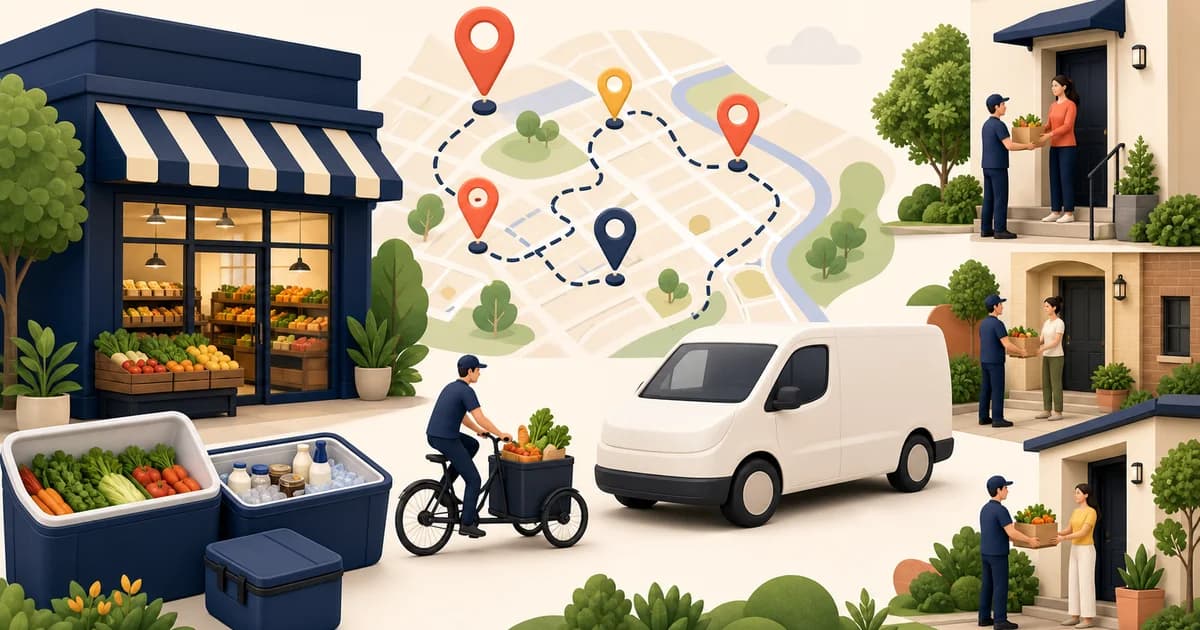
The short answer: local delivery logistics is not a dispatch feature added after the storefront. It is a chain of decisions about service area, inventory, order cutoff, picking, packing, temperature-sensitive handling, substitution consent, routing, handoff, and recovery. Design the customer promise from the constraints of that chain. A narrower zone or fewer slots that the team can fulfill consistently is more valuable than a broad same-day claim that collapses under normal exceptions.
Map the promise before choosing the tools
Write the proposed promise in one sentence: who can receive which products, where, during which windows, under which handoff conditions. Then ask what must be true for it to be accurate. A local delivery service might depend on store hours, supplier arrivals, picker capacity, vehicle type, traffic, building access, age or identity checks, temperature-sensitive products, and customer availability. If a condition is not controllable, the promise needs a conservative boundary and a clear exception path.
Do not collapse delivery, shipping, and pickup into one vague option. They have different costs, controls, and failure modes. State which service is being selected throughout the journey. The customer should be able to see the zone, time range, cutoff, address, contact instructions, and applicable fees or minimums before payment, and receive the same details in the confirmation.
1. Build service zones from operational evidence
Start with a small, map-based zone that the business can validate. Record travel time under realistic conditions, parking or access patterns, route density, delivery capacity, handoff restrictions, and the product conditions that make a route impractical. A radius drawn around a store is not necessarily a viable delivery area. Zone boundaries need a review process because traffic, staffing, carrier coverage, and demand change.
Use zones to determine what the site shows. A shopper outside the zone should not fill a basket under an unqualified delivery promise. Offer a truthful alternative, such as pickup or an availability notice, only when it exists. Collect the minimum location information needed, explain why it is used, and avoid treating a general address entry as consent for unrelated marketing.
2. Treat capacity as inventory
A delivery slot is sellable capacity. It has a limit based on picking time, route shape, vehicle space, staff breaks, product handling, and support capacity—not merely the number of hours on a calendar. Define how many orders or what basket complexity a slot can absorb, when it closes, who can override it, and how the storefront updates. If capacity is manually managed at launch, use a deliberately small release and reconcile each day rather than pretending it is automated.
Promotions, weather, holidays, and supplier disruptions can all change capacity. Give operations authority to pause, narrow, or extend slots, and give marketing an approved source before it advertises a delivery promise. A real capacity indicator helps customers plan; a fabricated scarcity message undermines the exact trust the system is trying to build.
3. Connect the sellable catalog to fulfillment location
The store needs to know not only that an item exists but whether it can be picked for this order in time. Separate stock that is physically present and sellable from expected, damaged, allocated, recalled, expired, or located at another site. Ensure the picker sees the same variant, quantity, notes, and substitution preference that the customer supplied. If the system cannot reserve stock confidently, limit the assortment or increase the manual checks before scaling demand.
For weighted goods, establish a workflow for estimated versus final quantity and the customer-facing charge. For perishable goods, define how picker quality decisions are made and escalated. These are not just warehouse details: they decide whether “available” and “fresh” are accurate storefront language.
4. Sequence picking and packing around product condition
Create distinct handling paths for shelf-stable, chilled, frozen, fragile, fresh, prepared, and any regulated product category. The specific requirements depend on the food, local rules, supplier instructions, and your operation. FDA retail-food resources and USDA food-safety education are useful U.S. starting points, but they are not a substitute for a jurisdiction-specific food-safety plan and qualified advice. Avoid public statements about temperature control or safety unless the team can document and execute the process behind them.
A practical work instruction identifies when an item is picked, what container or label it receives, where it is staged, who checks the order, when it is loaded, and what occurs if the route is delayed. Test the instruction on a busy day simulation. The objective is not paperwork for its own sake; it is reducing the gap between the customer’s basket and the goods at handoff.
5. Make substitution decisions before the picker faces them
Ask customers for item-level preferences while they can think about the tradeoff. Possible choices include no substitute, a similar product, a stated alternative, or contact before substitution if that service is achievable. Carry those preferences to the picker without ambiguity. Define the constraints: allergens, dietary requirements, brand, size, price tolerance, and quantity. A picker should not have to infer that a generic “similar” item is acceptable for a tightly constrained purchase.
When a replacement is made, preserve an auditable order record: requested item, fulfilled item, reason, price treatment, and the customer’s original preference. That record improves support, refunds, supplier conversations, and catalog choices. It also makes it possible to identify where a “substitution problem” is really an inventory accuracy problem.
6. Design handoff for real addresses and real people
A completed route is not necessarily a successful delivery. Buildings may have controlled access, customers may be unavailable, weather may make a leave-at-door request unsafe, and the contact method may fail. Let customers provide supported instructions but do not promise every instruction can be accommodated. Drivers need an escalation tree, a way to protect customer data, and a record of the outcome. The customer needs a clear expectation about arrival range, notification method, and what happens if a handoff cannot be completed.
Avoid collecting extra data “just in case.” Retain only what is required for the delivery and governed support process. If proof of delivery is used, decide its purpose, access, retention, and privacy controls before collecting it.
7. Build recovery into the normal workflow
Late, missing, damaged, unsuitable, or wrong items will happen. Design a reporting path that begins with the completed order, lets a customer select the problem, gathers only necessary detail, and says what will happen next without guaranteeing a remedy before review. Support agents should see the same order, substitutions, delivery status, and fulfillment notes. If they do not, customers will be asked to repeat information the business already has.
Track root causes, not only resolution cost. A cluster of missing-item reports may point to packing verification; a cluster of late deliveries may point to route capacity; a cluster of freshness complaints may point to receiving, staging, or product-quality controls. Feed the learning back into the promise and the storefront, not just the refund workflow.
A controlled delivery pilot
- Start with a defined zone, limited assortment, and a small number of delivery windows.
- Run orders that include a variable-weight item, an unavailable item, a chilled or frozen item, and difficult delivery instructions.
- Compare the customer confirmation, picker list, packed order, driver record, payment result, and issue-report experience.
- Time each handoff and record every manual override or promise that needed explanation.
- Review capacity, substitutions, completeness, delays, damage, and recovery weekly with named owners.
- Expand only when the evidence shows the existing promise is consistently supportable.
Storefront configuration is not delivery operations
Shopify documents local-delivery configuration, and Groxery provides a grocery-focused Shopify OS 2.0 presentation layer with responsive design, navigation, custom pages, branding controls, documentation, and support. Neither product independently validates your zones, confirms a food-handling practice, supplies drivers, or reconciles a packed order. Use the tools to present the delivery model you have tested, and keep the operation as the authority for what customers are promised.
Define the dispatch freeze
Set a point before departure when the route, customer instructions, packed order, and relevant product-condition checks become the dispatch record. Changes after that point need an owner and visible reason; they should not arrive through an untracked chat message. At dispatch, verify that every stop has a supported handoff method, exception contact, and order identifier, and that the driver receives only the customer information required for the route. This checkpoint prevents late merchandising or support edits from silently invalidating a packed basket.
Conclusion
Reliable local food delivery comes from a continuous chain: accurate inventory, capacity-aware slots, careful picking, explicit substitutions, practical routing, clear handoff, and accountable recovery. Build the chain first. Then make the customer experience confidently reflect what it can actually do.
Frequently asked questions
How large should a new local delivery zone be?
Only as large as the team can test and fulfill consistently under normal and exception conditions. Use observed travel, access, staffing, and product-handling constraints rather than a generic radius.
Should delivery slots be unlimited until demand grows?
No. A slot represents finite picking, routing, and support capacity. Set a cautious limit, observe actual performance, and increase it only with evidence that the process can handle more orders.
What metrics should a food delivery store review?
Review on-time completion, order completeness, substitution acceptance, damaged or freshness-related reports, failed handoffs, support contacts, refunds, and the root causes behind them. Metrics should drive operational fixes, not just dashboards.