Guides · August 23, 2026 · 13 min read
How to Start an Online Grocery Store
Start an online grocery store by defining the service area and assortment, controlling food data, and proving picking, substitutions, and delivery.
By Polo Themes
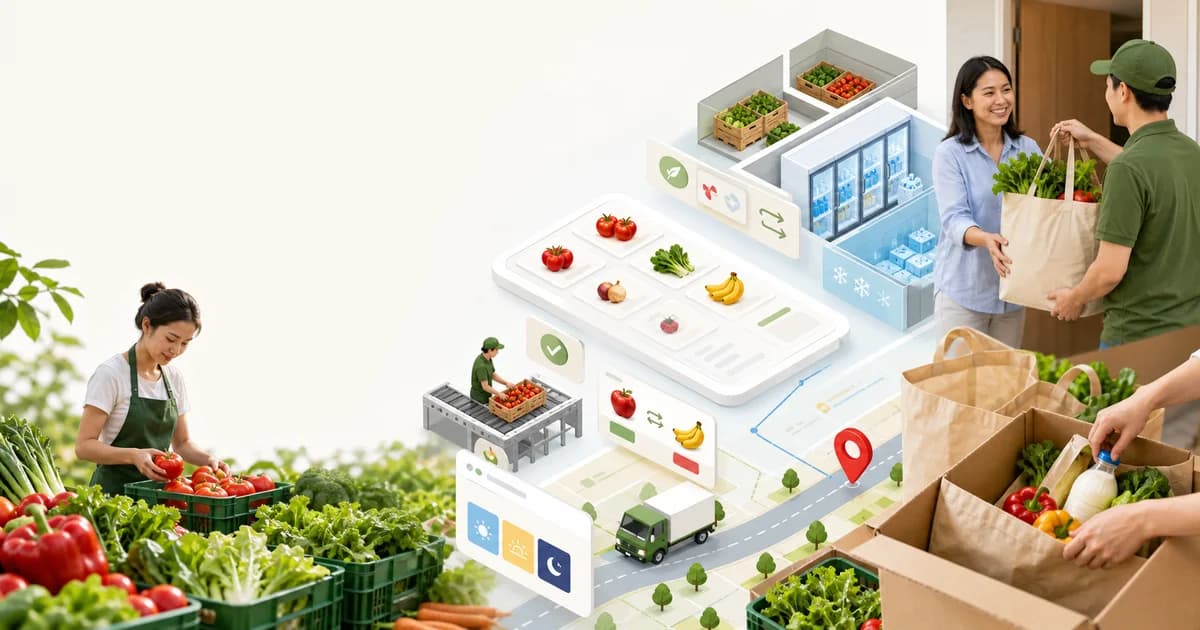
Start an online grocery store by limiting the service area and assortment, validating food and storage duties, and proving inventory, picking, substitutions, cold-chain, delivery, refund, and traceability workflows with realistic baskets.
Grocery commerce joins a dense repeat-purchase catalog to perishable inventory and location-dependent fulfillment. Shopify can present categories, collect an eligible payment, and coordinate orders, but it does not create cold-chain capacity, accurate fresh stock, substitutions, delivery slots, or food compliance. Define the fulfillment operation before promising convenience. A small service area with a reliable shelf-stable assortment is a more informative pilot than broad coverage the team cannot consistently pick and deliver.
Jurisdiction check: in the United States, FDA food-safety and labeling resources may apply alongside USDA, state, local, alcohol, or other authorities depending on the goods and operation. Verify facility, handling, allergen, labeling, traceability, delivery, and consumer obligations for every jurisdiction served. A documented grocery workflow can support those decisions, but Shopify, Groxery, and this guide do not promise compliance or food safety.
Key Takeaways
- Bound the launch by service area, temperature class, assortment, and real delivery capacity.
- Keep unit, ingredient, allergen, storage, freshness, and substitution data tied to exact products.
- Release slots from owned picking and delivery capacity, not optimistic checkout settings.
- Trace every affected batch and order through quarantine, communication, refund, and recall drills.
Which service area and temperature scope should a grocery store launch?
Launch only the area and temperature classes the operation can receive, store, pick, hold, deliver, and recover reliably. FSMA Final Rule on Sanitary Transportation of Human and Animal Food — FDA (United States) addresses vehicles, equipment, temperature controls, contamination prevention, and records for covered transport. Use Groxery to present only the routes and assortment that operations has proved.
Map the addresses the operation can serve through pickup, local delivery, or carrier shipping, and verify legal and partner constraints. Separate shelf-stable, fresh, chilled, frozen, prepared, alcohol, and other specialized categories according to qualified local guidance. Each may need different receiving, storage, picking, age or customer checks, packaging, delivery time, and refund handling. Exclude a category until its full path is owned.
How can a grocery launch assortment remain maintainable?
Choose a compact basket-building range with dependable supply, controlled label facts, understandable substitutions, and enough margin for careful fulfillment. Guidance & Regulation (Food and Dietary Supplements) — FDA (United States) organizes distinct safety, labeling, facility, import, and category resources; every added food type can add evidence and handling work. Use the store cost guide to model that operating burden.
Select products that serve repeat household jobs and can be sourced with consistent identifiers and data. Balance choice with picking complexity. Record brand, exact product, pack count, net quantity, unit basis, ingredients, allergens, nutrition or other required label information, storage, origin claims where supported, and availability owner. Distinguish similar pack sizes clearly. Supplier images cannot replace verified label and product data.
How should grocery inventory account for perishability?
Represent approved sellable quantity by location, temperature state, date, batch, and condition rather than one optimistic count. Shopify Help — Viewing inventory distinguishes Available, Unavailable, and On hand states across locations. Map expiry, spoilage, recall, and quarantine into those states deliberately, and let the product setup guide expose availability only after physical counts and reconciliation owners agree.
Define receiving checks, lot or batch and expiry handling where required, storage zone, rotation, shrink or waste recording, and quarantine. Decide when online inventory is updated and what buffer, if any, is justified by observed operations. Fresh products may not fit simple perpetual stock assumptions. Staff need a controlled way to mark unavailable items quickly and prevent a spoiled or recalled unit from remaining sellable.
Which grocery substitution rules must be defined before checkout?
Define customer consent, picker authority, matching attributes, price treatment, communication, and the no-substitution path before checkout. Food Allergies — FDA (United States) explains that covered labels must identify the food source of major allergens. A replacement can therefore change a safety-critical fact even when packaging looks similar; use the beginner storefront walkthrough to expose the decision clearly.
Decide whether substitutions are offered, how customers consent, which attributes must match, how price differences and allergies are handled, and when no substitution is safer. Build a picker workflow and customer communication path. Do not treat recommendations as automatic substitutes. A similar brand or package may differ in ingredients, dietary status, unit quantity, or intended use. Rehearse rejected and unavailable substitutions before offering the option.
How should grocery departments support basket building?
Organize departments around familiar shopping missions and verified attributes so customers can build a basket without losing pack, temperature, availability, or delivery context. Shopify Help — Creating collections and adding products supports manually or conditionally grouping products and variants. Put empty departments, unavailable staples, substitutions, mobile navigation, and delivery-ineligible items in the store launch checklist before opening a service area.
Use stable, familiar departments and useful subcategories. Product cards should make pack and quantity distinctions visible. Search should tolerate known naming variations without hiding exact identity. Support repeat ordering only when it rechecks current availability and product changes. Test a new shopper locating an ingredient-sensitive item and a returning shopper rebuilding a mixed basket. Promotional collections must not make delivery-ineligible products appear universally available.
What does Groxery provide for an online grocery storefront?
Groxery E-commerce Shopify Theme — Polo Themes describes a responsive, customizable grocery storefront with an advanced mega menu, custom navigation, and product presentation. Those features do not provide live inventory, picking, substitutions, delivery slots, routing, food-safety controls, or cold-chain monitoring. Test Groxery with real departments, pack sizes, allergens, unavailable lines, mixed temperatures, and long baskets.
Groxery is Polo Themes’ direct grocery-store match, built around responsive category, collection, and product presentation. It does not claim live store inventory, picking, substitutions, delivery slots, routing, food compliance, cold-chain monitoring, traceability, or age checks. Preview Groxery with real departments, pack sizes, ingredients, unavailable products, quantity changes, and mixed baskets. Connect operational services separately.
How should grocery picking and quality checks work?
Preserve exact product, quantity, acceptable freshness, temperature, substitution consent, and bag separation for every picked line, then reconcile the basket before handoff. FDA Food Code — FDA (United States) is a model for safe retail-food handling used by jurisdictions, not a universal local rule. Build the checklist from applicable requirements and test it under realistic workload.
Create a route through the storage environment, a clear order picking view, and checks for exact product, quantity, condition, date, temperature or other required state, substitution authorization, and bag separation. Name who resolves ambiguous products and who records changes. Pilot during realistic operating conditions, not at an empty store. A checkout order is only an instruction; fulfillment quality depends on the physical and human system.
How can grocery delivery be built from real capacity?
Build slots from measured picking, staging, vehicle, driver, route, and temperature capacity, with cutoffs and exception buffers. Shopify Help — Setting up local delivery for online orders supports delivery radii or postal-code zones and requires inventory at a fulfilling location. Put only proven coverage in the shipping setup guide, then test boundary addresses, concurrent checkout, late picking, and failed handoff.
Define service zones, cutoff logic, preparation cadence, packaging, vehicle or carrier constraints, handoff, contactless or age-related requirements where applicable, failed-delivery handling, and customer communication. Publish windows only after the team demonstrates them. Configure Shopify shipping or local methods from verified coverage and test addresses at the boundary. Do not claim that Groxery or a theme supplies date pickers or routing.
How should partial grocery failures be refunded?
Resolve missing, substituted, damaged, spoiled, or short-dated goods at line level, preserving what happened to the rest of the basket. Shopify Help — Refunding orders says merchants can refund all or part of an order and enter item quantities. Tell the customer what changed, apply the approved remedy, and keep inventory and quality consequences separate from payment.
Orders can fail at line-item level through unavailable, damaged, spoiled, incorrect, or substituted goods. Train support to identify the exact item and fulfillment event, record evidence proportionately, apply policy and applicable rights, and update the root cause. Decide how payment adjustments and customer messages interact with connected systems. A generic full-order return flow is often a poor model for consumed or perishable products.
How should grocery traceability and recall response work?
Connect supplier, item, batch or date, receiving, location, picked order, customer, and disposition closely enough to stop affected stock and contact buyers. Recalls, Outbreaks & Emergencies — FDA (United States) covers responses to mislabeled, contaminated, or outbreak-linked foods and notes USDA ownership of specified categories. Rehearse quarantine, order tracing, approved communication, regulator routing, and final disposition.
Maintain supplier, receiving, lot or batch, inventory, and order relationships required for the assortment and market. Rehearse stopping affected stock, identifying customer orders, preserving records, and sending approved communications through qualified routes. Ensure online availability changes promptly when inventory is quarantined. Shopify order data may contribute to the response, but it is not by itself a complete food traceability system.
What should a worked mixed-basket pilot prove?
Prove that shelf-stable, chilled, frozen, fragile, and substitutable lines remain accurate through discovery, picking, packing, handoff, and support. FSMA Final Rule on Sanitary Transportation of Human and Animal Food — FDA (United States) addresses temperature control, contamination prevention, suitable equipment, and records for covered transport. Exercise units, availability, consent, separation, slot limits, and partial failure together.
A household builds a basket containing shelf-stable and chilled goods, sees exact pack data and delivery eligibility, selects an available method, and completes a test order. Pickers find each item, record an unavailable line under the agreed substitution rule, protect temperature-sensitive goods, and hand off within the tested process. Support can refund the affected line and explain the outcome. The pilot fails if checkout offers an address the cold-chain cannot serve.
How should the grocery catalog and capacity reconcile each day?
Reconcile supply, sellable stock, freshness, temperature equipment, pick labor, delivery capacity, cutoffs, and interruptions before releasing each day’s catalog and slots. Shopify Help — Managing inventory says inventory is the quantity available for sale and supports tracking and adjustment history. Reduce availability when physical capacity changes instead of allowing checkout to create baskets the operation cannot fulfill.
Before accepting each operating period’s orders, confirm service area, available fulfillment windows, staff capacity, equipment, carrier or driver readiness, and exceptions such as a refrigeration problem. Reconcile high-risk fresh and promoted inventory more closely than stable goods where the model requires it. Pause products or methods when the physical operation cannot keep the storefront promise. A marketing schedule must follow capacity, not force it.
During picking, capture recurring stock mismatches, unclear pack identity, substitution requests, temperature exceptions, and products that consume disproportionate time. Review them with purchasing and merchandising. A product may need better shelf labeling, a corrected image, a different supplier identifier, a stock buffer based on observed error, or removal from online sale. Do not hide operational weakness by continually refunding after checkout.
After delivery, reconcile undelivered orders, partial refunds, substitution outcomes, complaints, and returned totes or equipment where relevant. Link the customer resolution to the inventory and quality consequence. The next day’s availability should not include missing, damaged, expired, or quarantined stock. This closeout makes the repeat-purchase promise credible because the storefront begins from a physical state the team has actually reviewed.
Make slot release and cutoff decisions operational
Release fulfillment capacity from observed picker, storage, packing, vehicle, and handoff constraints for the assortment offered in that window. Reserve room for known exception work rather than selling every theoretical minute. Define when a slot closes, who may reopen it, how weather or equipment failure changes capacity, and which orders can move without harming food condition or customer consent. A promotion may increase demand, but it cannot create refrigerator space, trained pickers, or a safe route.
In a worked exception, refrigeration monitoring identifies a condition outside the approved operating boundary before afternoon picking. Staff quarantine the affected zone, stop chilled items from new baskets, identify paid orders containing those items, and choose verified replacement, later delivery, partial refund, or cancellation paths with customers. Shelf-stable lines may proceed if separation remains safe. The team never clears inventory because it looks acceptable or substitutes another chilled item from the same unverified zone.
Apply food guidance to each category and route
For a United States operation, use FDA primary guidance for applicable food safety, labeling, allergen, facility, traceability, and recall questions, while routing meat, poultry, certain egg products, alcohol, and local retail or prepared-food matters to the relevant USDA, federal, state, or local authority. Document which authority owns each category instead of treating FDA as universal. For other markets, identify the national and local food authorities and verify distance-sale, temperature, labeling, traceability, and delivery duties before enabling the category or zone.
Grocery launch acceptance tests
- Basket truth: every line preserves exact pack, quantity, ingredient and allergen record, price, availability, and temperature class from selection through picking.
- Consent: substitute, no-substitute, price difference, and unavailable-line decisions follow the customer choice without silent replacement.
- Capacity: boundary addresses, closed slots, equipment loss, and staffing constraints prevent unsupported checkout promises.
- Condition: receiving, storage, picking, handoff, failed delivery, and returned goods maintain the approved product-specific decision path.
- Traceability: a test lot or batch can be stopped, located, tied to affected orders, and escalated through the named authority and supplier route.
Failure modes to test
- Pack confusion: similar images hide different counts, weights, or units and produce picking errors.
- Unsafe substitution: a replacement changes ingredients, allergens, dietary status, or customer consent.
- Inventory lag: unavailable or quarantined food remains purchasable because systems update too slowly.
- Capacity fiction: delivery windows are published without tested picking and transport capacity.
- Partial-order gap: staff cannot refund or communicate one damaged or missing line consistently.
- Theme overclaim: responsive grocery presentation is described as delivery, substitution, or cold-chain capability.
Implementation sequence
Approve service area, product classes, and food obligations. Qualify suppliers and data. Pilot receiving, storage, inventory, picking, substitution, delivery, refund, and recall processes. Build representative simple and temperature-sensitive products in Shopify. Stage Groxery with real departments and baskets. Configure payment and location-based delivery. Test boundary address, unavailable line, failed handoff, partial refund, and recall identification before expanding.
Frequently asked questions
Does Groxery provide delivery slots or routing?
No. Its seeded claim is responsive grocery category, collection, and product presentation. Delivery scheduling and routing need separately verified Shopify configuration, services, and operations.
How should grocery substitutions work?
Define customer consent, matching criteria, allergy and dietary safeguards, price handling, picker authority, communication, and no-substitution cases before enabling them.
Can fresh and shelf-stable goods share one workflow?
Only where receiving, storage, availability, packaging, service area, and delivery requirements truly align. Treat temperature and perishability as operating constraints.
What should a grocery pilot include?
Use a realistic mixed basket, an unavailable line, a boundary address, substitution decision, temperature-sensitive handoff, failed delivery, partial refund, and traceability check.
When should a delivery slot be removed?
Remove or reduce it when verified picking, packing, storage, vehicle, driver, handoff, weather, or exception capacity can no longer support the products and addresses offered. Name who may make and reverse that decision. Existing orders need a separate assessment and customer remedy; closing new checkout does not resolve them. Do not reopen capacity from a marketing request until the physical operation is ready and a boundary address has been retested.
How should a refrigeration exception affect online stock?
Quarantine the affected physical zone and immediately prevent its products from new sale while the qualified food-safety owner assesses condition and required action. Identify open baskets and paid orders, keep shelf-stable stock separate where appropriate, and offer only verified replacement, delay, refund, or cancellation choices. Appearance or remaining shelf life cannot override an unverified storage history, and refunded units must not return automatically to availability.
Can prior purchases power one-click grocery reordering?
They can seed a basket only if the current workflow rechecks exact pack, ingredients, allergens, dietary representation, price, availability, destination, and delivery eligibility. A remembered product may have changed supplier, formula, size, or temperature path. Show changes before payment and require the customer’s current substitution choice. Reorder convenience must not convert an old consent or product record into a silent replacement.
What records support a partial refund?
Keep the exact line, quantity, picked or substituted item, fulfillment event, delivery evidence, customer report, approved remedy, payment adjustment, inventory consequence, and quality escalation where relevant. Link the resolution to the batch or source when required. This lets purchasing distinguish a stock error, picker mistake, damage, spoilage, carrier failure, and customer preference instead of repeatedly refunding without correcting the owning process.
When may a grocery delivery be rescheduled?
Only when the revised picking, storage, product condition, vehicle, handoff, address, customer availability, and applicable rights support it. Reassess perishable lines separately from stable goods and obtain customer agreement where required. A calendar change must not extend food beyond its approved condition or conceal a failed capacity promise.