Business · August 23, 2026 · 8 min read
How to Start an Online Grocery Business
A practical planning guide for building an online grocery business around sourcing, inventory, food handling, substitutions, delivery capacity, and recovery.
By Polo Themes
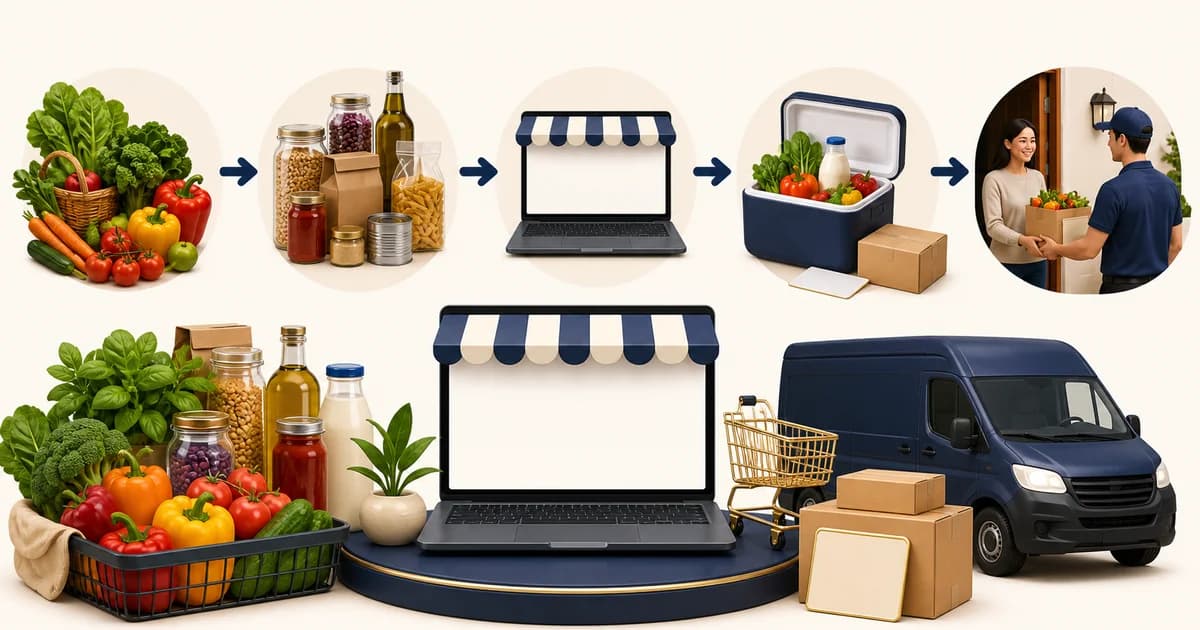
The short answer: start an online grocery business by proving the fulfillment system before expanding the storefront. Choose a narrow service area and assortment, map what happens from supplier receipt to customer handoff, and run real test orders through the awkward cases: an out-of-stock item, a weighted item, a late delivery, and a complaint. The website should describe that working system; it cannot make a fragile operation dependable.
Begin with a bounded offer
“Online grocery” covers very different businesses: a local full-basket shop, a farm or specialty producer, a prepared-food service, a pickup operation, or a delivery marketplace. Start with one clear model rather than combining every category and delivery promise. Define the customer, the geographical boundary, the initial assortment, the fulfillment owner, and the service promise in a short operating brief. A smaller honest promise gives you a chance to learn before inventory complexity and customer expectations outgrow the team.
Also decide what you are not offering. Do not imply that pickup is delivery, that a limited zone is city-wide, or that a curated assortment has the same availability as a large supermarket. If alcohol, regulated foods, supplements, prepared foods, imports, or cross-border sales are in scope, the obligations may differ materially. This guide is operational guidance, not legal or food-safety advice; identify the rules that apply where you source, store, sell, transport, and deliver, then obtain qualified local advice.
1. Verify the legal and food-handling model first
List the responsible business entity, premises, food categories, supplier records, storage conditions, transport, labeling, taxes, insurance, customer-data handling, and complaint process. Determine which authorities govern the actual operation, not just the website’s location. In the United States, FDA retail-food resources and state or local health authorities are relevant starting points; other jurisdictions use different regimes. If a product has a special handling, labeling, age, licensing, or recall requirement, build the record and process before listing it.
A useful compliance map has three columns: the obligation, the owner, and the evidence. For example, a product label may be owned by the manufacturer, an on-site storage log by the retailer, and a delivery handoff by a carrier. This makes it easier to see where a marketing claim depends on a supplier assertion or a process that has not been tested. It also prevents policy pages from becoming broad promises with no operating owner.
2. Design the product record before the product page
A food catalog needs more than title, image, and price. Establish a maintained record for brand, product identity, pack size, selling unit, ingredient and allergen information where applicable, storage condition, supplier, inventory location, availability, substitution eligibility, and fulfillment notes. For fresh or variable-weight goods, specify whether the displayed amount is an estimate, how the final quantity is measured, and how the customer will learn about a meaningful difference.
Do not treat supplier copy as automatically correct. Give someone responsibility for checking updates, discontinued products, packaging changes, and images. Make unknown information visibly unknown rather than guessing. The product page can then be calm and clear because it is drawing from a reliable record. Shopify’s product documentation can help with catalog administration, but it does not determine your food-specific data model or local obligations.
3. Make inventory and availability operationally real
Inventory is a promise to a shopper and a work queue for a picker. Decide where the sellable number comes from, how reservations work, when the store hides an item, and how often the source updates. Separate physically received stock from stock that is expected, damaged, allocated, recalled, or in the wrong location. If exact stock is not feasible at first, scope the offer so staff can reconcile it rapidly, and state the substitution or refund process plainly.
Start with a manual reconciliation routine. At the end of each test day, compare the web order, picker record, packed basket, driver handoff, payment record, and customer outcome. The differences reveal the data fields and checkpoints you actually need. Automating a workflow before you can explain its exceptions is a reliable way to make errors faster.
4. Build picking, packing, and temperature control as one path
Map the physical journey by product condition: shelf-stable, chilled, frozen, fresh, fragile, prepared, and anything with a supplier-specific handling requirement. Establish clear order of pick, packing materials, labeling, staging, loading, and handoff rules. Food-safety practices depend on the product and jurisdiction, so use authoritative local and supplier guidance rather than a generic temperature claim. USDA food-safety education is a useful U.S. reference point, not a substitute for your operating plan or local requirements.
Train against exceptions, not only the ideal route. What does a picker do when the last item is damaged? Who approves a substitute? What happens when a chilled order misses a handoff? How is a suspected quality issue isolated? A customer-friendly interface needs answers because it will expose the choices the team has already made.
5. Set a substitution policy shoppers can use
Substitution is a customer preference, not merely an inventory remedy. Offer a clear per-item choice such as no substitute, similar substitute, or contact me where the operation can honor it. Explain the decision maker, price treatment, and route for a post-delivery concern. Keep dietary restrictions, allergens, pack size, quantity, brand, and budget constraints visible to the person fulfilling the order. If the operation cannot reliably contact a customer, do not promise that it will.
Measure which categories drive substitutions and why. A repeat pattern may reveal a poor assortment decision, a supplier issue, a weak item relationship, or inventory data that lags reality. The answer is rarely to hide the information from the customer.
6. Define delivery capacity before publishing slots
Draw zones that your team can service consistently. For each zone, record distance, travel time, handoff constraints, order cutoff, vehicle or carrier capacity, fees, pickup alternative, and escalation contact. Delivery slots should be generated from those limits, not from a marketing calendar. A soft launch with a few dependable windows is safer than a broad same-day claim that turns every delay into a support incident.
Test failed delivery, inaccessible addresses, customer absence, traffic disruption, damaged bags, and unsafe handoff conditions. Decide when the driver contacts support, what the customer sees, and how proof of delivery is handled with respect for privacy. The operational answer should match the policy, confirmation email, and support script.
7. Publish transparent commercial terms
Before payment, show how the customer will be charged, what changes with variable-weight goods or substitutions, delivery or service charges, minimums if any, cutoff times, cancellation or edit limits, and the path to report a problem. Do not put a price, a “free” promise, or a delivery estimate in a campaign unless the exact condition is current and supportable. Promotions need the same stock and capacity review as the normal catalog.
8. Run a manual pilot and keep the evidence
- Place internal and invited-customer orders using realistic addresses and payment rules.
- Include unavailable, variable-weight, chilled, fragile, and substitution-sensitive items.
- Record every time a web promise differs from inventory, packing, handoff, or payment.
- Ask customers whether the product record, slot, substitutions, and resolution steps were understandable.
- Fix the recurring causes before increasing zones, assortment, or campaign spend.
- Assign an owner and review cadence to every customer-facing operational claim.
Use the storefront as a truthful interface
Groxery is Polo Themes’ grocery and food Shopify theme. Its catalog record identifies Shopify OS 2.0, responsive design, custom branding, advanced navigation, custom pages, social sharing, newsletter support, documentation, and support. It can help present a grocery catalog and brand, but it does not supply suppliers, licenses, inventory accuracy, pickers, temperature controls, delivery routing, or complaint resolution. Configure only the capabilities your operating model can support and verify the actual customer path with current catalog data.
Rehearse supplier and recall disruption before expansion
A grocery launch plan also needs a controlled way to stop selling an item. Choose a representative product and rehearse a supplier discontinuation, packaging or label change, quality hold, and recall notice. Identify how the team finds affected inventory and orders, blocks new sales, isolates stock, preserves the supplier communication, informs the appropriate internal owner, and responds to customers under qualified guidance. The exact legal and safety response depends on the product and jurisdiction; the rehearsal is meant to expose missing records and responsibilities, not invent a universal recall procedure.
The catalog record should make the exercise possible. Keep the identifiers and supplier relationship needed to distinguish one batch, package, or variant from another when those details apply. Decide who can change a product from available to held, what happens to open baskets and unfulfilled orders, and which customer-facing wording has been approved. A generic “out of stock” state may be insufficient when support needs to distinguish an ordinary replenishment gap from a product under review.
Set expansion gates, not just growth goals
Add a zone, category, supplier, or delivery window only after naming the evidence required. For a new zone, prove route and handoff capacity. For a new category, prove receiving, storage, product data, picking, and issue handling. For a new supplier, verify the records, update route, lead times, and exception contact. For more delivery windows, show that current windows remain supportable during realistic peaks. Expansion should be a reviewed operational change, not an automatic response to demand.
- Hold the boundary when substitutions, inventory corrections, late routes, or unresolved complaints are recurring faster than owners can correct their causes.
- Narrow the assortment when product facts or handling requirements cannot be maintained reliably across the current catalog.
- Pause promotion when delivery capacity or support coverage no longer matches the public offer.
- Expand cautiously when representative orders, including exceptions, complete consistently and the next increment has trained owners and documented recovery.
Record every gate decision with the changed scope, evidence reviewed, accountable owner, and next review date. This gives merchandising and marketing a current boundary they can publish, and it gives operations a clear reason to decline a campaign that outruns the service. The discipline is especially valuable when demand is encouraging: growth is easier to manage when the business knows which promise has actually been earned.
Conclusion
The first version of an online grocery business should be a controlled fulfillment experiment, not a maximal product launch. Prove the narrowest service area, product record, handling path, substitution rule, capacity model, and recovery process. Then let the store communicate that earned reliability clearly.
Frequently asked questions
Do I need every grocery category before launching?
No. A bounded assortment can be a better launch because it makes sourcing, storage, labeling, and fulfillment easier to verify. Expand after the existing categories are accurate and the team can resolve exceptions reliably.
How should an online grocery store handle out-of-stock items?
Make the item’s status visible, collect a clear per-item substitution preference, give fulfillment staff the required constraints, and provide a documented resolution route. The exact policy should reflect what the operation can actually perform.
Does a Shopify theme make a grocery store compliant?
No. A theme is a presentation layer. Compliance and food safety depend on the business, products, jurisdictions, records, facilities, and operating practices, which require qualified review.