Business · August 23, 2026 · 7 min read
How to Start and Grow a Clothing Line With a Testable Assortment
A practical way to build a clothing line around a clear customer, honest fit, manageable production, and evidence-led learning.
By Polo Themes
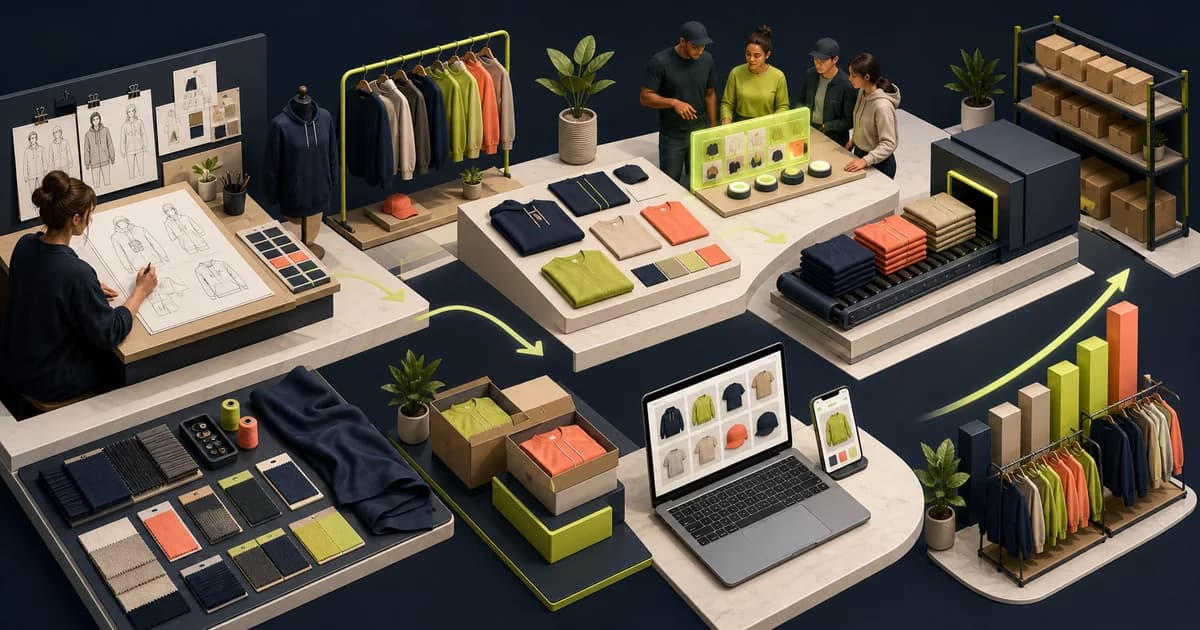
The short answer: begin with a small assortment built for a specific customer and a specific wearing problem. Prove that the garment can be made, photographed, described, fitted, sold, supported, and returned before adding categories. A clothing line is not validated by a launch image or a large first drop; it is validated when the product promise survives real orders and the team learns what to change next.
Start with a customer and a use, not a mood board
A visual reference can establish taste, but it does not define demand. Write a narrow starting statement: who the customer is in the context that matters, what they are trying to wear or solve, what existing options make difficult, and what your line will deliberately not serve. “Everyone who likes elevated basics” is a positioning wish. “People who need durable, easy-to-layer workwear for a particular climate and routine” gives design, fit, content, and merchandising teams something they can test.
Interview prospective customers and people who support them. Ask to see how they choose, care for, alter, replace, and abandon garments. Do not ask whether they would buy an imagined product; ask about the last relevant purchase, the confusing choices, the worn-out item they miss, and the tradeoffs they made. Treat anecdotes as hypotheses, not market-size proof. Your early goal is a useful decision record, not an impressive deck.
Define the first assortment as a system
A first assortment should have roles. An entry piece introduces the proposition; a core piece shows the repeatable fit or fabrication; a statement piece creates a reason to pay attention; and an attachment piece helps build an outfit or increases utility. You may not need every role, but naming them prevents a collection from becoming a pile of unrelated samples. Document which colours, sizes, fabrics, and silhouettes are essential to the test and which are deferrable complexity.
- Write the customer, use case, garment promise, and explicit exclusions for every initial style.
- Limit colour and size decisions to combinations the team can source, photograph, count, and replenish accurately.
- State what makes each product a core, entry, statement, or attachment item.
- Design product names that are distinctive but still intelligible in navigation, search, invoices, and support.
- Keep a source-of-truth record for style code, material, construction, measurements, supplier, care, and status.
Treat fit as product development, not storefront copy
Fit uncertainty is a central product risk. Decide what body measurements, finished-garment measurements, ease, stretch, rise, length, and intended silhouette mean for each style. Record how each measurement is taken and which units appear to customers. A generic chart can be a starting reference, but it cannot accurately explain every cut, fabric, or supplier. Fit notes should emerge from product development and wear testing, not from a final marketing pass.
Use wear tests that are appropriate to the intended customer and garment. Invite useful critique: where the garment pulls, twists, rides up, loses shape, restricts movement, or creates confusion. Keep feedback connected to the sample version. If feedback is collected from people, explain its purpose, obtain consent for any material you publish, and do not turn a small group into a claim that the garment fits everybody.
Make production and fulfilment visible early
The sales page cannot repair a production plan that lacks clear ownership. Before taking orders, understand the material source, minimums, sample and production lead times, quality checks, labelling requirements applicable to your market, packaging, storage, pick-and-pack process, shipping choices, and return intake. Seek qualified legal, tax, labour, and product-labelling advice for the jurisdictions and products you serve; this article is not a compliance determination.
Create a practical exception map. What happens when a fabric is delayed, a size is oversold, an item is damaged, a parcel is lost, a customer receives an incorrect variant, or a return cannot be resold? The answers should inform the availability message, dispatch estimate, customer-service scripts, and financial reserve. Publishing a shorter lead time than the operation can support may win an initial order and lose the relationship that follows.
Build product pages from the real product record
A shopper should be able to identify the garment and make a properly informed decision. Include a name, price presentation, selectable variant state, composition, care information, fit notes, measurements, model context where available, image sequence, availability, delivery information, and a route to returns support. Do not imply that editorial images represent an exact colour, fabric behaviour, or bundled outfit unless the product record supports it.
Wosa is Polo Themes’ catalogued fashion and clothing Shopify theme. Its responsive, customizable design foundation can help establish a coherent storefront and product-display system. It cannot supply your measurements, verify a supplier claim, or make an unavailable variant available. Populate it with reviewed content, keep its navigation comprehensible, and test pages with realistic long names, sold-out sizes, missing images, and a narrow phone viewport.
Launch a learning cycle, not a one-way campaign
Choose a modest initial release that the operation can observe closely. Align campaign language with the actual assortment and delivery policy. Capture the questions visitors ask, where they leave the size process, which variants they attempt to choose, what product details support needs to repeat, and why customers return items. Traffic alone is not a verdict. A high click-through rate paired with confused support requests or fit-related returns is a signal to improve the product and its information.
- Before release, reconcile catalog quantity, selected variant names, images, measurements, prices, delivery terms, and links.
- Run a complete mobile purchase path with a real card-safe test method and confirm order notifications and support ownership.
- Make a launch brief that identifies the target audience, approved claims, inventory boundary, content owner, and response path for questions.
- Review the first orders and support contacts daily enough to correct factual errors quickly.
- After the test period, compare product-level demand, cancellations, fit-related returns, repeat interest, and support burden before expanding.
Grow through deliberate assortment decisions
Growth should make the original promise more useful, not merely make the catalog larger. Add a style when it extends a validated outfit, occasion, material story, or customer need and when its data can be maintained. Retire or revise a style when it creates repeated fit uncertainty, quality issues, impossible replenishment, or misalignment with the line’s purpose. Keep an archive of decisions so seasonal enthusiasm does not erase the lessons of the last run.
Watch the relationship between product-level signals. Size-guide use may indicate healthy consideration or unresolved confusion; pair it with selection completion and return reasons. A popular campaign can hide a weak core product, and a low-volume style can be strategically important as an attachment item. Segment observations by product, variant, device, acquisition source, and purchase cohort before drawing a conclusion.
A 30-day first-line checklist
- Week 1: define the customer, garment roles, product record fields, and the highest-risk assumptions.
- Week 2: complete samples, fit observations, production ownership, quality checks, and exception paths.
- Week 3: photograph and write pages from verified facts; build the collection, product, cart, delivery, and returns journey.
- Week 4: test accessibility and purchase states, launch within capacity, observe questions and outcomes, then record what changes next.
Decide whether the next style deserves to exist
Before approving another style, write the customer problem it extends, the existing garment or outfit it complements, and the evidence behind the decision. Then list the new complexity: pattern and sample work, fabric and trim sources, size range, color variants, photography, product data, quality checks, storage, fulfillment, support, and returns. A style can fit the brand visually and still be the wrong operational next step.
Use a simple decision review rather than a growth slogan. Keep the style when it strengthens a validated use case and the team can maintain its fit and product record. Revise the proposal when demand is plausible but the variant or production scope is too wide. Delay it when a supplier, measurement method, or quality standard is unresolved. Reject it when it only repeats a current role without a defensible customer or assortment reason.
Rehearse the first return before launch
Take a finished sample and simulate the entire reverse journey. Can the customer find the applicable policy from the product page and order? Does the request retain style, size, color, order, and reason accurately? Can the team inspect the garment, distinguish a fit issue from damage or fulfillment error, update sellable inventory correctly, and feed the lesson back to product development? The exercise connects a polished launch to the less visible work that determines whether the line can improve.
- Record the return reason in language useful to product, fit, fulfillment, and support teams.
- Keep feedback linked to the exact sample or production version.
- Do not generalize one return into a sizing conclusion; review patterns with the relevant context.
- Correct misleading measurements, imagery, or copy at the source and across active campaigns.
- Define what must be inspected before an item can return to available inventory.
- Carry the resulting decision into the next sample brief and assortment review.
The same discipline applies to repeat orders. Check whether a returning customer can identify the same style when names, colors, or seasons change, and disclose material or fit revisions that affect comparison. Growth is easier to sustain when the catalog preserves useful continuity instead of making every release appear unrelated and entirely new.
Set a review trigger for every compromise accepted during the first run. A temporary fabric, limited fit sample, manual stock process, or narrow delivery route may be reasonable when it is explicit and controlled. Record the owner, customer-facing consequence, and condition for revisiting it. Otherwise, launch workarounds silently become the operating model and make later growth harder to evaluate.
When the line expands, protect the original product records. Returning customers and support teams need to know whether a familiar style is unchanged, revised, or merely renamed. Version meaningful fit, material, construction, and care changes, and present current facts without implying continuity the product cannot support.
Use the same version in orders, returns, and support records so lessons stay attached to the garment customers actually received.
Conclusion
A durable clothing line earns trust one accurate decision at a time. Begin with a smaller promise than you think you need, make the garment and operating reality legible, and treat early orders as evidence rather than applause. The right next category is the one your team can make and describe honestly while preserving fit, quality, and support.
Frequently asked questions
How many products should a first clothing line have?
There is no universal number. Start with the fewest styles and variants that can test your customer promise without making production, sizing, photography, or support unreliable.
Can a theme replace custom commerce development at launch?
Often a theme and native platform features are enough to validate the basic journey. Add custom work only when a verified customer need cannot be met accessibly and maintainably by the current system.
Which metric matters most for an early line?
Use a set: successful variant selection, product-level demand, support questions, cancellations, and fit-related return reasons. A single conversion number cannot explain whether the product promise is working.