Guides · August 23, 2026 · 12 min read
How to Start a Dropshipping Store on Shopify
Start dropshipping with a defensible assortment, verified suppliers, original product records, and tested routing, tracking, returns, and outage recovery.
By Polo Themes
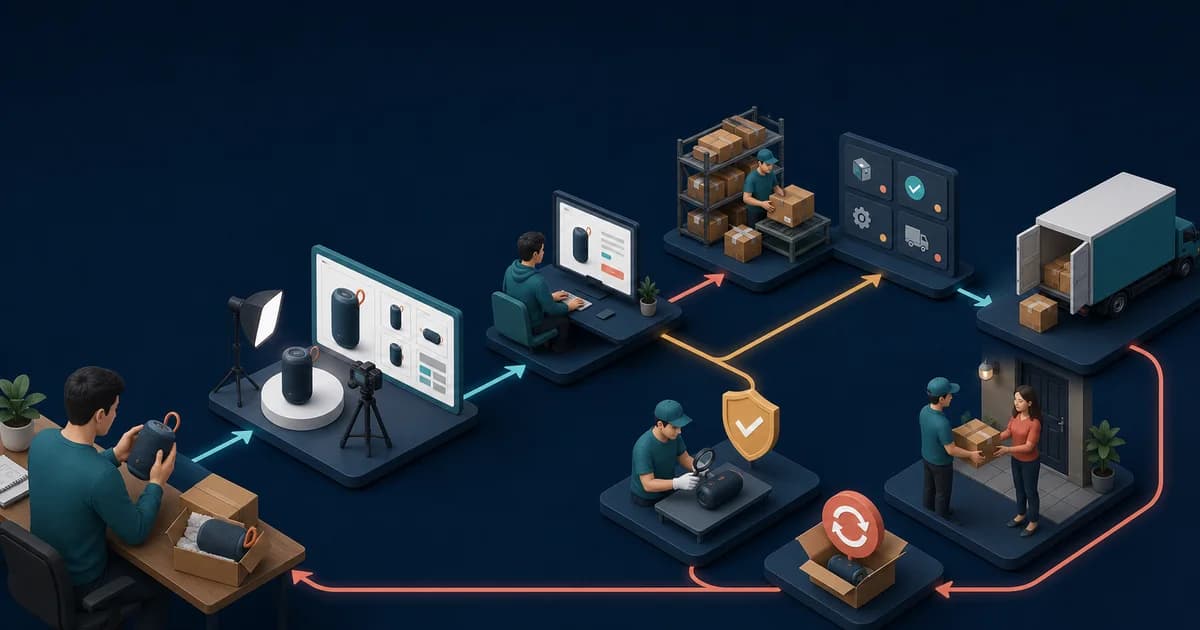
Start a Shopify dropshipping store by choosing a defensible customer and assortment, vetting suppliers with real orders, creating original product information, and proving inventory, routing, customs, tracking, returns, and supplier-failure recovery.
Dropshipping changes who holds and ships inventory; it does not reduce the merchant’s responsibility to the customer. The store still makes the product, payment, delivery, policy, and support promises. A supplier feed can publish thousands of items faster than the business can verify them, turning convenience into misinformation. Begin with a small assortment and place sample orders through the exact intended route before connecting automation.
Jurisdiction check: dropshipping does not change which product, import, advertising, delivery, refund, privacy, tax, or safety rules apply. US merchants can begin with FTC mail, internet, or telephone order guidance and the regulator for each product category, including FDA where food, supplements, cosmetics, devices, or animal products are involved. Verify every jurisdiction served; supplier vetting and app automation do not promise compliance.
Key Takeaways
- Choose a customer problem and supplier set the merchant can verify and support directly.
- Own original product data, shipping promises, customer communication, returns, and remedies.
- Route orders through explicit authority, exception queues, stock reconciliation, and outage controls.
- Audit every supplier journey with samples, delivery evidence, refunds, and concentration limits.
Which customer problem should a dropshipping store solve?
Choose a customer problem and bounded assortment whose products, suppliers, delivery, support, and remedies the merchant can understand firsthand. Mail, Internet, or Telephone Order Merchandise Rule — FTC (United States) requires a reasonable basis for advertised shipping times and delay consent or refunds when promises cannot be met. Evaluate Polo Themes — Shopify theme catalog only after that model exists.
Define the buyer, use case, product standard, and reason the selected assortment belongs together. Avoid products chosen only from advertising dashboards or supplier rankings. Exclude regulated, safety-critical, branded, fragile, battery, ingestible, child, or other high-obligation categories unless the business has appropriate expertise and verified permission. A defensible catalog can explain selection, quality, compatibility, and support in original terms.
How should dropshipping supplier identity and authority be qualified?
Verify the legal supplier, product source, brand authority, warehouse origins, stock method, processing, carriers, customs documents, cancellations, returns, recalls, data handling, and escalation before routing orders. Mail, Internet, or Telephone Order Merchandise Rule — FTC (United States) requires a reasonable basis for shipment promises, making dispatch evidence essential. Use the store cost guide to model exposure, not prove reliability.
Verify the legal supplier, business location, product source, brand authorization, contact, service terms, warehouse origins, inventory method, processing, carrier choices, customs documents, packaging, tracking, cancellations, returns, defects, recalls, data handling, and escalation. Use primary records and direct communication. Do not treat an app marketplace listing as proof that the supplier or product is lawful, authentic, or dependable.
Why should a dropshipper place representative sample orders?
Sample orders reveal actual identity, quality, dimensions, packaging, sender, documents, tracking, customs behavior, delivery time, damage, and return instructions across the intended route. Shopify Help — Dropshipping explains that suppliers pick, pack, and ship while merchants retain customer service and tracking responsibility. Feed verified observations into the product setup guide instead of copying supplier descriptions blindly.
Order the ordinary product, most complex variant, and a product likely to reveal packaging or delivery constraints through the same workflow customers will use. Inspect exact identity, quality, media match, labels, included items, packaging, sender information, tracking, timing without publishing the observation as a universal guarantee, customs experience, and support response. Repeat when the supplier, warehouse, or product revision changes. Reject products that cannot pass inspection.
How should original dropshipping product data be controlled?
Create merchant-owned titles, descriptions, dimensions, materials, compatibility, inclusions, warnings, media rights, dispatch origin, delivery range, returns, and support records from verified evidence. Mail, Internet, or Telephone Order Merchandise Rule — FTC (United States) requires a reasonable basis for stated shipping times. Original wording is still misleading when it repeats unsupported supplier facts or hides delivery conditions customers need.
Write verified titles, descriptions, specifications, media, options, identifiers, origin or delivery facts, and policies for the target customer. Normalize supplier variants and remove impossible combinations. Maintain rights for media and copy. Do not import ratings, endorsements, scarcity, certifications, or claims without appropriate evidence and permission. The merchant’s storefront must remain truthful even when supplier feeds use inconsistent marketing language.
Which system should control each dropshipping fact?
Name the system and owner for product truth, stock, price, address, routing, tracking, cancellation, refund, return, and incident status. Mail, Internet, or Telephone Order Merchandise Rule — FTC (United States) makes the seller responsible for shipping promises and delay remedies, so supplier status cannot remain ambiguous. Test stale feeds, duplicate orders, changed addresses, and rejection through the store launch checklist.
Map which system owns product identity, price, inventory, availability, order routing, tracking, cancellation, and refund. Decide how updates flow and how conflicts are quarantined. Test delayed feeds, duplicate identifiers, discontinued variants, wrong warehouse, and partial updates. An automated import should not publish a new product or claim without review. Keep Shopify inventory and customer promises aligned with the source that the operation actually trusts.
How should dropshipping order routing and exception queues work?
Route each paid, eligible, validated order to the correct supplier once, then monitor acknowledgement, allocation, dispatch, tracking, and delivery. Hold address conflicts, unavailable stock, price changes, restricted destinations, and duplicate messages in merchant-owned queues. Mail, Internet, or Telephone Order Merchandise Rule — FTC (United States) requires delay consent or a refund when the seller cannot meet the promised shipping time.
For each paid order, define validation, supplier submission, acknowledgement, inventory reservation, tracking, customer notification, and reconciliation. Create a visible queue for rejected, delayed, split, or unacknowledged orders. Staff must know when to contact the supplier and when to contact the customer. Do not mark an order fulfilled merely because it was transmitted. Supplier acceptance and carrier movement are separate evidence.
How should a dropshipping store configure honest shipping?
Build delivery ranges from measured supplier processing, origin, carrier, destination, customs, tracking, and exception evidence, with clear split-shipment and duty language. Mail, Internet, or Telephone Order Merchandise Rule — FTC (United States) requires a reasonable basis for advertised ship times and defined delay handling. Configure only promises validated by representative orders in the shipping setup guide.
Identify warehouse origins, served destinations, products, packages, carrier methods, customs responsibility, tracking quality, and return locations. Use Shopify profiles, zones, and rates to represent verified paths. Avoid a global delivery promise derived from the supplier’s shortest estimate. Test addresses at service boundaries and mixed carts from different origins. Explain split shipments and import responsibilities where applicable through qualified advice.
How can the merchant own the dropshipping returns path?
Give customers one merchant-controlled intake, authorization, destination, tracking, remedy, and escalation route even when a supplier receives the item. Mail, Internet, or Telephone Order Merchandise Rule — FTC (United States) requires prompt refunds for unshipped merchandise when delay consent is unavailable. Keep that financial duty connected to physical disposition, and never send customers to negotiate with an unknown warehouse.
Publish a return process the merchant can execute. Define customer contact, authorization, destination, condition, shipping responsibility, supplier approval, replacement, refund, and rejected-return escalation under applicable law. Do not tell customers to negotiate with an unknown supplier. Test a wrong item, defect, late cancellation, refused parcel, and supplier who stops responding. Keep financial resolution and physical return state connected.
How should supplier failure be planned before launch?
Plan for supplier silence, false stock, price changes, late dispatch, invalid tracking, substitution, quality drift, data exposure, recall, and termination. Define stop-sale, communication, cancellation, refund, alternative qualification, and evidence preservation. Mail, Internet, or Telephone Order Merchandise Rule — FTC (United States) requires customer consent to shipping delays or a refund, so supplier failure needs a merchant-owned remedy.
Record backup supply or product-removal options, open-order identification, customer communication, refund authority, feed shutdown, data export, and app removal. If a supplier disappears, stop affected products and new routing immediately rather than waiting for complaints. Preserve evidence and fulfill merchant obligations. A catalog with no fallback may still launch narrowly, but the customer remedy must not depend on the supplier remaining cooperative.
When should a dropshipping store evaluate themes?
Evaluate themes after assortment, evidence, authority, shipping, returns, support, and exception states are defined, because those requirements determine useful presentation. Polo Themes — Shopify theme catalog offers presentation candidates, while Shopify Help — Products identifies descriptions, media, variants, inventory, tags, and metafields the chosen theme must expose. Reject any design that disguises supplier dependence or operational uncertainty.
Polo has no seeded dropshipping-specific product among Optics, Medical, Wosa, CourseWhiz, Electronix, and Groxery. Any choice is adjacent to the actual niche represented by the goods, not to the fulfillment model. Browse the Shopify theme catalog after product and operating requirements are clear. A theme cannot validate suppliers, synchronize inventory, route orders, track parcels, or handle returns unless a separate tested integration provides that behavior.
What should a worked supplier-outage drill prove?
Rehearse stopping affected products and routing, identifying paid unfulfilled orders, verifying supplier status, communicating accurate choices, canceling or refunding, preserving evidence, and restoring only after fresh qualification. Mail, Internet, or Telephone Order Merchandise Rule — FTC (United States) requires consent to a shipping delay or a prompt refund. Fail the drill if supplier cooperation is necessary to perform either remedy.
A paid order reaches the routing system but receives no supplier acknowledgement. The exception queue alerts the owner, who checks current stock through the approved contact, pauses the affected variant, informs the customer, and either routes through a verified backup or refunds under policy. Tracking is not fabricated and the order is not marked fulfilled. The rehearsal fails if the first signal is a customer asking why a nonexistent parcel has not moved.
How should the customer experience be audited supplier by supplier?
Audit each supplier through sample orders, product accuracy, processing, packaging, tracking, delivery, customs, damage, support, returns, refunds, and incident response. Shopify Help — Dropshipping explains that the supplier picks, packs, and ships while the merchant remains responsible for customer service and tracking. Suspend or narrow any supplier whose performance prevents the merchant from delivering the published experience.
Maintain a scorecard based on observed orders: identity accuracy, product conformity, packaging, processing communication, carrier handoff, tracking quality, customer-visible sender, customs behavior, damage, returns cooperation, data accuracy, and escalation. Keep raw evidence and review context. Do not turn a small sample into a public performance claim. Use it to decide catalog scope, routing priority, monitoring, or suspension.
Review suppliers independently even when one app connects them. Shared software does not mean shared warehouses, product controls, service levels, or return locations. A mixed cart can create several parcels and policies. Test whether the storefront explains this before payment and whether support can identify which supplier owns each line. Consider limiting carts or assortment combinations when the resulting experience cannot be made understandable.
When performance degrades, pause the affected products before launching more advertising. Inspect whether the cause is supplier stock, routing integration, order acknowledgement, carrier movement, product quality, or merchant communication. Apply the remedy at the owning layer and place a fresh sample order after material changes. Dropshipping remains viable only while the merchant actively governs the network instead of outsourcing observation to customer complaints.
Set supplier concentration and substitution boundaries
Decide how much of the customer promise may depend on one supplier, warehouse, carrier, integration, or catalog feed. Maintain a merchant-owned map of affected products and open orders so an outage can be contained. A backup supplier is usable only after its legal authority, sample, product identity, packaging, inventory semantics, route, returns, and customer experience pass the same approval. Never switch an order to a visually similar source merely to protect dispatch time.
Consider a bestseller whose supplier stops acknowledging orders while still reporting stock. The exception queue blocks new routing, merchandising pauses the product and its ads, and operations identifies paid but unacknowledged lines. Customers receive the verified wait, alternative, or refund choice. An approved backup may receive new orders only under its own SKU and promise; old orders move only with customer consent. The incident closes after reconciliation and a fresh end-to-end sample proves recovery.
Apply market rules despite the remote supplier
The merchant must identify the competent product-safety, customs, tax, privacy, advertising, sanctions, and consumer authorities for every product and destination; the supplier’s willingness to ship is not approval. For United States sales, use the primary federal and state authority appropriate to the exact category and claim, including CPSC, FDA, FCC, or FTC where applicable. For other markets, document the importer or responsible-person role, required labels and records, restricted goods, returns address, and remedies before opening checkout. Keep unclassified products out of automated imports.
Dropshipping launch acceptance tests
- Authority: each supplier, brand, image, claim, product, importer path, and destination has reviewed evidence and an owner.
- Order state: paid, acknowledged, allocated, shipped, canceled, refunded, disputed, and lost orders reconcile across merchant and supplier systems.
- Promise truth: product identity, dispatch origin, parcel count, delivery range, duties, tracking, and return route match the customer-facing offer.
- Outage containment: stale stock, failed acknowledgement, feed corruption, and carrier interruption stop affected sales without hiding open orders.
- Recovery: a changed supplier or product completes a new sample order, return, refund, and support rehearsal before traffic resumes.
Failure modes to test
- Feed pollution: unreviewed products, claims, images, or variants publish automatically.
- Phantom inventory: supplier availability lags while Shopify continues accepting orders.
- False fulfillment: transmission to the supplier is treated as shipment without acknowledgement or tracking.
- Origin surprise: package sender, customs, delivery time, or return country differs from customer-facing information.
- Supplier abandonment: refunds and support depend on a vendor that no longer responds.
- Theme confusion: a storefront presentation is described as a dropshipping operations system.
Implementation sequence
Define customer, assortment, category risks, and merchant promise. Qualify supplier and sample orders. Create original product standards and source-of-truth rules. Build routing, exception, shipping, customs, returns, and failure recovery. Connect a small quarantined feed and representative product in Shopify. Choose a theme by product niche only. Test stock lag, rejected routing, wrong item, split shipment, customs issue, return, refund, and supplier outage before traffic.
Frequently asked questions
Does dropshipping remove fulfillment responsibility?
No. The supplier may hold and ship stock, but the merchant still owns customer-facing product, delivery, policy, and resolution promises under applicable obligations.
Should a supplier feed auto-publish products?
Not without a controlled review that verifies identity, rights, claims, variants, media, availability, shipping, and support. Quarantine new or changed records until accepted.
Which Polo theme is for dropshipping?
None is seeded for dropshipping as a fulfillment model. Choose only by the actual product niche and label any non-direct fit as adjacent.
What proves a supplier is ready?
Verified identity and authority, representative sample orders, accurate data, acknowledged routing, tracking, returns, escalation, and a rehearsed failure path provide stronger evidence than a marketplace listing.
Can an approved backup supplier fulfill existing orders?
Only after the exact replacement product, source, dispatch location, delivery promise, duties, packaging, tracking, returns, warranty, price effect, and customer consent have been resolved. Approval for future orders does not authorize a silent reroute of past purchases. Preserve the original order promise and record the accepted change so support and refunds do not confuse two suppliers or product identities.
When should supplier products be paused automatically?
Pause them when stock or price data becomes stale, acknowledgements stop, identifiers conflict, fulfillment misses the approved boundary, tracking fails systematically, the returns route closes, or a safety, rights, or quality concern appears. Automation may contain exposure, but a named merchant owner must assess open orders and approve recovery after fresh product, routing, delivery, return, and refund evidence. Resume advertising only after that proof is recorded.