Design · August 23, 2026 · 9 min read
Grocery and Food Delivery App Design
Grocery delivery UX should support repeat shopping, substitutions, quantities, freshness, delivery slots, fees, and changing availability.
By Polo Themes
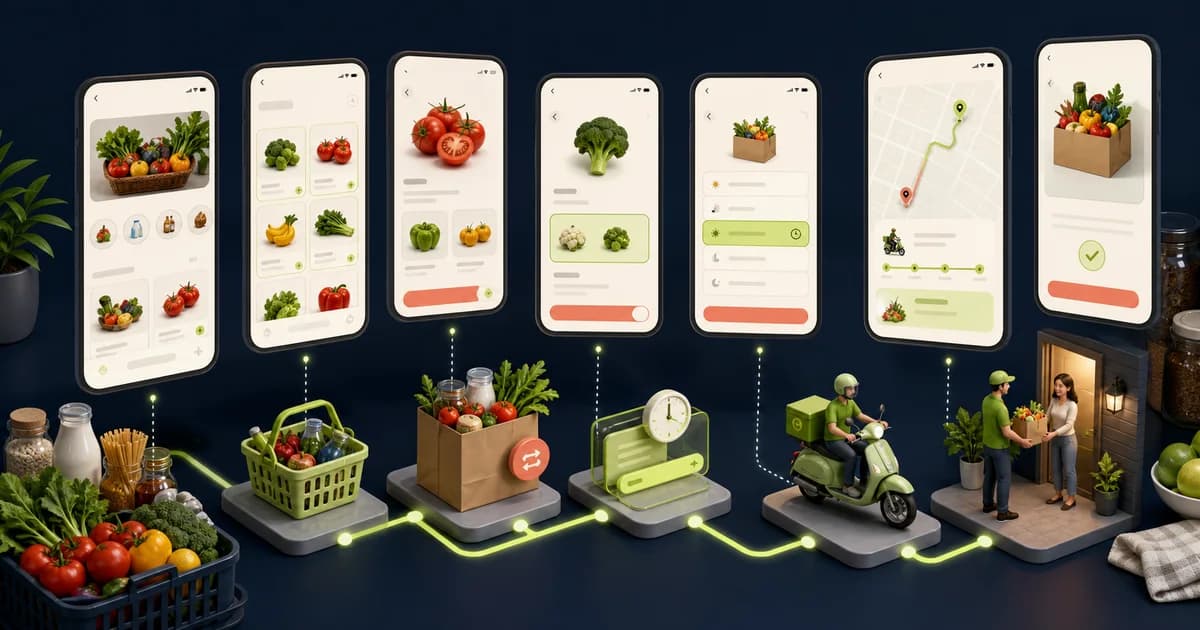
Grocery journeys combine a large changing catalog with time-sensitive fulfilment. The interface should support quick discovery and repeat purchase while keeping availability, quantities, substitutions, fees, and delivery expectations current.
Key Takeaways
- Show unit pricing, quantity basis, availability, and substitution choices clearly.
- Treat delivery slots and fees as changing operational data.
- Keep allergen and storage information attached to accountable sources.
- Test picking changes, partial fulfillment, delays, and refund recovery.
How should you model the grocery catalog?
The U.S. Food and Drug Administration’s “Food Allergies” identifies 9 major food allergens under federal law. Model category, brand, pack, unit, weight, ingredients, dietary attributes, allergen data, origin, storage, price basis, and availability as governed fields; packaged and weighted goods require different quantity and final-price behavior.
Assign sources, owners, and safe missing states, and never infer dietary suitability from marketing copy. The ethical social-proof guide advances the catalog model by showing how reviews, badges, policy claims, and post-purchase messages need provenance rather than borrowed credibility.
Do not infer dietary or allergen claims from marketing text. Keep product names and units consistent enough for search and comparison. Frequent assortment changes require maintainable imports and review, not hand-curated cards alone.
How should you model volatile fulfilment?
Baymard Institute’s “Product Page UX” reports more than 1,300 issues and over 110 guidelines. Model volatile fulfilment as explicit out-of-stock, quantity-limit, weighted-price, substitution, slot, minimum, and fee states; label estimates and confirmation points so a storefront snapshot never masquerades as a guaranteed picked basket.
Preserve the basket while specific items or costs change, and provide a calm next action. The CTA design guide advances this state model by tying action labels to prerequisites, loading, failure, retry, ownership, and recovery instead of treating every update as another “Continue” button.
- Ask substitution preference clearly.
- Show cost changes.
- Notify without alarm.
How should you design fast repeat discovery?
Google’s “Web Vitals” defines good 75th-percentile experience as LCP within 2.5 seconds, INP within 200 milliseconds, and CLS at most 0.1. Keep categories, search, recent items, lists, favorites, and reorder responsive within that budget, while clearly distinguishing a prior item from its current pack, price, substitute, or availability.
Show enough identity, pack or unit, price basis, promotion, stock, and quantity control to prevent fast mistakes. The pricing-presentation guide advances repeat ordering by clarifying unit basis, discounts, fees, currency, and total commitment when today’s basket differs from the previous one.
Product cards need image, exact identity, pack or unit, price basis, promotion, stock, and quantity control without excessive density. Test one-handed touch, long names, many similar variants, and slow image loading.
How should you present unit and weighted pricing?
The Federal Trade Commission’s “.com Disclosures: How to Make Effective Disclosures in Digital Advertising” tests 22 examples by net impression. For weighted goods, show unit price, expected weight, estimated total, final-weight rule, substitution effect, and charge timing together; an estimate headline must not obscure how fulfilment determines the final amount.
Expose minimums, service fees, delivery, bags, deposits, and tax before commitment, then verify the receipt against fulfilment. The fashion-commerce guide provides a useful comparison because variant identity and measurement context also determine whether shoppers understand exactly what quantity and product they selected.
Do not hide minimums, service fees, delivery, bags, deposits, or tax until commitment. Update basket estimates accessibly. Verify final order and receipt calculations through the real commerce and fulfilment systems.
How should you handle quantity and stock changes?
Baymard Institute’s “Baymard’s UX Research Methodology & Data” includes more than 200,000 research hours and 4,400 moderated participant-site sessions. Test quantity edits while stock, pack size, price, and promotions change between browse, basket, picking, and delivery; preserve unaffected items and identify the exact change rather than resetting the basket.
Support increment, decrement, direct entry where useful, limits, and removal without duplicate-tap errors or false scarcity. The cart-abandonment guide advances recovery by connecting these edits to total cost, delivery context, payment failure, and respectful return to an intact basket.
Stock can change between browse, basket, picking, and delivery. Explain reservation behavior only if true. Avoid fake low-stock urgency. Test concurrent updates, duplicate taps, and offline-adjacent recovery.
How should you design substitution preferences?
The U.S. Food and Drug Administration’s “Food Allergies” identifies 9 major food allergens under federal law. Let shoppers allow, reject, or constrain substitutions at the supported level, and carry ingredients, allergens, dietary attributes, brand, size, price, and communication preferences through picking; similarity never proves a replacement is safe.
Explain the real default, proposed-substitute review, completed changes, and issue route without coercion. The Groxery Shopify theme is the relevant product destination for storefront presentation of unit price, stock, substitutions, slots, and allergen information, while operational logic still needs integration.
During picking, show proposed or completed substitutions and a route to approve or report issues where supported. Never infer allergen safety from similarity. Substitution is an operational workflow requiring integrated end-to-end validation.
How should you design delivery slot selection?
The World Wide Web Consortium’s “Web Content Accessibility Guidelines (WCAG) 2.2” uses 320 CSS pixels as its ordinary reflow reference. At that width, show slot date, window, cost, capacity, location, cutoff, selected state, and hold behavior from live data; preserve basket and preferences when a slot expires or fails.
Show available dates and windows, cost, capacity, location, cutoff, and change behavior from live data. Keep the selected slot visible and explain whether it is held. Handle no availability, expired hold, changed address, and unavailable items.
Do not guarantee arrival beyond operational capability. Test time zones, daylight changes, holidays, and narrow screens. Preserve basket and preferences when a slot fails, and offer pickup or later alternatives only when real.
How should you support dietary and allergen needs?
The U.S. Food and Drug Administration’s “Food Allergies” identifies 9 major food allergens under federal law. Support dietary and allergen needs with sourced attributes, named filters, detailed ingredients, visible limitations, and accessible product information; formulations and packaging can change, and substitutions must never silently override a recorded preference.
Use governed attributes, clear labels, filters, and detailed ingredient or allergen information from accountable sources. State that product packaging or formulation may change where applicable and direct shoppers to current authoritative information.
Avoid relying on icons alone or making medical guarantees. Keep substitutions from silently violating preferences. Review with qualified content owners and test screen-reader access to product details and filter state.
How should you design checkout and order changes?
The World Wide Web Consortium’s “Web Content Accessibility Guidelines (WCAG) 2.2” requires at least 1 of 3 safeguards for financial transactions: reversibility, checked data with correction, or review and confirmation. Grocery checkout must also expose estimates, substitutions, fees, slot, authorization, final-charge timing, edit cutoff, cancellation, refunds, and safe retry.
Keep basket items, quantities, estimates, substitutions, fees, delivery, payment, and total understandable. Explain edit cutoff, authorization, final charge, cancellations, refunds, and missing items. Prevent duplicate orders.
After purchase, provide picking, substitution, out-for-delivery, delivered, and issue states according to actual operations. Notifications need consent and privacy. Test order changes and support rather than ending at confirmation.
How should you ground groxery claims correctly?
The Federal Trade Commission’s “.com Disclosures: How to Make Effective Disclosures in Digital Advertising” contains 22 examples showing that context shapes meaning. Ground Groxery freshness, origin, dietary, stock, delivery, and substitution messages in governed fields, market scope, dates, and owners; the verified theme does not supply inventory, picking, routing, payment, or fulfilment.
Repository seed data confirms a Groxery storefront theme with Shopify OS 2.0, responsive customization, navigation, newsletter, sharing, image or video lightbox, documentation, and related theme features. It does not list a Groxery Figma product.
The theme is a storefront foundation. It does not provide inventory, picking, substitutions, delivery slots, routing, payments, allergen governance, or fulfilment. Integrate real services and validate the complete operational path before presenting those capabilities.
How should you design rapid basket building?
Baymard Institute’s “Product Page UX” reports more than 1,300 product-page issues and over 110 guidelines. Rapid basket building combines clear categories, forgiving search, recent items, lists, concise product identity, unit or weight pricing, live stock, and quick quantity editing; speed should reduce repeated effort without hiding product differences or current availability.
Use useful categories, search, recent items, lists, and clear unit or weight pricing. Product cards need enough identity to prevent mistakes without becoming dense.
- Show unit basis.
- Keep quantity editing fast.
- Preserve basket context.
Adapt the verified Groxery theme responsibly
PoloThemes' seed data confirms that the Groxery theme includes responsive customization features. It does not establish a delivery backend; inventory, slots, substitutions, routing, and payments require actual systems and end-to-end testing.
- Map operational owners.
- Avoid implied live capability.
- Test order changes and support.
How should you test a basket through fulfilment?
The U.S. Food and Drug Administration’s “Food Allergies” identifies 9 major food allergens. Build a fulfilment test basket that includes an allergen-sensitive item, weighted produce, a promotion, an unavailable staple, substitution preferences, and a constrained slot; then trace picking changes, final charges, delivery, missing-item recovery, refunds, and receipts without inferring safety.
Include allergen-sensitive preferences and never infer safety from a similar product. Observe what operations can actually update and what support sees. This test separates storefront appearance from the live grocery system and exposes claims the theme cannot provide alone.
Test real grocery scenarios
Run weekly-repeat, urgent small basket, weighted produce, unavailable staple, allergen-sensitive order, substitution, no slot, changed address, payment failure, and post-delivery issue scenarios. Use realistic units and catalogue churn.
Review missing items, substitutions, refunds, late delivery, search failures, and support after launch. Improve catalog and operations as well as interface. Grocery experience quality depends on the handoff from screen to picker to doorstep.
Rehearse a basket through substitution and fulfilment change
Build a basket containing weighted produce, an age-restricted item, an allergen-sensitive product, a promotion, and an item likely to become unavailable. Ask a shopper to choose substitutions, understand estimated versus final price, select a delivery window, and state what will happen when fulfilment changes.
Simulate out-of-stock replacement, weight adjustment, expired slot, address rejection, payment retry, and delayed delivery. Notifications, consent, totals, and recovery must remain coherent across app states. Dietary filters and labels should reflect authoritative product data and communicate limitations rather than promise medical safety from incomplete catalog attributes.
Verify the final picked items, substitutions, charges, refunds, and delivery record against the customer-facing confirmation. Record the operational owner for every transition. Repeat the scenario when inventory, picker workflows, promotion logic, payments, or notification services change because a visually simple basket can hide complex fulfilment consequences.
Include a household editing the same basket near the delivery cutoff. Resolve stale quantities, removed items, and changed slots explicitly rather than silently accepting the last write. The final confirmation should make the charged basket and chosen substitution policy unambiguous. Preserve an accessible history of who changed what when conflict resolution affects price.
Conclusion
Grocery design connects rapid basket building to live inventory, quantities, substitutions, slots, fees, and fulfilment. Groxery is a verified Shopify theme foundation, not the operational delivery system behind those states.
Frequently asked questions
How should weighted prices be displayed?
Show the unit basis, expected quantity and estimate, and explain when final weight and charge are confirmed. Verify the final order and receipt calculations.
Does Groxery provide delivery-slot logic?
No such backend capability is established by the repository seed data. Inventory, picking, substitutions, slots, routing, and delivery require real integrated systems.