Figma · August 23, 2026 · 7 min read
Best Figma UI Kit for Medical/Healthcare Apps
Assess a healthcare kit through medicine discovery, appointment states, prescription handling, privacy boundaries, and safe escalation.
By Polo Themes
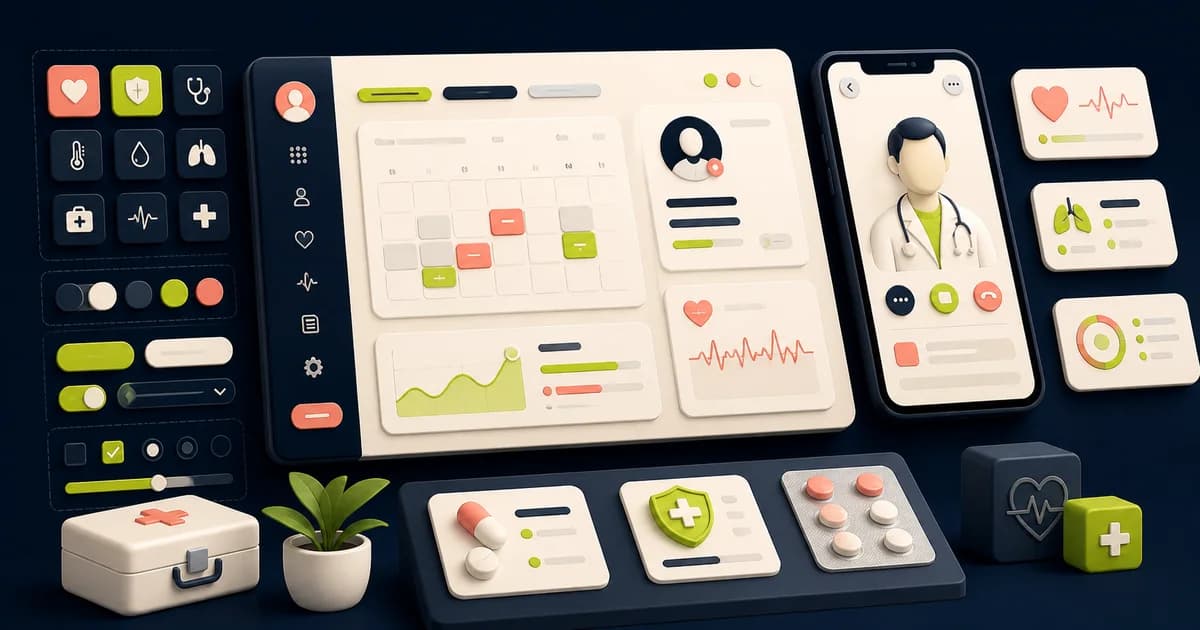
Polo Medical is the direct catalog match for a product combining medicine commerce and clinician consultation. The repository description names finding medicines, making appointments, uploading prescriptions, and paying online, and records more than twelve pages and screens. That is relevant domain scaffolding. It is not evidence of clinical safety, privacy compliance, accessibility conformance, prescribing authority, pharmacy operations, or suitability for a specific jurisdiction.
Evaluate the source with one high-consequence journey rather than a polished landing page. A person searches for a medicine, encounters an eligibility boundary, submits a prescription, receives a request for correction, books professional help, pays through a supported route, and returns for status. Every state should identify what is known, what is pending, who is responsible, and how urgent needs leave the digital flow.
Keep catalog facts and health claims separate
The Medical catalog entry also records editable design, organized layers, customizable colors, free Google Fonts, icon choices, imagery, a design system, and components. Verify those seller-authored features in the current file. The entry does not claim a particular clinical content standard, medical-device status, data-hosting model, identity process, consent regime, emergency service, or regulatory certification. Never add those claims to marketing or documentation without authoritative evidence.
Create an ownership legend in Figma. Mark interface copy proposed by design, clinical language awaiting professional approval, policy text awaiting legal or operations review, and values supplied by an implemented system. This prevents a realistic mockup from becoming an accidental source of medical truth. Approved requirements and production systems should remain authoritative.
Test medicine discovery without implying diagnosis
Load products with active ingredients, strengths, forms, pack sizes, availability, prescription status, warnings, and similar names. Design search and results so customers can distinguish them without relying on packaging imagery. Decide which facts appear in results and which require detail. Search suggestions and rankings must not silently imply clinical recommendation; their purpose and source should be defined by the responsible product and clinical team.
Prototype an item that cannot be purchased through the ordinary route. Explain the restriction, preserve useful context, and offer the appropriate professional or support path without creating urgency through generic error styling. Include unavailable stock, unsupported delivery area, age or identity requirement where applicable, and a customer who needs immediate care. Emergency escalation language must be approved for the real service and location.
Treat prescriptions as sensitive records
A prescription upload frame needs file requirements, consent, progress, validation, secure-handling expectations, failure, deletion, resubmission, and status. Use synthetic documents during design and testing. Do not copy real health information into shared design files or screenshots. Define what metadata designers need and keep production data in its authorized system.
Separate technical receipt from professional acceptance. “Uploaded” means the service received data; it does not mean a prescription is valid, legible, current, applicable, or fulfilled. Model pending review, request for clearer evidence, mismatch, partial acceptance where the service permits it, approval, rejection with safe explanation, and customer withdrawal. Assign every transition to a real operational role.
Build appointment states around care continuity
Test clinician or service discovery, availability, timezone, appointment type, reason for visit, identity prerequisites, confirmation, reminders, rescheduling, cancellation, late arrival, clinician delay, no-show, and follow-up. Avoid presenting a slot as guaranteed before the booking system confirms it. The interface should preserve what the user entered when a time becomes unavailable and offer a comprehensible alternative.
A consultation card should state the responsible service, channel, preparation, cost or coverage where verified, expected response, and limitations without overselling certainty. Decide how the user leaves a remote workflow for urgent or in-person care. Clinical and operations owners must approve escalation, availability, and response language; the Figma kit supplies composition, not a care model.
Minimize and compartmentalize sensitive information
For each screen, ask whether every personal or health detail is needed for the current task and role. Build a permission matrix for customer, clinician, pharmacist, support, and administrator. Prototype access denial, expired access, corrected identity, delegated care where supported, and audit-sensitive actions. Shared components should not expose confidential fields merely because another role’s version contains them.
Design privacy explanations at the point of collection in language appropriate to the audience. Avoid filling templates with universal promises about encryption, retention, deletion, or sharing. Those statements depend on the implemented architecture and policy. Use placeholders labeled for verification, then replace them only with approved, testable claims.
Use accessibility as a safety practice
Check clear headings, plain labels, visible focus, keyboard order, error summaries, field-level errors, text enlargement, contrast, target size, timeout handling, and alternatives to motion or color. People may use the service under stress, with low vision, cognitive load, limited dexterity, or unfamiliar terminology. A calm visual style does not guarantee an understandable task.
Run a comprehension review with representative synthetic content: similar medicine names, long clinical terms, several appointment statuses, an unclear upload, and a denied action. Ask participants what happened and what they would do next. Figma can support the demonstration, while implemented semantic structure and assistive-technology testing determine actual conformance.
Inspect the Medical source
Audit medicine cards, appointment slots, forms, upload controls, consent notices, status banners, payment summaries, navigation, and account records as components. Review variants, properties, nested dependencies, auto layout, names, foundations, and documentation. Replace demonstration content and resize. Log every detached instance and every health workflow state that requires a new product decision.
Map selected patterns to code, data, identity, scheduling, prescription, pharmacy, payment, notification, and support owners. The same Figma card may depend on several authoritative services. Annotate freshness, pending conditions, and failure behavior. Engineers and domain specialists should review the map before the visual trial becomes an implementation plan.
Healthcare-kit checklist
- Medicine identity, strength, form, prescription status, availability, and warnings are legible without diagnostic implication.
- Prescription receipt, review, correction, approval, rejection, withdrawal, privacy, and operational ownership are distinct.
- Appointments cover confirmation races, preparation, delay, rescheduling, cancellation, no-show, follow-up, and escalation.
- Sensitive data is minimized by task and role, with denied, expired, corrected, and audited access represented.
- Clinical, legal, privacy, operations, accessibility, and implementation claims remain unverified until their owners approve evidence.
- Components withstand long terminology, errors, enlarged text, keyboard use, missing data, and narrow widths.
- The decision record names supplied catalog scope, adopted patterns, rejected assumptions, and remaining validation work.
Failure modes
The first failure is wellness styling masquerading as clinical design. Friendly imagery and soft colors can coexist with ambiguous medicine identity, unsafe urgency, or inaccessible forms. Recover by testing the consequential task in plain form, establishing approved content and state ownership, then applying brand expression without reducing clarity.
The second failure is one green success state for uploaded, reviewed, prescribed, paid, and fulfilled. These events have different actors and consequences. Split them, state evidence and next action, and design waiting and correction. Never let a prototype suggest professional approval that the service has not produced.
The third failure is claiming compliance from a template. Regulations vary by service, data, organization, and jurisdiction; accessibility also depends on implementation. Recover by recording requirements and verification methods outside the commercial asset, marking gaps inline, and retaining specialist review as a release gate.
Run a cross-role safety review
Prepare one synthetic record that includes two similarly named medicines, a missing prescription page, an appointment that becomes unavailable, a payment still pending, and a customer asking for urgent help. Show the same case to customer support, clinician or pharmacist roles where applicable, operations, privacy, product, content, accessibility, and engineering. Ask each reviewer what they believe happened, what information they need, and what action they are authorized to take.
Convert disagreements into explicit requirements rather than polishing the prototype until it appears settled. Record authoritative data sources, status definitions, role permissions, approved language, escalation ownership, retention questions, and verification methods. Mark unresolved decisions inline. The result should distinguish a screen that Medical supplies, a pattern the product team extends, and a safety or compliance gate that no commercial Figma asset can satisfy.
Repeat the review after one implemented vertical slice. Production identity, scheduling, document, payment, and notification behavior may contradict early assumptions. Update the design and decision register from evidence, while preserving prior reasoning for audit. A medically themed file can accelerate visual and interaction work only when the service continues to correct it with operational truth.
Conclusion
Polo Medical offers relevant recorded starting scope for medicine discovery, appointments, prescriptions, and payment. Its value should be judged inside the editable source with a difficult, privacy-sensitive care journey. Adopt the components that withstand that test, while keeping clinical safety, approved language, privacy, accessibility, operations, and implementation as separately verified responsibilities.
Frequently asked questions
Does Polo Medical include appointment and prescription concepts?
Yes, the repository description names appointments and prescription upload. Inspect the delivered file for exact screens and states; design the real service rules with accountable specialists.
Can the kit prove healthcare compliance?
No. The catalog makes no such certification. Applicable clinical, privacy, security, accessibility, consumer, and jurisdictional requirements need explicit evidence and verification.
Should real prescriptions be used in prototypes?
No. Use synthetic, non-identifying fixtures designed to exercise formats and states. Keep real health information inside authorized production or test systems with appropriate controls.