Figma · August 23, 2026 · 7 min read
Best Figma UI Kit for Grocery/Food Delivery
No dedicated Groxery Figma kit is recorded; evaluate adaptable foundations against serviceability, substitutions, slots, and live orders.
By Polo Themes
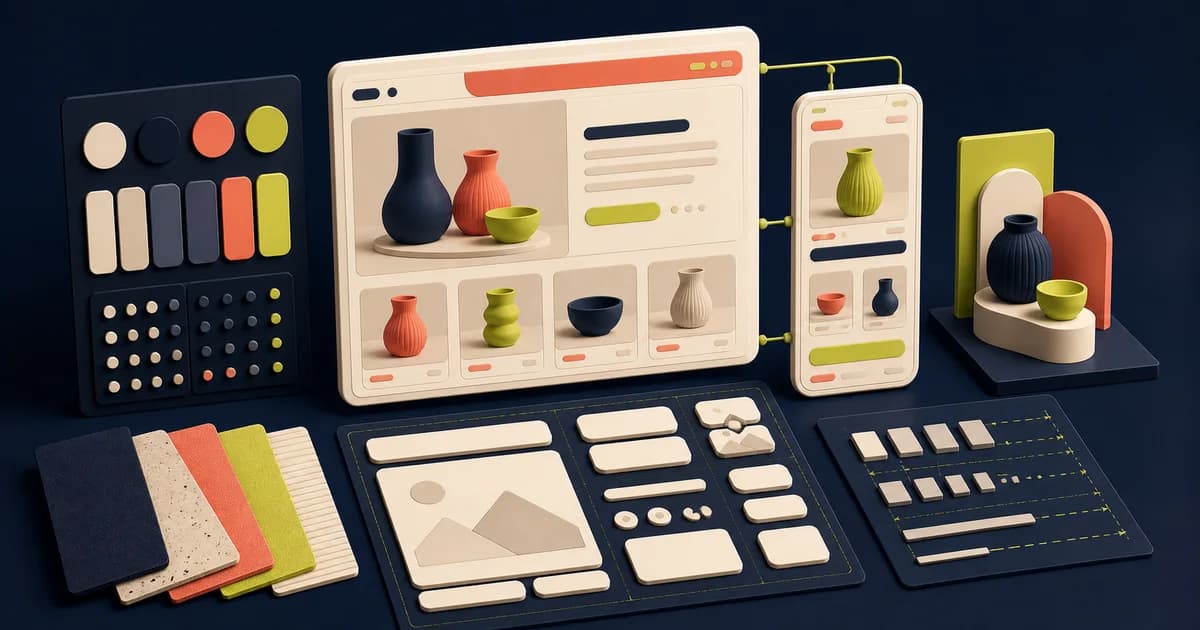
Polo’s repository does not record a dedicated Groxery Figma UI kit. It records a Groxery Shopify theme, which is a different product type. The E-Commerce Figma Bundle lists Course Whiz, Medical, Optics, Wosa, and Electronix as its five members; Groxery is not among them. That boundary matters: the best Figma starting point for grocery is currently an adaptable foundation plus locally designed operations-heavy flows, not a claimed Polo grocery kit.
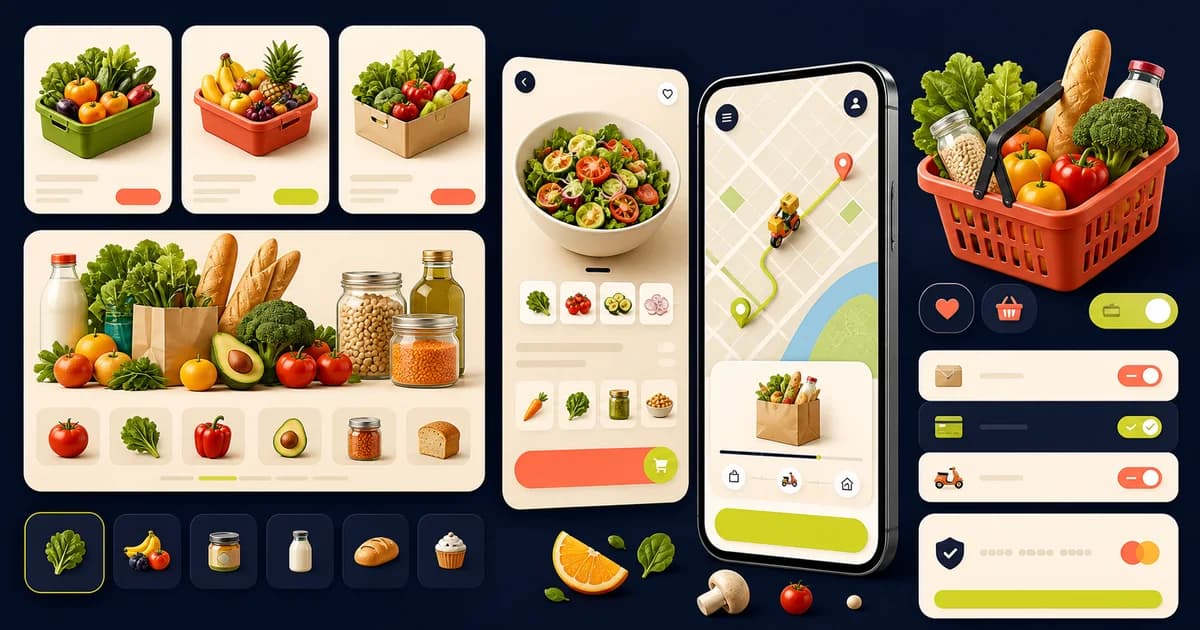
The evaluation should begin with postcode or address serviceability and continue through a mixed basket, weighted goods, an unavailable item, substitution preference, delivery-slot loss, picking changes, payment adjustment, live tracking, and support. Generic retail cards can help with visual structure, while grocery availability, timing, pricing, and fulfillment require a distinct service model.
Choose foundations without inventing a catalog product
Material 3 and Apple Design Resources can ground mobile controls and platform conventions. Polo’s five-kit bundle can offer general commerce composition references such as catalog, product, cart, and account patterns. None should be described as a grocery-specific Figma product. Inspect the actual source and retain only primitives that can express grocery states without confusing shoppers or store operators.
A coded Groxery Shopify theme may be relevant to a separate implementation decision, but its existence does not prove a matching Figma file or the flows recommended here. Evaluate design source and implemented theme independently. This article discusses a Figma selection method and does not document the Groxery theme’s runtime behavior.
Start with serviceability and fulfillment mode
Ask for the minimum location information needed to determine whether the service can fulfill an order. Explain why it is needed and allow manual entry when precise location permission is unnecessary. Distinguish delivery, pickup, shipping, and unavailable modes. Preserve location context across browsing and explain when changing it resets availability, prices, promotions, or the basket.
Prototype a customer entering from a deep-linked product before choosing location. The page should avoid promising price, stock, or delivery until the relevant store or service area is known. Once selected, show the active context clearly without repeating it on every card. Test an address becoming unsupported and a customer switching between pickup and delivery.
Model grocery product data
Create catalog fixtures for packaged items, produce sold by weight, variable-weight prepared food, multi-buy offers, age-restricted goods where applicable, chilled products, and items with dietary or allergen information. Include missing images, changed pack sizes, deposit or fee, and regional assortment. Product and legal owners must verify all food, nutrition, allergen, restriction, and pricing content.
Cards need unit or quantity context, current price, comparable price where required, promotion conditions, stock confidence, and a fast but recoverable add action. Test incrementing beyond availability, minimum or maximum quantity, a weighted estimate, and a replacement pack size. A generic quick-add button without feedback can create a basket whose eventual total surprises the customer.
Design substitutions before checkout
Let customers set substitution preferences at a useful level: per item, category, or whole order according to the actual service. Options may include allow a suitable substitute, contact me, or do not replace. Explain price and approval behavior only after operations and payment owners verify it. Do not promise an exact replacement or contact channel merely because the prototype has a toggle.
During picking, show original item, proposed substitute, relevant differences, price impact, response deadline, and what happens without a response. Include a rejected substitute, no alternative, partial quantity, and an accessibility-friendly notification route. The authoritative order system must govern state; Figma documents the intended communication and choices.
Treat delivery slots as changing inventory
Prototype slot discovery after serviceability and at the point the business actually reserves capacity. Show date, window, fee, cutoff, fulfillment mode, and any eligibility. Then remove the selected slot before confirmation. Preserve the basket, explain the change, and provide alternatives. A calendar full of demonstration times does not represent operational availability.
Test changing address, basket total, restricted item, or fulfillment mode after slot selection. Decide whether the slot remains valid, must be rechecked, or changes fee. Use pending feedback during recalculation. Delivery promises and cutoffs must come from verified systems and operations policy, not hard-coded template copy.
Handle estimated and adjusted totals
Weighted goods, substitutions, unavailable items, bag or service fees, promotions, tips where supported, and payment authorization can make the final total differ from the initial estimate. Label estimates precisely and break down changes. Prototype authorization, adjustment, refund, and receipt states with the payment owner. Avoid an alarming “price changed” message that provides no line-level explanation.
The basket should group decisions requiring attention: missing substitute preference, quantity limit, unavailable product, expired offer, and slot dependency. Keep valid items intact. Test a large weekly order rather than three ideal products; information density, sticky controls, performance assumptions, and error recovery become different at scale.
Follow picking and delivery
Map confirmed, picking, substitution needed, packed, awaiting pickup, dispatched, arriving, delivered, partially delivered, failed, cancelled, and support states only where the service uses them. Define which timestamps are estimates and which events are verified. Give customers a route when tracking becomes stale or delivery evidence is disputed.
Operator and picker interfaces may need scan, quantity, weight, substitution, exception, temperature, age-check, and handoff actions. A buyer-oriented kit will not cover these merely because it has an order page. Build role-specific surfaces from appropriate components and prevent private customer details or privileged actions from leaking through shared instances.
Grocery Figma checklist
- The design and metadata state plainly that no dedicated Groxery Figma kit is recorded in the catalog.
- Location and fulfillment mode govern assortment, price, promotion, slot, fee, and basket changes transparently.
- Pack, quantity, weight, unit context, restrictions, dietary facts, availability, and authoritative content are distinguishable.
- Substitution preferences and proposed replacements cover price impact, deadlines, rejection, absence, and partial quantity.
- Delivery capacity handles reservation, expiry, address or basket changes, fees, cutoffs, and recovery.
- Estimated, authorized, adjusted, refunded, and final totals are not collapsed into one misleading amount.
- Buyer, picker, operator, driver, and support responsibilities expose appropriate data and actions.
- Components withstand large baskets, rapid stock changes, keyboard use, enlarged text, missing media, and narrow widths.
Failure modes
The first failure is pretending a conventional shipping cart supports grocery. It omits serviceability, slots, perishable inventory, weights, substitutions, and live picking. Recover by designing the exception-heavy order before styling category pages. Reuse generic components only where their meaning survives.
The second failure is false price precision. The interface presents one fixed total while operational changes are expected. Define estimate and adjustment states with commerce, payments, and operations, and make line-level reasons readable. Never invent fee or authorization behavior for a screenshot.
The third failure is the nonexistent-product implication: calling the bundle or Groxery Shopify theme a grocery Figma kit. Correct the metadata and prose, identify the actual source being evaluated, and maintain a gap register. Product-type honesty is essential to a trustworthy recommendation.
Test the flow under time and access pressure
Use a customer rebuilding a frequent basket on a small phone while a delivery cutoff approaches. Enlarge text, navigate by keyboard where the web surface supports it, use a screen reader during implementation, and introduce a substitution alert while the keyboard is open. Important price, allergen, restriction, slot, and changed-order information must not rely on color, tiny badges, transient toast messages, or precision gestures.
Prototype a caregiver or shared-household scenario only if the planned service supports it. Decide whose address, payment, dietary preference, order history, and notifications are visible. Do not infer delegation from a shared cart illustration. Identity, consent, privacy, and support owners must establish the real model before the design suggests one person can act for another.
Validate with store operations
Walk the same synthetic order with a picker and support colleague. Include a missing weighted item, damaged produce, a substitute awaiting response, an expiring slot, and a partial delivery. Ask which data arrives when, which action is possible, and what evidence is preserved. Their answers often contradict the instantaneous certainty of a buyer prototype; update the states from operational evidence.
Keep that order as a regression fixture for any adopted foundation. When navigation, cards, basket rows, status messages, or design tokens change, replay serviceability, substitution, adjustment, and delivery recovery. A general kit earns continued use only if local grocery components remain understandable and connected. Archive the exact source and gap record so no later contributor mistakes it for a dedicated Groxery Figma product.
Conclusion
There is no dedicated Groxery Figma kit in the recorded Polo catalog, and Groxery is not part of the five-kit Figma bundle. Use platform resources or inspected commerce foundations for primitives, then design grocery serviceability, weighted items, substitutions, delivery capacity, adjusted totals, picking, and recovery as product-owned flows. The best kit is the one that supports that extension without hiding operational truth.
Frequently asked questions
Does Polo sell a Groxery Figma UI kit?
No dedicated Groxery Figma product is recorded in the repository catalog. A Groxery Shopify theme is recorded, which is a separate implemented-product category.
Is Groxery included in the Figma bundle?
No. The recorded bundle members are Course Whiz, Medical, Optics, Wosa, and Electronix.
Can a general commerce kit still help?
Yes, for foundations and generic catalog components. Grocery serviceability, weights, substitutions, slots, live orders, adjusted totals, and operational roles need dedicated design and implementation.