Figma · August 23, 2026 · 7 min read
Best Figma UI Kit for Electronics Stores
Evaluate an electronics kit through specification comparison, compatibility, model identity, bundles, warranty, and fulfillment.
By Polo Themes
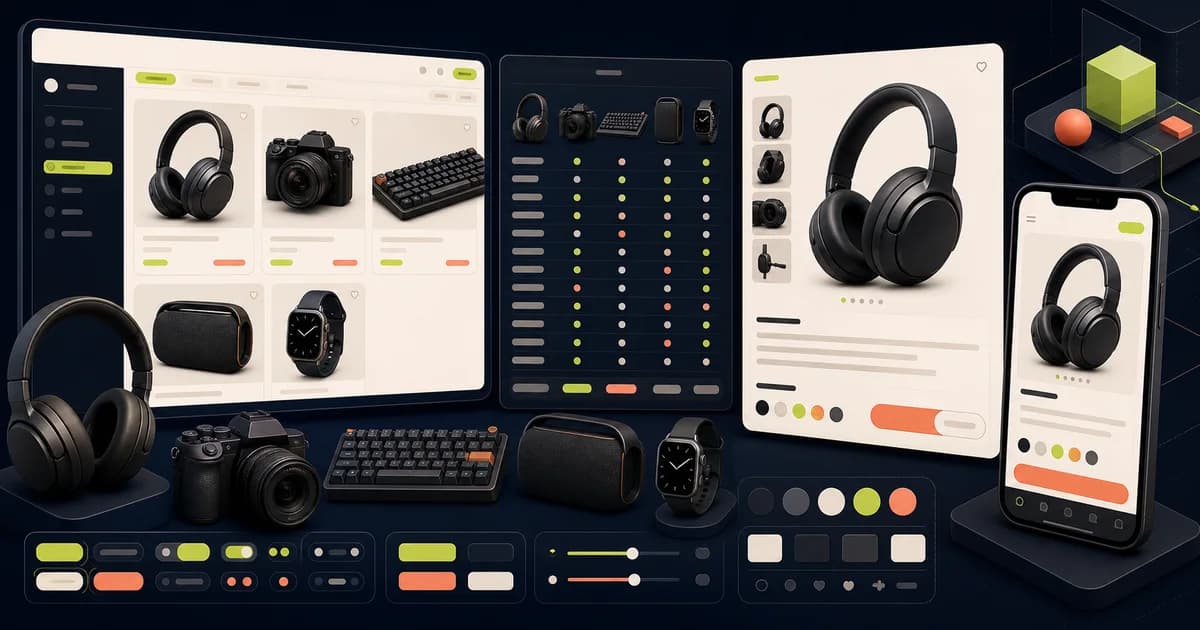
Polo Electronix is the direct recorded Figma match for electronics retail. The repository describes more than ten pages and screens, naming landing, authentication, product listing and detail, search results, cart, and reviews. That gives a team recognizable storefront scaffolding. The catalog does not state that it includes a complete specification taxonomy, compatibility engine, bundle rules, warranty service, responsive implementation, accessibility certification, or production commerce code.
The decisive trial is a specification-heavy purchase. A customer compares two similar models, checks compatibility with equipment they own, chooses capacity and accessories, understands warranty and delivery, encounters unavailable stock, and returns after the cart changes. The source should make evidence scannable and states maintainable. Lifestyle imagery alone cannot carry a technical decision.
Use the catalog description accurately
Electronix is also recorded as editable and customizable, with organized layers, free Google Fonts, solid and outline icons, customizable colors, components, and a design system. These are seller-authored features to confirm in the current file. The catalog names reviews but does not define verification, moderation, or rating logic. It names search but does not establish ranking, synonym, or compatibility behavior.
Tag design guidance separately from product facts. Recommendations below about specifications, repairability, compatibility, warranty, delivery, and accessibility are evaluation criteria for the retailer. They should not be attributed to Electronix unless direct inspection confirms the corresponding pattern, and they do not replace approved merchant data or policy.
Build a technical catalog fixture
Prepare products with brand, model number, generation, dimensions, weight, power, ports, connectivity, capacity, compatibility, included items, warranty, release status, and several category-specific attributes. Include missing and conflicting values. Decide which facts belong on cards, comparison, detail, and documentation. The interface should preserve units and sources rather than converting every difference into a marketing badge.
Use model identity consistently across search, card, detail, cart, order, and support. Similar product names can conceal different generations or regional versions. Show identifier and variant at the decision points where confusion matters. Test a renamed product and a superseded model. Content owners should control customer-friendly naming while the commerce system retains authoritative identifiers.
Test search and comparison
Search for a model number, partial identifier, category term, misspelling, specification, and incompatible accessory. Decide whether suggestions represent products, categories, support content, or recent history. Results should expose enough evidence to refine without forcing repeated detail-page visits. A zero-result route should offer corrected vocabulary and relevant categories without claiming an unavailable substitute is equivalent.
Create a comparison table with three products whose attribute sets overlap imperfectly. Group facts by customer decision, preserve missing and not-applicable values, keep headings visible, and provide a readable narrow-screen alternative. Do not highlight a winner without an explicit, approved criterion. Sticky columns and horizontal movement require keyboard, focus, zoom, and screen-size testing in implementation.
Make compatibility a first-class state
Prototype an accessory compatible with some models, requiring an adapter for another, and unknown for a regional variant. Distinguish compatible, incompatible, conditional, and unverified. Explain the source and scope of the result. Allow customers to revise the base device without losing unrelated choices. A green check should never imply broader compatibility than the catalog or verified service can establish.
If compatibility depends on firmware, operating system, connector, power, size, carrier, or installation, surface the relevant condition near purchase. Link to detailed support content where necessary. Product and technical-content owners must verify these claims. A Figma interaction can show the query and result states; the implemented data and rules determine truth.
Compose bundles and services honestly
Test a manufacturer bundle, retailer-created group, optional protection plan, installation service, and accessory recommendation. Identify whether each item has an individual price, stock, delivery, return, and warranty. Avoid presenting several optional products as “included.” If savings are shown, the commerce platform should supply the calculation and eligibility rather than the template inventing it.
Changing capacity or color may alter model number, price, stock, images, delivery, and eligible accessories. Prototype those dependencies. Preserve user selections when valid and explain resets when not. A component that handles only decorative swatches requires substantial extension for electronics variants.
Bring warranty, support, and lifecycle into view
Place concise verified warranty, return, delivery, and support information near the purchase. Distinguish manufacturer warranty, retailer obligations, optional protection, and service plan only where the merchant actually offers them. Do not invent durations or coverage. Test refurbished, open-box, imported, final-sale, and discontinued products when present in the real assortment.
Follow the order to setup help, registration where supported, delivery damage, missing item, return, repair, replacement, refund, and recycling or disposal content where relevant. Electronix’s recorded cart and review pages do not imply these post-purchase services. Estimate the missing journey and assign operations and support owners.
Inspect the Electronix source
Audit product cards, spec groups, comparison rows, selectors, compatibility messages, bundles, price states, reviews, cart lines, forms, and navigation as components. Verify properties, variants, nesting, auto layout, naming, foundations, and dependencies. Replace every demonstration record in a controlled copy and note detachment, overrides, and new domain patterns.
Check long technical strings, localized units, missing values, enlarged text, keyboard navigation, visible focus, contrast, non-color meaning, errors, and narrow widths. Dense does not need to mean tiny. Figma can preserve intended hierarchy, while final semantics, table behavior, device input, and assistive-technology results require implementation testing.
Electronics-kit checklist
- Model identity and category-specific attributes remain consistent from search through order and support.
- Comparison groups meaningful facts and represents missing, unknown, and not-applicable values honestly.
- Compatibility distinguishes verified, conditional, incompatible, and unknown results with scope and source.
- Variant changes synchronize identifier, specifications, images, price, stock, delivery, and accessories.
- Bundles, protection, installation, warranty, return, repair, and support are not collapsed into ambiguous add-ons.
- Components withstand dense values, units, translations, enlarged text, keyboard use, and narrow widths.
- Catalog features remain separate from merchant data, technical claims, policy, accessibility, and implementation evidence.
Failure modes
The first failure is designing electronics as fashion: large photography, short copy, and a color selector dominate while specifications and compatibility hide below. Recover by testing the comparison and difficult variant first, then use imagery to support rather than replace evidence.
The second failure is specification dumping. Hundreds of ungrouped values make the page complete but unusable. Group attributes by decision, explain unfamiliar terms, preserve exact values, and support comparison. Ask customers and technical-content owners which differences actually change the purchase.
The third failure is an unverified compatibility promise. A badge appears trustworthy while its data is stale or its condition omitted. State the supported scope, freshness, and clearly documented exceptions, provide a recovery path, and make the implemented rule service—not the Figma frame—the authority.
Make reviews useful for technical decisions
Test reviews for several product variants and generations. Identify whether a review applies to the exact model, a product family, or a seller experience. Support verified-purchase meaning only when the service can establish it. Include sparse history, conflicting reports, images, moderation, manufacturer responses, and a safety-related claim requiring escalation. The catalog records a review page; it does not define this governance.
Summaries should not manufacture certainty from a small or biased sample. Show count, distribution, recency, relevant variant, and filtering without presenting automated themes as facts beyond their evidence. Define who can report, edit, remove, or respond. Content and support owners should review language, while the implemented service remains authoritative for eligibility and moderation state.
Test delivery and setup together
Large, fragile, high-value, hazardous, or installation-dependent electronics may have distinct fulfillment choices. Prototype address eligibility, pickup, scheduled delivery, signature, installation, old-device removal, delay, damage, and failed handoff only where the merchant offers them. Show dependencies between product, service, slot, and fee. A standard parcel estimate should not conceal a service appointment.
Create a durable evaluation fixture with two nearly identical models, one regional variant, a conditional accessory, a mixed-stock bundle, a changed delivery service, and a disputed compatibility result. Replay it across updates and responsive widths. If Electronix continues to preserve identifiers, evidence, selections, and recovery without detachment, the source is earning its role as a technical-commerce foundation. Ask merchandising, technical content, support, engineering, and accessibility reviewers to sign off on their respective evidence rather than turning visual approval into a universal acceptance claim. Preserve the dated catalog records used during each review.
Conclusion
Electronix is Polo’s strongest recorded Figma starting point for electronics because its scope covers core browsing, product, search, cart, account, and review pages. Select it after a real specification comparison, compatibility case, dependent variant, bundle, warranty message, and post-purchase route survive inspection. The template provides technical-retail scaffolding; verified data, service policy, accessible implementation, and code remain yours.
Frequently asked questions
How many Electronix screens are recorded?
The repository catalog states more than ten and names landing, authentication, listing, detail, search results, cart, and reviews. Inspect the delivered version for exact contents.
Does Electronix verify product compatibility?
No such engine is claimed by the catalog. Compatibility needs authoritative product data, defined rules, conditions, updates, and implementation.
Should every specification appear above the fold?
No. Prioritize identity and purchase-critical differences, group the full specification logically, and make important facts searchable and comparable without shrinking text.