Guides · August 23, 2026 · 7 min read
Apparel Sizing and Fit UX: Reduce Guesswork Before Checkout
Design sizing guidance that combines measurements, fit intent, model context, and honest uncertainty instead of a false promise of certainty.
By Polo Themes
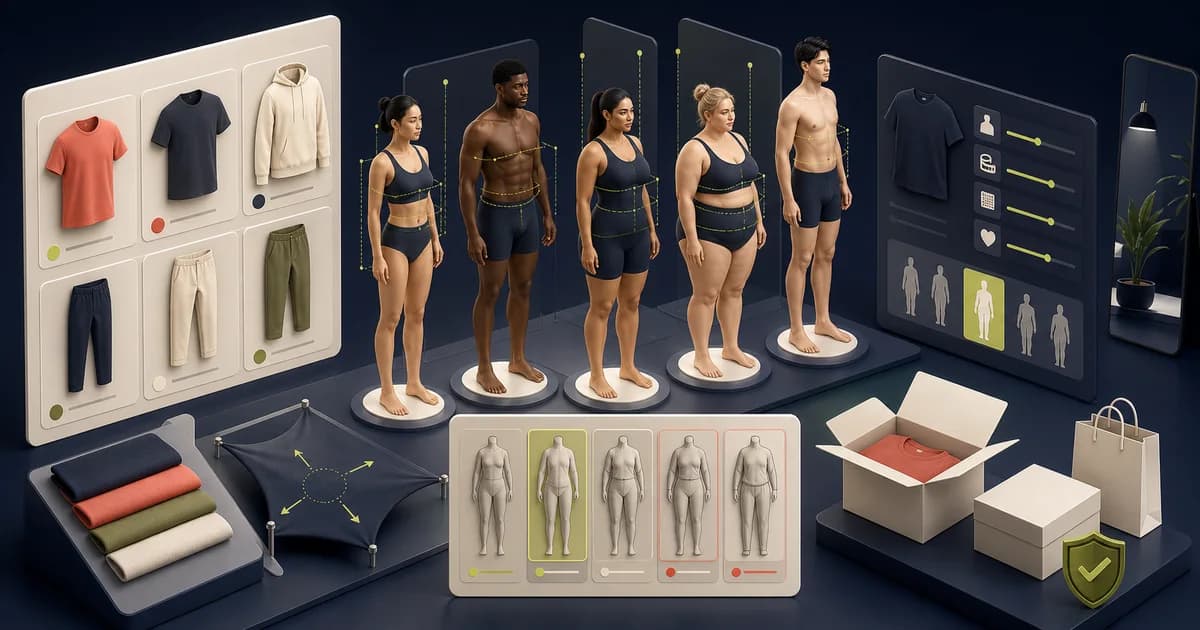
The short answer: fit UX should help a shopper make a better-informed size choice while making its uncertainty explicit. Put cut-specific finished-garment measurements, body guidance, material behaviour, model context, and a clear selection control in one coherent decision path. Do not promise that a generic chart or recommendation can know how every person prefers a garment to fit.
Understand the decisions behind “What size am I?”
The question usually contains several questions: What is this garment intended to feel like? Which measurement matters for this cut? Is the fabric stretchy? How does the model’s styling relate to me? What happens between two sizes? Can I exchange or return it if I choose incorrectly? A product page that offers only S, M, and L labels asks the customer to resolve all of that alone. Good UX arranges the evidence so the person can compare their own preference with the actual garment.
Start with customer-service contacts and return reasons, then map uncertainty by product family. Trousers may prompt questions about waist, rise, inseam, and hip ease; coats about layers and sleeve length; bras about support and band/cup system; knitwear about stretch and intended volume. Do not use one universal fit pattern just because it is easier to maintain. The product taxonomy and fitting process should determine the data you collect.
Separate body and garment measurements
Body measurements describe the person. Finished-garment measurements describe the item after construction, usually laid flat or measured with a defined method. They answer related but different questions and should be clearly labelled. State units, explain how to measure, and avoid switching conventions within a category. If a value has tolerance or can vary because of a handmade or stretch process, say so plainly rather than implying false precision.
For every key style, keep an internal measurement specification linked to the public table. Record point of measure, method, unit, size grading, version, and source. Give a product owner authority to correct discrepancies. This small operating discipline matters because a beautiful size table rapidly becomes untrustworthy when a new supplier, revised pattern, or alternate fabric changes the garment but not the page.
Write a cut-specific fit note
A good fit note conveys the intended silhouette and the factors that change it. “Relaxed through the body with dropped shoulders; choose your usual size for the intended shape, or compare chest and length measurements for a closer fit” gives a customer a usable next step. It is better than “runs large,” which could mean different things to different people. Notes should be reviewed against the finished garment and revised when samples or fabric behaviour change.
- Name the intended silhouette: fitted, regular, relaxed, oversized, cropped, full-length, or another defined term.
- Describe decision-changing behaviour such as stretch, recovery, weight, lining, rise, drape, or adjustable construction.
- Point to the measurements that matter most for this garment.
- Explain the tradeoff between adjacent sizes without declaring one choice universally correct.
- Keep language factual and respectful; do not frame normal body variation as an exception or problem.
Use model context carefully
A model’s worn size and relevant measurements can make image scale more understandable when they are current, voluntary, and consistently presented. They are an example, not a fit guarantee. Pair model context with an image sequence that shows the garment clearly and with tables that remain usable without interpreting a person’s body from a photograph. Never imply that a single body type establishes what is “normal” for the product.
Design the selection control as part of the guidance
Size selection, availability, price, fit note, and guide should be located close enough that a customer can act on the information without losing state. Label every size control, identify which value is selected, make unavailable sizes unmistakable, and explain error states in text. If guidance opens in a dialog, ensure it can be reached by keyboard, closes predictably, returns focus, and does not obscure the selected variant. A modal is a presentation choice, not an excuse to hide essential information.
Do not make fit advice conditional on collecting more personal data than the decision requires. If a tool asks for body measurements or profile information, explain what it uses, how it is retained, whether it is shared, and how a customer can continue without it. Test the fallback path. A customer should be able to use a table and fit note without accepting opaque profiling.
Connect sizing to operations
The most thoughtful guidance fails if the customer receives a different product or cannot understand the remedy. Keep variants, labels, packing checks, exchange policies, and returns intake aligned with the same size naming system. Ask return forms for a voluntary, neutral reason that is useful for product learning: too small, too large, different than expected, quality issue, preference changed, or another controlled category. Do not force a customer to diagnose their body to obtain support.
Review return and exchange data at a product-and-size level with context. A rise in returns may reveal an unclear chart, a production change, a bad sample, an image that hides length, or an acquisition campaign that set the wrong expectation. It is not automatically evidence that customers are choosing poorly. Inspect garments and support conversations before rewriting the advice.
Implement it in a fashion storefront
Polo Themes lists Wosa as a responsive, customizable Shopify theme for fashion and clothing storefronts. Use its product-display foundation to keep selected variants, images, and decision information legible. Validate the actual configured page with long size names, unavailable values, mobile zoom, keyboard use, and realistic product data. Theme capabilities do not remove the need for a measurement specification, content owner, or accessible interaction testing.
A fit UX release checklist
- Audit every product family for the body and finished-garment values that truly matter.
- Write a measurement method and assign an owner for each public table.
- Publish cut-specific notes with material behaviour and intended silhouette.
- Pair model context and product images with the same source-of-truth style version.
- Test selection, unavailable states, guide access, and errors on phone and keyboard.
- Review support contacts, exchanges, and returns after launch before declaring the experience improved.
Resolve a size question without pretending certainty
Test the experience with a shopper whose body measurement sits between two published values. The interface should explain what each table measures, the intended silhouette, relevant stretch or ease information recorded for the garment, and how the two sizes differ. It should allow a considered choice without presenting an automated recommendation as a guarantee. When the product record cannot support an answer, provide a clear support boundary instead of guessing.
Repeat the scenario for a garment with a different cut under the same brand size label. If the guidance produces the same answer without acknowledging the style difference, it is probably relying too heavily on a generic chart. Put cut-specific notes and finished-garment evidence close to the selector, while keeping units, measurement diagrams, and table labels consistent enough to compare.
Create a fit-information change log
- Record the style and production version covered by each measurement table.
- Name who measured the garment, the method used, the units, and the review date.
- Document changes to pattern, supplier, material, wash treatment, or construction that may affect fit.
- Update product copy, diagrams, support guidance, and active campaigns from the same approved revision.
- Preserve prior guidance for orders from earlier versions when customer support needs it.
- Review returns and exchanges as contextual evidence, not automatic proof of one sizing cause.
Make the support handoff specific to the garment. Pass the style, selected size, relevant measurement table version, and the customer’s stated question without requesting unrelated body information. Give staff approved guidance and a clear limit on what they can infer. Record recurring ambiguity against the product record so the next revision improves the page rather than expanding private support work.
When a size becomes unavailable, keep its guidance visible if it helps comparison, but distinguish information from purchasability. Do not silently select another size or present scarcity as fit advice. Let the customer choose a notification or alternative route only after the current state is clear.
Conclusion
Sizing is not a pop-up added near checkout. It is a product-information system that extends from pattern and sample through photography, variants, fulfilment, and returns. Give customers specific evidence and clear choices, preserve their ability to decide without invasive data collection, and learn from the surprises that remain. That is how fit guidance becomes more useful over time. Assign ownership for measurement changes and preserve the product-level history behind every revision so customer service and merchandising do not contradict each other.
Frequently asked questions
Should every garment have its own size guide?
Use a cut-specific guide whenever the relevant measurements or fit behaviour differ materially. A shared guide can work for genuinely comparable styles, but it must not conceal differences.
Are fit recommendation tools always necessary?
No. Start with accurate tables, clear fit notes, and usable controls. Consider an additional tool only if a demonstrated need remains and its privacy, accessibility, and maintenance tradeoffs are acceptable.
Which return information is useful to collect?
Collect only what helps improve the product or support the return. Use neutral categories, make optional detail clear, and avoid treating a customer’s body as the cause of every mismatch.